Startup Positioning: How to Become the Obvious Choice (Not a Nice-to-Have)
By Saroj Jha · July 7, 2026 · 12 min read
Positioning is the context you put your product in so the right buyers instantly understand why it's for them — five connected decisions, not a tagline. Get it right and your marketing compounds; get it wrong and no campaign will save you.

each dot = 1% of your addressable buyers
The 95-5 rule
5%
of B2B buyers are in-market
Positioning has to work on the other 95%.
That last point is the one most founders learn the expensive way. You can have a genuinely better product, run clean ads, and publish great content — and still watch prospects bounce because they never understood what you are or why it matters to them. This guide covers what positioning actually is, why it outranks your campaigns, the framework to get it right, and how to tell when yours is broken.
What is positioning — and what it isn't?
Positioning is the frame of reference that makes your product's value obvious to the people who should buy it. It is not your brand identity, your tagline, or your feature list. As positioning expert April Dunford puts it in Obviously Awesome, positioning is the deliberate act of choosing the context that makes you the best at something a specific set of customers cares about.
The clearest way to feel this: the same product framed two different ways lands completely differently. A "diet muffin" sounds like a compromise; the identical item framed as a "paleo snack" sounds like a deliberate choice. Nothing about the product changed — only the context did. That context is positioning, and it silently drives how buyers judge your price, your features, and your relevance before they've read a word of your copy.
Positioning isn't messaging or branding, but it's the foundation both stand on. Strong positioning amplifies every marketing and sales effort you make; weak positioning quietly taxes all of them.
Why does positioning matter more than your campaigns?
Because most of your buyers aren't ready to buy today — and when they are, they've already made up their minds about who's on the list. Research from the Ehrenberg-Bass Institute (Professor John Dawes, popularized by the LinkedIn B2B Institute) established the 95-5 rule: at any given moment, only about 5% of B2B buyers are actively in-market. The other 95% aren't shopping — they're under contract, mid-budget-cycle, or simply not thinking about you.
Here's why that makes positioning non-negotiable. When one of those 95% finally enters the market, they don't start from a blank page — they reach for the brands already sitting in their memory. Studies of B2B buyers find that roughly 8 to 9 in 10 already have a shortlist of vendors in mind before they begin formally researching, and the large majority buy from that day-one list. Positioning is what determines whether you're on that list. If a buyer can't quickly grasp what you are and why you're relevant, you're not just losing today's deal — you're absent from the memory that decides next year's.
This is exactly why positioning sits upstream of demand generation. You can't efficiently create or capture demand for something people don't understand. (For how positioning feeds the two demand motions, see our guide to demand creation vs. demand capture.)
The five components of positioning
Strong positioning is built from five interdependent pieces, and — critically — they have to be worked in order, because each one depends on the one before it (April Dunford's framework):
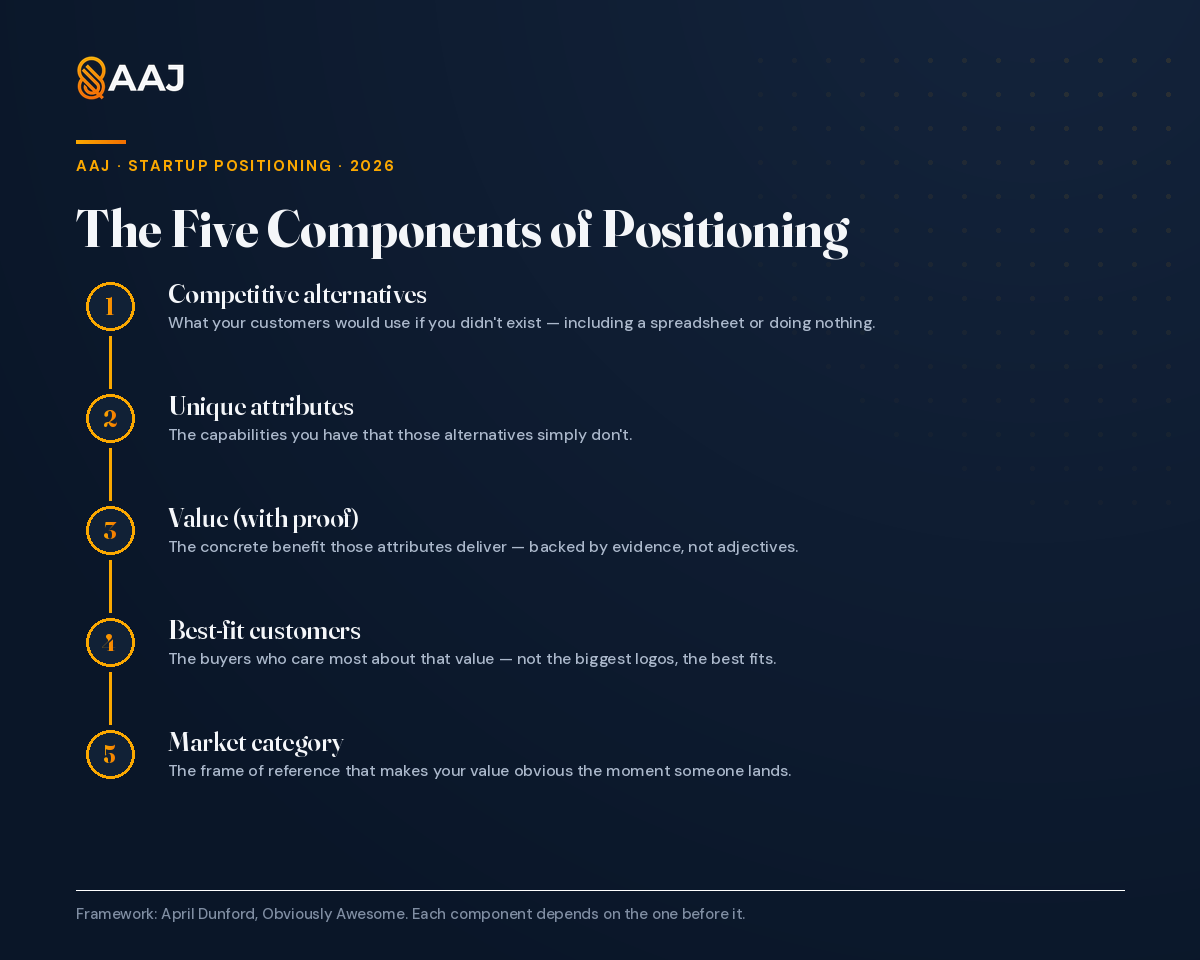
- Competitive alternatives. What would your customer use if you didn't exist? This is rarely just your obvious competitors — it includes DIY workarounds, a spreadsheet, an intern, or doing nothing at all. In B2B, the alternative is often just "spend the budget somewhere else."
- Unique attributes. The capabilities and features you have that those alternatives genuinely don't. Your attributes are only "unique" relative to the real alternatives — which is why step one comes first.
- Value (with proof). The concrete benefit those unique attributes deliver. Value should be as fact-based as possible — demonstrated by your own product's performance and, ideally, backed by third parties. Adjectives aren't value.
- Best-fit customers. The buyers who care most about that value. These aren't necessarily your biggest logos — they're the segment whose characteristics make them value what only you can offer. Dunford's classic example: a company that narrowed from "everyone" to specifically credit unions, and grew faster precisely because the fit was tighter.
- Market category. The frame of reference you wrap around your product so its value is obvious to those customers. Category is shorthand buyers use to make sense of you in seconds — choose the one that puts your strengths at the center.
The mistake nearly every founder makes is starting at step two — your capabilities — because that's what you know best and are proudest of. But capabilities mean nothing without the alternative to compare them against and the customer who values them. Start with alternatives, and the rest falls into place.
How do you know your positioning is broken?
The symptoms are remarkably consistent, and none of them look like a "positioning problem" on the surface:
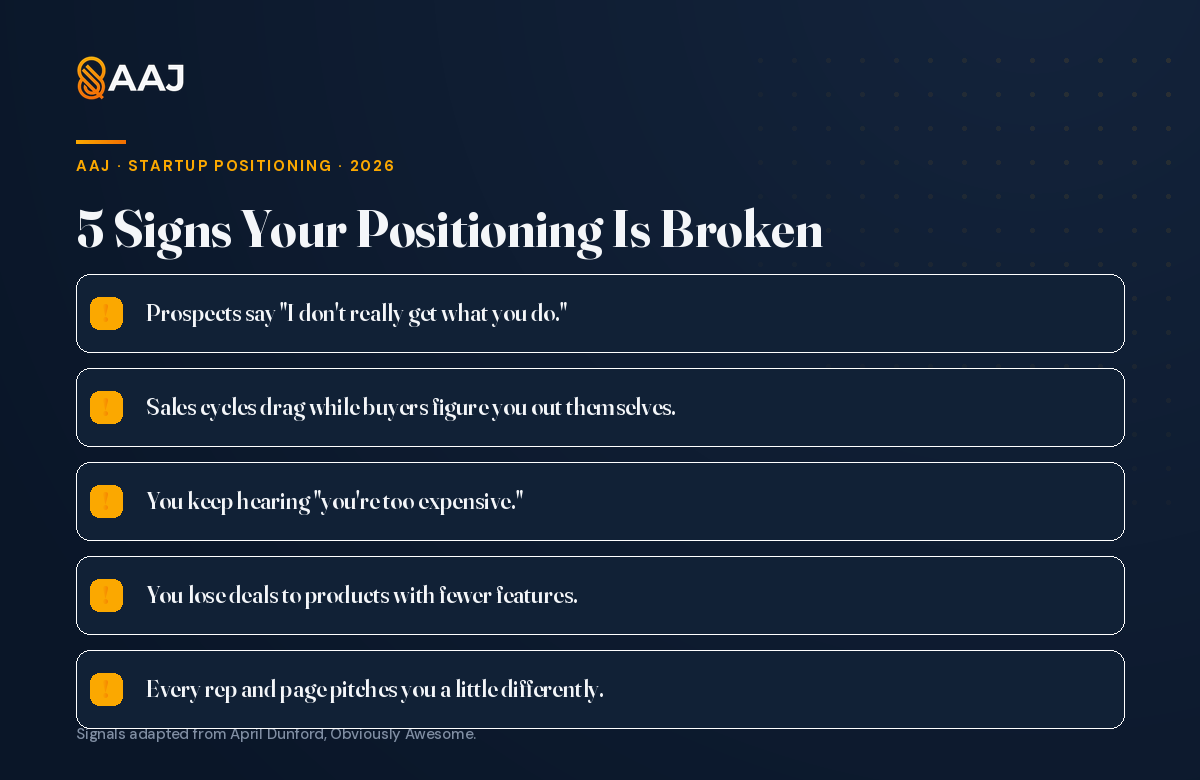
- Prospects say some version of "I don't really get what you do."
- Sales cycles drag on while buyers slowly figure you out on their own — because marketing isn't framing it and sales isn't landing it.
- You keep hearing "you're too expensive." When unique value isn't obvious, every price looks too high.
- You lose deals to products with fewer features than yours.
- Every rep, deck, and landing page pitches you a little differently.
Notice what these have in common: they're all value-clarity failures, not lead-volume failures. Founders reliably misdiagnose them — pouring money into more traffic and more outbound when the real leak is that the traffic they already have doesn't understand them. More leads into broken positioning just means more people who don't get it.
The three ways to position
Dunford outlines three strategic plays, and choosing the right one is half the battle:
- Head-to-head: compete to win an existing, well-understood category. Only viable if you can credibly claim to be the best in it — usually not the move for an early-stage challenger.
- Big fish, small pond: dominate a specific subsegment of a category where you're clearly the best fit. This is where most Seed–Series B startups should play. Narrowing feels scary — you're saying no to buyers — but a tight fit with the people who care most beats a loose fit with everyone.
- Create a new game: define or reframe a category entirely. The highest-upside and highest-difficulty option, because you have to educate the market on a category before you can win it.
The instinct to keep your positioning broad — "we could sell to anyone" — is the single most common way founders leave growth on the table. The riches are in the niches, because that's where your value is most obvious.
How to actually do your positioning
You don't need a six-month rebrand. You need a decision you can defend and align the team around. A founder-friendly version of Dunford's process:
- Start from who already loves you. Your best-fit customers are hiding in your happiest accounts. Study why they chose you and stayed.
- List your true competitive alternatives — including spreadsheets, manual processes, and "do nothing." Be honest about what you're actually displacing.
- Isolate your real differentiators against those alternatives, then map each to a value theme with proof.
- Narrow to the customers who care most about that value, and describe them by characteristics, not just job titles.
- Choose the market category that makes your strengths obvious — and only then, if it helps, layer on a relevant trend (carefully; trends age).
- Capture it and align sales, marketing, and pricing. Positioning that never reaches the sales floor or the pricing page is just a slide.
To pressure-test and write it up, a positioning-statement structure still helps as a capture tool: For [best-fit customer] who [need], [product] is the [category] that [key value]. Unlike [main alternative], we [key differentiator]. You can draft and refine yours with our free Positioning Statement Generator, then put it to work across your go-to-market strategy.
What breaks positioning in practice
Two failure modes dominate. The first is treating positioning as a marketing-only exercise. Dunford describes the pattern exactly: sales nods along in the room, then walks out and reverts to the old pitch. Positioning only works when product, marketing, and sales share the same story and use it consistently. The second is starting from your own features instead of the buyer's alternatives — which produces positioning that's accurate to you and meaningless to the market.
One more, aimed at anyone tempted to "refresh" everything: don't churn your brand assets and messaging constantly. Mental availability is built through consistency and repetition. Every time you throw away the associations you've built, you restart the clock on being remembered by that all-important 95%.
Sources
- April Dunford — Obviously Awesome: How to Nail Product Positioning (the five-component framework, the 10-step process, the three positioning styles, and the signs of weak positioning)
- Professor John Dawes, Ehrenberg-Bass Institute for Marketing Science — the 95-5 rule (only ~5% of B2B buyers in-market at any time), published 2021 and popularized by the LinkedIn B2B Institute
- LinkedIn B2B Institute — mental availability and category entry points (why out-of-market buyers matter)
- B2B buyer shortlist research (via Mark Ritson / MiniMBA) — 80–90% of buyers have a vendor shortlist before formal research, and the majority buy from that day-one list
- Geoffrey Moore — the classic positioning-statement structure, used here as a capture tool
Ready to sharpen your positioning?
Request scope. We'll pressure-test your positioning against Dunford's five components, identify where it's leaking value, and leave you with a defensible statement you can align sales, marketing, and pricing around.
Part of the Strategy & Positioning hub - see the other 9 resources on this topic.