The Authenticity Audit: how to tell a real creator recommendation from an expensive imitation
By Saroj Jha · August 31, 2026 · 11 min read
I wrote this article, then ran its own sources through the check I'm about to describe. Three of the eight didn't survive. That turned out to be the most useful part.
The comment section already ran your audit
You have probably seen this exact sequence. The creator video comes back from production and it looks expensive — even lighting, clean audio, a script your team approved line by line. Reach is fine. Saves are flat. Then you open the comments and half of them are some version of the same syllable: ad.
Nobody was fooled, and nobody was especially annoyed either. The audience just re-filed the post. It arrived looking like a recommendation and got read as a commercial, and those two things are priced very differently in a person’s attention.
For most of the social era you could buy your way past that. Polish was expensive, so polish was evidence: if it looked like it cost money, somebody had staked money on it, and that meant something.
Generative AI removed the stake. A convincing script, a clean voiceover, a color-graded thirty seconds now cost close to nothing — which means they prove close to nothing. Perfection stopped being a signal the moment it stopped being scarce.
So the question in the room has changed. It used to be how do we make this look more premium? It should now be would anyone believe a real person made this on purpose?
That question is what an Authenticity Audit answers. It isn’t a rejection of production quality, and it isn’t a ban on AI tools — I use both. It’s a check on whether the work still carries a human point of view by the time it reaches the feed.
What the trust numbers actually say
The figure everyone is quoting this year: 7% of consumers say visibly AI-generated marketing makes them trust a brand more, and 31% say it makes them trust the brand less. Distrust is roughly four times more likely than trust.
It’s a real number, and it’s worth knowing exactly where it comes from — a December 2025 survey of 8,000 adults across eight countries, run by Klaviyo with Datalily, published as the 2026 AI Consumer Trends report in March 2026 and written up by eMarketer that May. [1][2]
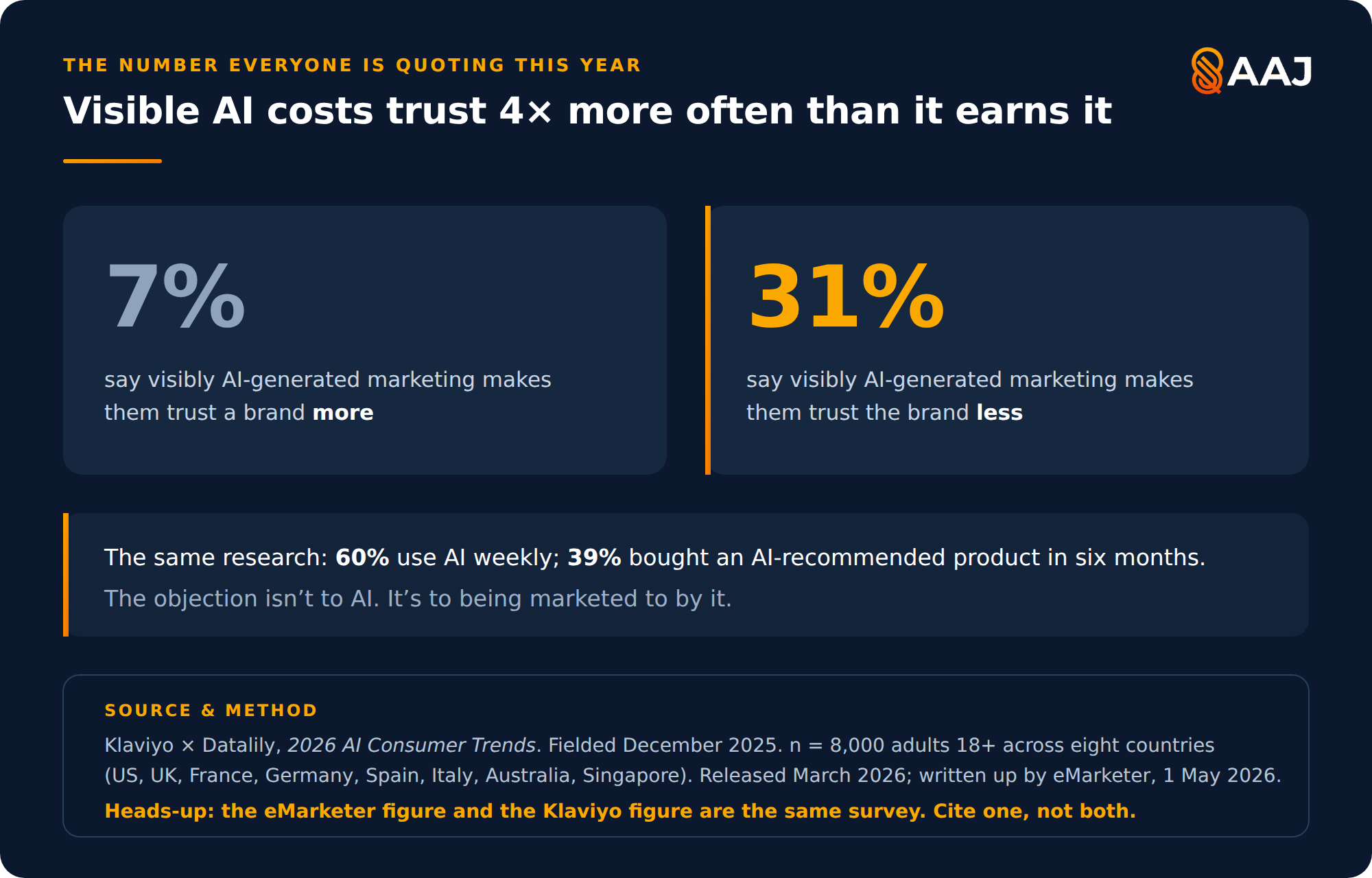
Now the part that usually gets left out. The same research finds 60% of consumers use AI weekly and 39% bought an AI-recommended product in the past six months. [1] People are not avoiding AI. They are using it constantly and resenting being marketed to by it.
That distinction tells you where the risk actually sits. Using AI to research a brief, cut fifteen variants of a caption or localize a script costs you nothing in trust, because nobody sees it. Shipping something that reads as machine-made, with no person accountable for the claim, is what costs you.
There’s a small joke buried in the sourcing, and I’ll take it as the lesson. eMarketer’s write-up of these trust figures carries a note saying the article “was prepared with the assistance of generative AI tools.” [2] That’s fine, and it’s the whole point: a named publication put its name on the claim. AI inside the process is invisible. AI as the author is the problem.
Two other datasets point the same way, with different levels of confidence. Razorfish reports 63% of consumers say AI makes them value human-made things more, and 64% agree generative AI on social media is dangerous — figures synthesized from Publicis Media trend research with no published sample or method, so treat them as directional. [3] National University cites Hootsuite data that roughly one in three consumers are less likely to choose a brand using AI-generated ads. [4] Different studies, same direction of travel.
Then I audited my own footnotes
Here is where this article changed.
The first draft had eight references. I have a rule about publishing numbers: every one gets chased to its origin before it goes out. Three didn’t survive the trip.
One study, cited twice
I quoted eMarketer for the 7%/31% figures, then a paragraph later wrote “other 2026 consumer research points in the same direction” and cited Klaviyo. It doesn’t point in the same direction. It is the same direction — the same survey, appearing once as the primary source and once as the trade-press write-up of that source. I had manufactured a consensus out of a single dataset. That is the most common sourcing error in marketing content, and I made it in an article about credibility.
A fourteen-year-old statistic wearing new clothes
The draft said “up to 92% of consumers trust word of mouth and user-generated content more than traditional advertising.” I followed it back: National University cites social.plus, which traces to Nielsen’s Global Trust in Advertising study — from 2012. [5] And the original finding isn’t what the restatement says. Nielsen found that 92% trust recommendations from friends and family above all other forms of advertising. Not UGC. Not creator content. Friends and family.
The number survived fourteen years of recirculation by quietly changing what it was about. I cut it.
A number I liked, from nowhere
My benchmark for micro-influencer engagement — 3–5% against about 1% for mega — came from a Medium post with no citation, no methodology, no platform and no sample size. I had kept it because it agreed with what I already believed.
That’s the whole failure mode in one sentence — and it’s the same mechanism that produces a bad creator brief. Start with the conclusion, find something shaped like evidence, ship it.
If I’m going to argue that audiences can smell unearned confidence, the least I can do is not serve them any.
What an Authenticity Audit actually checks
An Authenticity Audit answers one question: is this content a recommendation, an imitation of one, or an ad standing in a creator’s feed?
It doesn’t start with the finished video. By the time you’re reviewing a cut, every decision that determines authenticity has already been made — in creator selection, in the brief, in the approval chain, in what you chose to measure. Audit the system, not the asset.
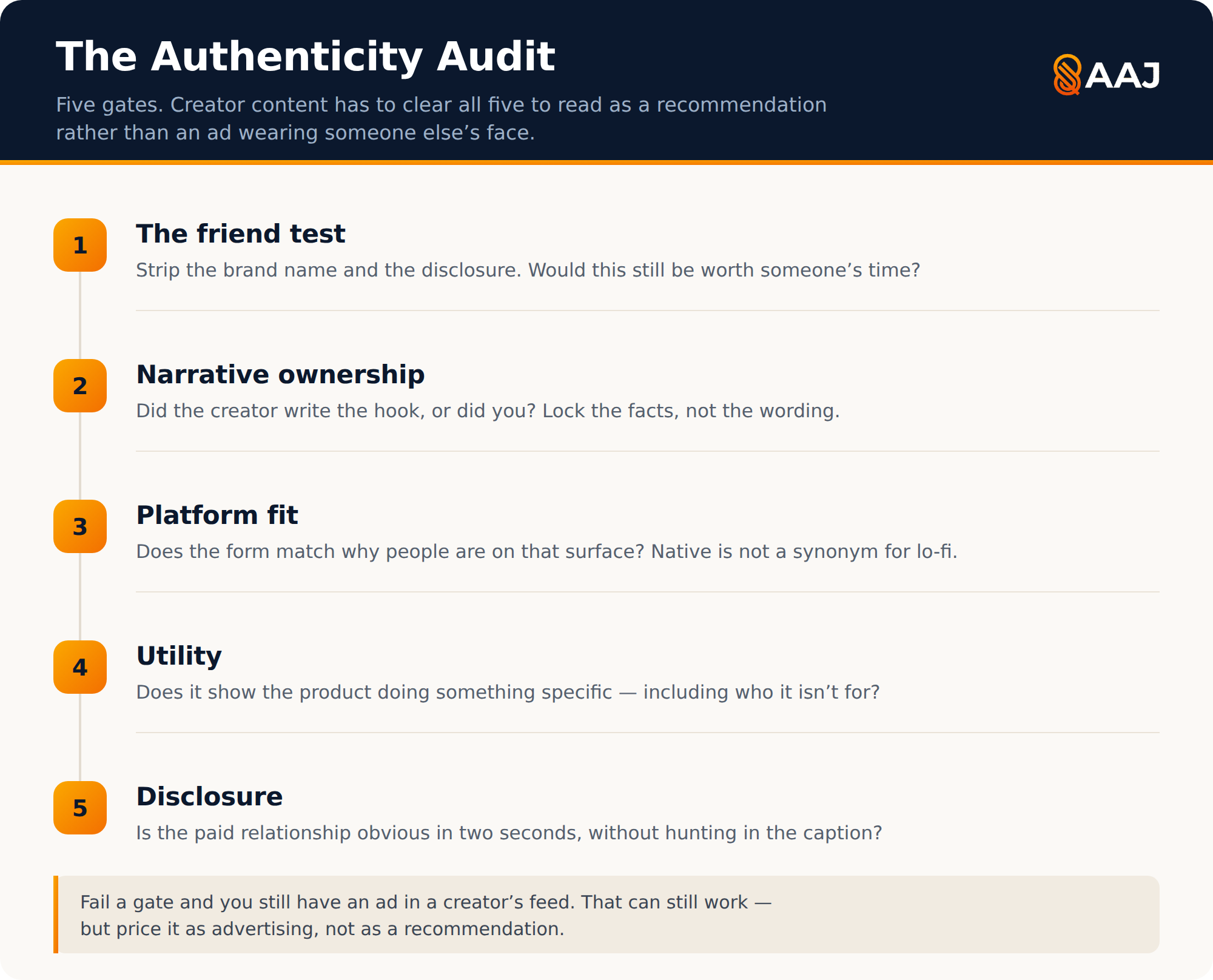
1. The friend test
Strip the brand name and the disclosure. Would the post still be worth someone’s time?
This isn’t an argument for hiding the sponsorship. Disclosure is non-negotiable, legally and as a matter of not insulting your audience. It’s a test of whether the content earns attention beyond the transaction. Content fails when it runs on stock enthusiasm, superlatives and a script any creator in any category could have read. It passes when it carries a point of view the audience recognizes as that person’s.
2. Narrative ownership
Did the creator write the hook, or did you?
You need to protect product accuracy, safety and legal claims. Past that, control gets expensive: the thing you are paying for is the creator’s judgment, and every line you dictate buys back a little less of it. Split the brief in two.
- Non-negotiables: required disclosure, verified product facts, prohibited claims, campaign dates, approved offers, brand-safety rules.
- The creator’s territory: the hook, the wording, the location, the humor, the personal story, the edit rhythm, and how the product shows up in their content.
Aspire’s 2026 predictions argue for a similar split from a different angle — lo-fi always-on content for community, higher production for the moments that warrant it. [6] Worth reading, with one caveat: it’s a qualitative predictions piece with no data behind it. Take it as an argument, not as evidence.
3. Platform fit
Does the form match why people are on that surface?
Native is not a synonym for lo-fi. A TikTok tutorial that opens on the problem instead of a logo animation is native. A twelve-minute YouTube review with real depth is native. A LinkedIn post with a credible professional take is native. Meanwhile a handheld, badly-lit video built from rigid talking points is not native — it’s an ad in a costume. Shaky camera work is a signal of authenticity, never a substitute for it, and audiences learned to tell those apart years ago.
4. Utility
Does the content show the product doing something specific? This is the gate most campaigns fail, so it gets its own section below.
5. Disclosure
Is the paid relationship obvious within about two seconds, without hunting in the caption?
Burying the disclosure doesn’t preserve the illusion. It just makes the eventual discovery feel like a small betrayal, in public, under your post. Clear disclosure up front costs less performance than most teams fear, and it removes the one objection that poisons a comment section.
Utility is the part you can’t fake
In a crowded feed, utility is the reason a piece of content gets to exist at all. The most credible integrations show a product solving a specific problem in a specific setting: a step removed from a routine, a frustration avoided, a workflow that got shorter.
Compare two versions of the same sponsored post. One says the product is the best thing the creator has ever used. The other shows where it sits in a routine, what the texture is actually like, which problem it addresses — and, this is the part almost nobody does, who shouldn’t bother with it.
The disqualifier is the most underused move in creator marketing. “This isn’t for you if…” is the strongest credibility signal available, because it’s the one thing an ad would never say. It also does real commercial work: it filters out the buyers who would have churned or returned, and it turns the comments into a qualification thread instead of an argument.
Peer recommendation does have a genuine trust advantage. But if you’re going to put a number on it, use one that is actually about creator content and less than a decade old. Most of the statistics circulating in this space are neither.
The micro-creator question the benchmarks can’t answer
Follower count was treated as the value signal for years. Reach still matters for awareness, but reach is not relevance and it is certainly not trust. Micro-creators serve narrower communities and usually know them better — organized around a niche, a city, a profession, a hobby. When you need qualified attention rather than volume, that concentration is the asset.
Everyone agrees on this in principle. The trouble starts when someone asks for the number.
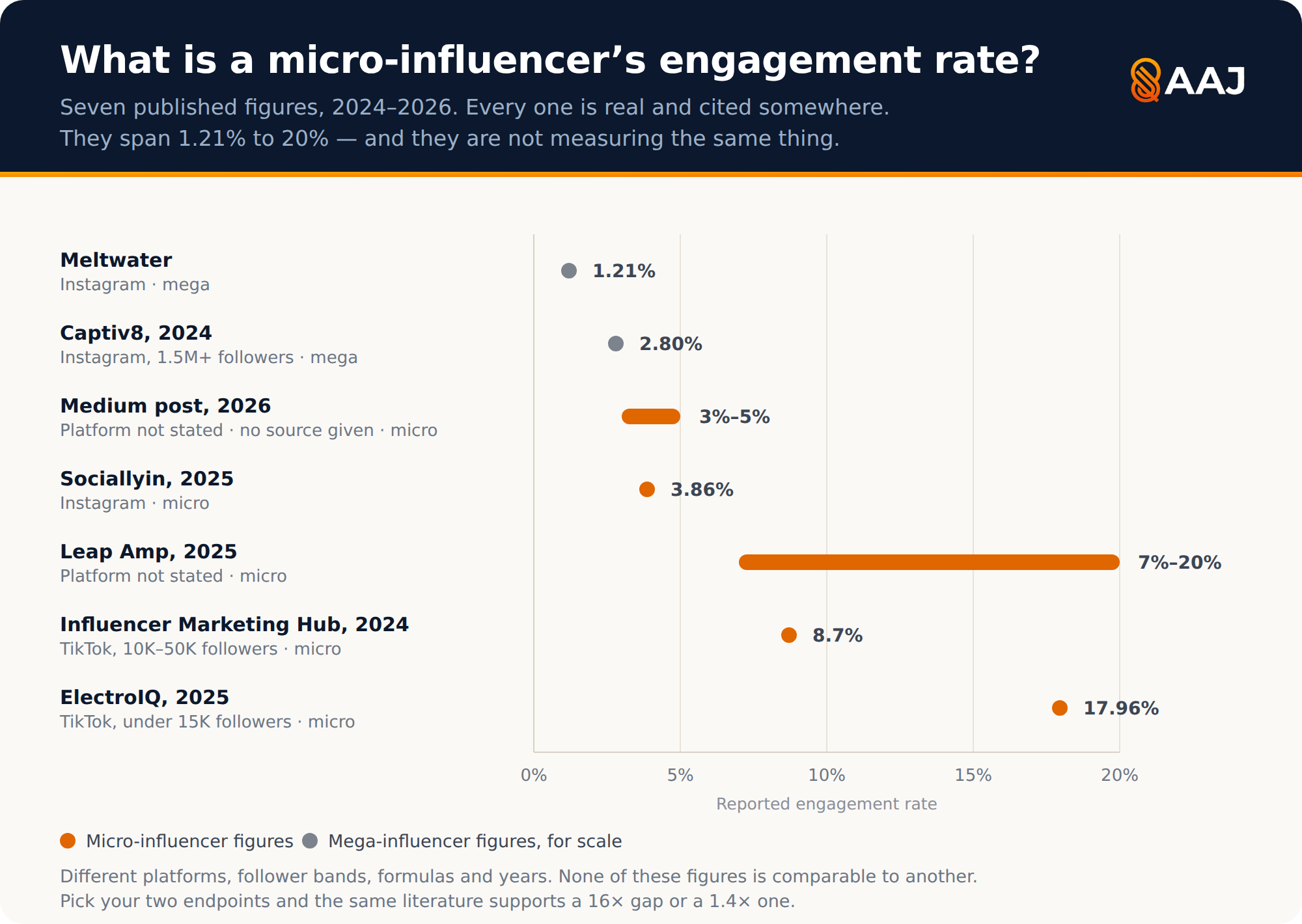
Those are seven real, published, currently-circulating figures for influencer engagement rate. They range from 1.21% to 20%. They come from different platforms, different follower bands, different formulas, and years spanning 2024 to 2026. [7][8] Not one of them is comparable to another.
Pick the friendliest micro figure (20%) against the least flattering mega figure (1.21%) and you can tell your board a 16× story. Pick 3.86% against 2.80% — both Instagram, both from named research — and the same literature gives you 1.4×. The evidence base supports whichever slide you already wanted to make. That isn’t evidence. It’s decoration.
One more thing I noticed while assembling that chart: 3.86% shows up in two separate write-ups attributed to two different research firms. Somewhere upstream, one figure got recirculated with a new name on it. Once you start pulling these threads it is hard to stop.
So use the tiering logic and ignore the benchmark numbers. Run your first three creators, calculate engagement the way you define it, and that becomes your benchmark. It will be the only one on the internet that is actually about your category, your platform and your audience.
The durable principle needs no citation: the right creator is rarely the largest creator. And a portfolio beats a bet.
- A few larger creators for efficient reach
- Micro-creators for category credibility and community depth
- Customer advocates for real-world proof
- Subject-matter experts for high-consideration purchases
- Employee creators, where it fits, for the view from inside
Each partner should have a defined job. If you can’t say what a creator is for, you’re buying impressions with extra steps.
One post can’t build familiarity
Authenticity is hard to establish in a single appearance. A creator mentioning a product once, in a promotion-heavy month, reads as exactly what it is.
Longer relationships give an audience more to go on: repeated use, answered questions, updates, the occasional honest reservation. That accumulation is the evidence. It is also operationally cheaper — creators who know the product need less onboarding, approvals get lighter, and the creative can respond to what the audience actually asked last time.
Slate Teams reports engagement 30–50% higher for sustained creator relationships than for one-off deals. [9] I’d hold that loosely: it’s a vendor writing about the category it sells into, with no published methodology. The mechanism is sound. The multiplier is marketing.
And length alone doesn’t buy credibility. A creator who has delivered the same approved sentence for four quarters isn’t a partner — they’re a spokesperson with worse production values. The relationship has to leave room for the format to change and for the creator to say something you didn’t script.
What to change this quarter
Rewrite the brief
Replace the script with one page: business objective, audience, mandatory facts, disclosure requirement, prohibited claims, and the metric you’ll judge it on. Then ask the creator to bring the hook. If a creator can’t propose one, you have a selection problem, not a briefing problem.
Score creator fit, not creator size
Audience overlap, comment quality, past sponsorship density, content consistency, brand-safety history, and any evidence they used the product before you paid them. Follower count is a tiebreak, not a criterion.
Test the variables you’re guessing about
Tutorial against review. Polished against native. Offer-led against problem-led. One-off against recurring. Don’t assume lo-fi wins — in categories where the audience expects craft, rough production reads as carelessness rather than honesty. Let the test decide, not the trend piece.
Measure past the surface
Likes are cheap. Track saves, shares, comment quality, click-through, conversion, assisted conversion, repeat purchase and CAC where your measurement supports it. For awareness work, use qualified reach and lift studies rather than impressions.
Read the comments with the creator
Every activation generates a free list of objections, use cases and product questions from precisely the people you are trying to reach. That list is the brief for the next piece of content. Most teams never open it.
The thing worth keeping
None of this is an argument against craft, or scale, or AI. I used AI while writing this. What I didn’t do was let it be the last thing that touched a factual claim — which is the only part of the workflow where it actually costs you something.
When polish can be generated on demand, specificity is what’s left. The brands that win the next few years won’t be the ones that look the most expensive. They’ll be the ones that let creators say something true, make content useful enough to survive without the logo, and build belief through repeated evidence rather than manufactured perfection.
Authenticity isn’t an aesthetic. It’s an operating discipline. And the fastest way to find out whether you have it is to audit your own footnotes — though be warned, it cost me three out of eight.
References
- Klaviyo & Datalily, 2026 AI Consumer Trends. Fielded December 2025; n = 8,000 adults 18+ across the US, UK, France, Germany, Spain, Italy, Australia and Singapore; released March 2026. klaviyo.comPrimary source for the 7% / 31% trust figures and for the 60% weekly-use and 39% purchase figures.
- eMarketer, “Shoppers aren’t impressed by AI-generated marketing,” 1 May 2026. emarketer.comTrade-press write-up of reference [1] — not an independent study. Cite one or the other, not both as corroborating evidence.
- Razorfish, “5 Consumer Trends Rewriting the Brand Playbook in 2026.” razorfish.comSource of the 63% and 64% figures. Synthesised from Publicis Media Data Intelligence trend research; no sample size or methodology published. Directional only.
- National University, “Social Media Trends in 2026.” Published March 2026, updated August 2026. nu.eduSource of the Hootsuite “one in three” figure. The same page carries the “92% word of mouth” claim, which does not hold up — see [5].
- Nielsen, Global Trust in Advertising, 2012.The true origin of the widely recirculated “92%” figure. The original finding concerns recommendations from friends and family, not user-generated or creator content. Not used in this article.
- Aspire, “2026 Influencer Marketing Predictions.” aspire.ioQualitative predictions piece. Contains no supporting data; cited here as an argument, not as evidence.
- TANKE, “Macro vs Micro Influencers.” tanke.frCompiles Leap Amp (micro 7–20%, macro 3–6%) and Meltwater Instagram figures (micro 3.86%, mega 1.21%).
- Archive, “Micro-Influencer Engagement Rate Statistics.” archive.comCompiles Captiv8 (2024), Sociallyin (2025), Influencer Marketing Hub (2024) and ElectroIQ (2025) figures. No sample sizes disclosed for any of them.
- Slate Teams, “Influencer Marketing Future: Predictions for 2026 and Beyond,” 17 April 2026. slateteams.comSource of the 30–50% claim for sustained relationships. Vendor-published; no methodology given.
Cut from the draft: S. Despin, “Micro-Influencers vs. Mega-Influencers: The ROI War of 2026” (Medium, April 2026). It reported micro-influencer engagement of 3–5% against roughly 1% for mega-influencers with no source, no methodology, no platform and no sample size. It is plotted in the chart above as an illustration, not used as a citation.
Want the channel side of this? Most creator recommendations travel through channels analytics can't see — that mechanic is worked through in Dark Social: where B2B demand actually happens now.
Want it built with you? The Full Diagnostic is the done-with-you version: your channels, your creators, and a measurement plan that separates influence from noise.
Not sure which of your channels is actually earning trust?
Bring your creator programme, your spend and your last two quarters of results to a 30-minute working session. You'll leave with a prioritised plan you can run this quarter.