Dark Social: Where B2B Demand Actually Happens Now
Dark social is the buying activity your analytics can't see: links forwarded in Slack DMs, your framework pasted into a private WhatsApp group, a recommendation dropped in a peer community. Industry studies going back to RadiumOne and validated repeatedly since put the share of B2B content sharing that happens through these private channels at up to 84% — meaning for every share you can see on public social, several more are happening where no pixel follows.
And it's getting bigger, not smaller. HubSpot's State of Marketing research found B2B buyers now touch about 13 pieces of content before ever talking to sales — up from 8 a few years ago — and roughly 9 of those 13 touchpoints happen in environments marketers can't directly track: AI assistants, private communities, and dark social. Your funnel didn't shrink. It went dark.
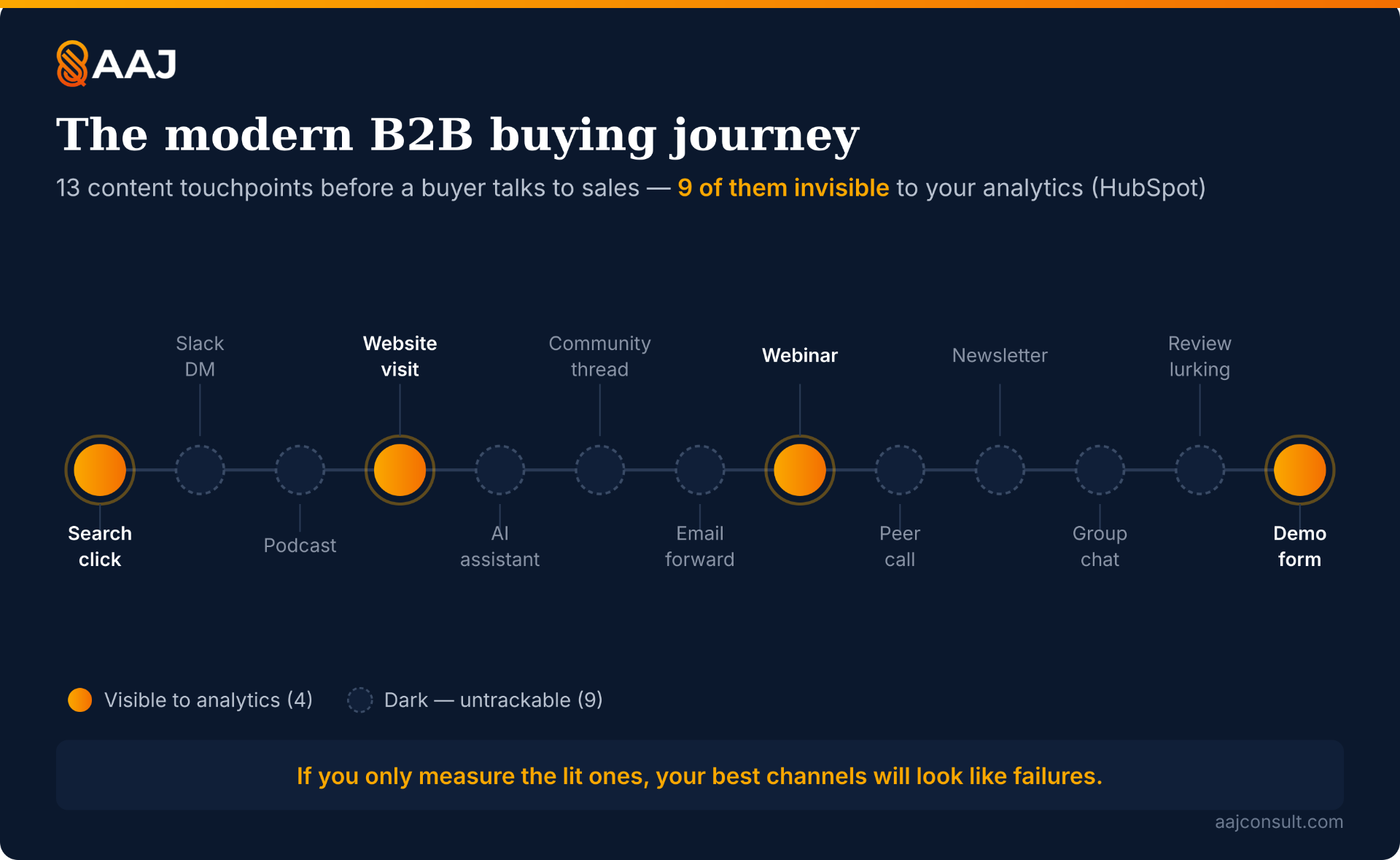
How we got here
The term isn't new — Alexis Madrigal coined "dark social" at The Atlantic back in 2012, describing traffic that arrived with no referrer because someone pasted a link into an email or chat. For a decade it was a footnote in analytics discussions. Three forces turned the footnote into the main event.
First, the private-channel migration: B2B work conversation moved into Slack, Teams, WhatsApp and Discord, and buying conversation moved with it. The question "what tool should we use for X?" is now asked in a 400-person practitioner community before it's ever typed into Google. Second, the privacy era: iOS changes, cookie deprecation, and link-tracking strippers didn't create dark social, but they demolished the tracking that let marketers pretend the visible slice was the whole pie. Third, and most recently, AI assistants: a growing share of buyer research now happens inside ChatGPT, Gemini, and Copilot conversations — zero-click, zero-referrer, and invisible to your analytics in exactly the way a Slack DM is. The dark funnel didn't just grow; it gained a new continent.
The result, plainly: the majority of your pipeline's formative moments now happen where you cannot watch. The only strategic question is whether you design for that reality or keep optimizing the visible minority.
Why this breaks the playbook you were taught
The last decade's demand machine ran on a simple loop: gate a PDF, count the form fills, call them leads, hand them to sales. That loop assumed the buying journey was visible — that interest showed up as trackable clicks and form submissions.
It doesn't anymore, and the numbers say so: in LinkedIn's B2B Marketing Benchmark research, 73% of B2B marketers report declining performance from tactics that worked just a few years ago. The gated-content model has a specific failure mode worth spelling out. Run the arithmetic on a typical gated asset: strong landing pages convert a small fraction of visitors, so for every hundred readers who wanted your thinking, a handful traded an email for it — and the other ninety-plus either bounced or found an ungated version from a competitor. You suppressed distribution among exactly the people most likely to forward it. Meanwhile the "leads" you did capture were disproportionately students, competitors, and PDF collectors, which is why sales stopped trusting the MQL pile years before marketing admitted it.
There's a second failure mode: the metrics themselves now lie by omission. A growing share of high-intent buyers never becomes a trackable lead at all — they lurk, they read, they ask their community, and then they arrive as "direct traffic" already 80% decided. If your dashboard only counts form fills and last clicks, it will systematically tell you your best-performing work is failing and your demand-capture spend is heroic. Teams then defund the thing creating demand and double down on harvesting it — the classic over-rotation to capture that leaves pipeline mysteriously shrinking two quarters later.
Here's the reframe that makes dark social feel like an opportunity instead of a measurement crisis: your content is being distributed for free by your most trusted salespeople — your readers. A VP forwarding your article to three colleagues is doing warmer outreach than any SDR sequence, with a credibility no brand account can buy. The job isn't to track it. The job is to be worth forwarding.
The dark-social demand playbook
1. Ungate your best thinking. The trade you were making — thinking for emails — was always worse than it looked, because forms captured a sliver of interest while suppressing all the sharing. The working rule: ungate ideas, gate assets. Publish frameworks, teardowns, and points of view openly, because their job is to travel. Gate the things that fairly warrant an email exchange — working tools, templates, calculators — because their job is to convert the demand the open content created. One more rule that feels wrong and isn't: make your best content copy-pasteable. A framework that survives being pasted into Slack without its formatting — numbered steps, quotable one-liners — gets pasted into Slack.
2. Make the founder the channel. Forrester projects that by the end of 2026, two-thirds of B2B content will come from decentralized, expert-led sources rather than central marketing teams. Buyers forward people, not brand accounts — a company page announcement dies in the feed while the same insight from a founder's profile gets screenshotted into group chats. What actually works as a cadence: two to three posts a week from the personal profile, rotating three archetypes — the earned lesson, the contrarian take with receipts, and the useful artifact. Let the company page echo a day later; never lead with it. And reply to every comment — the comments are where the DMs start, and the DMs are where dark social becomes visible pipeline.
3. Show up where the forwarding happens. Niche Slack and Discord communities, sub-1,000-listener podcasts, curated newsletters, regional founder groups. These don't scale, which is exactly why they work — and why your competitors skip them. The entry protocol matters: pick two or three communities where your actual buyers live, spend the first month only answering questions with zero links, and let your profile do the selling. One genuinely helpful answer in a trusted room outperforms a month of cold outreach — and unlike an ad, it keeps getting screenshotted for years.
4. Ask the only attribution question that sees in the dark. Add one field everywhere it fits — demo form, signup flow, onboarding, and (non-negotiably) the first sales call script: "How did you hear about us?" Use a free-text box, not a dropdown; dropdowns teach people to pick "Google" when the true answer is "someone in a Slack group linked your budget template, then I googled you." Self-reported attribution is imperfect, biased toward the memorable — and still the best window into dark social you'll ever get.
5. Measure in aggregate, not in clicks. If most touchpoints are untrackable, stop building strategy on touchpoint data. Watch the signals dark social does move: branded search volume, direct and unattributed traffic trends, self-reported attribution mix, inbound quality, and mention velocity. For the budget question specifically, aggregate methods like marketing mix modeling sidestep tracking entirely — they read the relationship between spend and outcomes at the weekly level, which no privacy change can break. Dark social broke attribution; it didn't break measurement.
What this means for your channel plan
Dark social doesn't replace your channel scorecard — it changes the scoring. Channels now earn their place two ways: by driving measurable response, or by feeding the unmeasurable conversation while being detectable in self-reported attribution and branded-search drift. A channel that "performs badly" in last-click but keeps showing up in "how did you hear about us" isn't underperforming — your measurement was. Practically, this argues for the barbell most successful early-stage teams converge on anyway: one capture channel you can measure tightly (search, review sites), one creation channel you mostly can't (founder content + community), and the discipline not to judge the second with the first's ruler.
The 90-day dark social plan
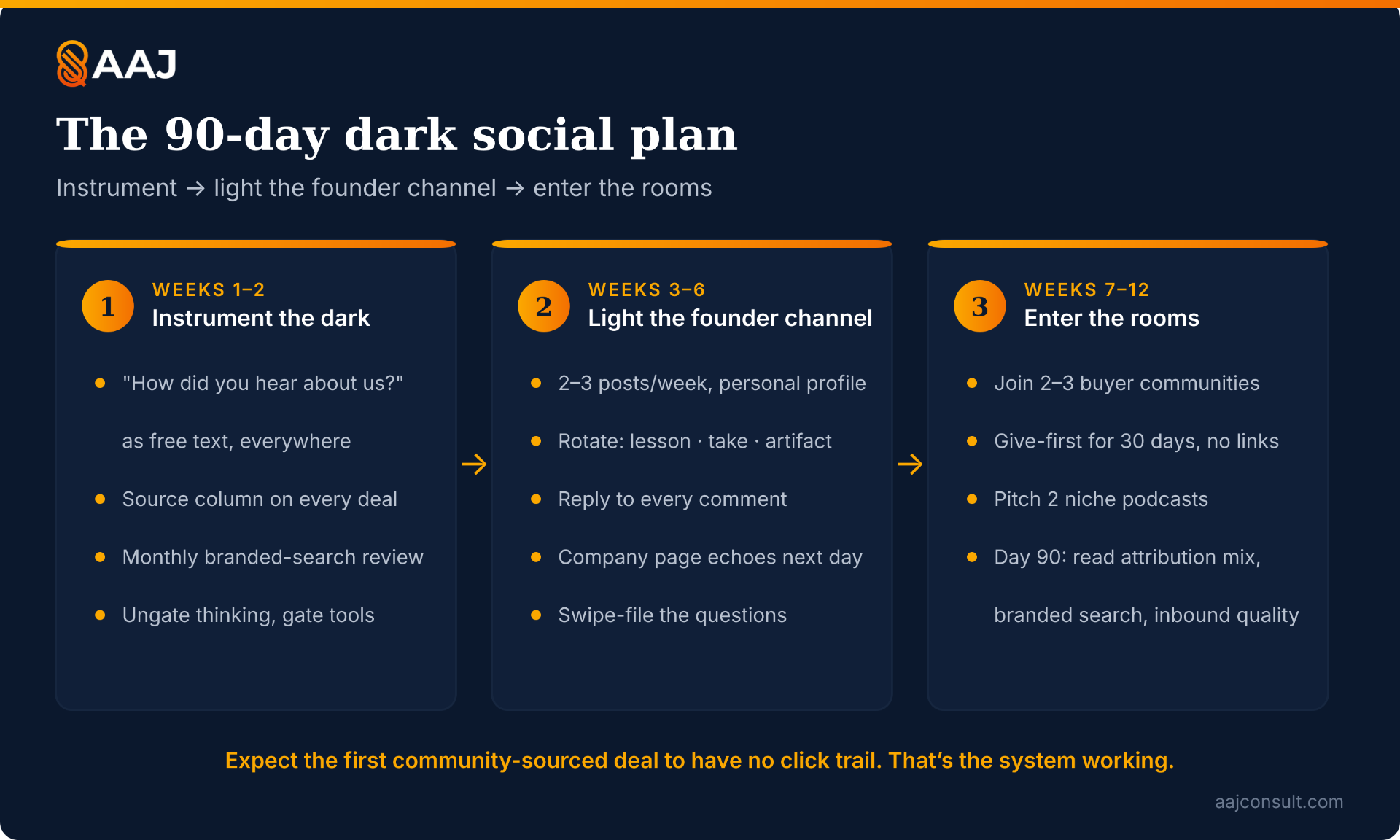
Weeks 1–2 — instrument the dark. Add the "How did you hear about us?" free-text field to every form and the sales script. Add a Source column to your deal tracking. Set a monthly 30-minute review of branded search volume and direct traffic. Audit your gated content: ungate the thinking, keep the tools gated.
Weeks 3–6 — light the founder channel. Commit to the 2–3×/week cadence with the three post archetypes. Reply to every comment. Repost the best performer to the company page a day later. Start a swipe file of questions from comments and DMs — it's next month's content calendar writing itself.
Weeks 7–12 — enter the rooms. Join two or three communities where buyers live; give-first for thirty days. Pitch two niche podcasts with a specific take (not a bio). At day 90, read the evidence: the self-reported attribution mix, branded search trend, and inbound quality. Expect the first community-sourced deal to reference a post or template you can't find a click for anywhere — that's the system working.
What not to do
Don't try to surveil the dark — buying intent data on "who's in what Slack group" or DM-scraping tools burns trust for noise. Don't spam communities; one pitchy link can end your welcome in a room that took months to earn. Don't kill paid because attribution undercounts it — capture channels still harvest what creation channels plant; fix the measurement (self-reported + aggregate) before the budget. And don't wait for perfect attribution to act: the teams winning in dark social decided that being everywhere buyers talk beats proving which conversation converted.
The startups winning demand in 2026 aren't the ones who found a way to track everything. They're the ones who made peace with the dark — and became the name that gets dropped in the rooms they'll never see.
Put it to work
The Startup Marketing Plan includes the channel scorecard for making two-channels-not-six decisions — and if you want budget math that survives a world without tracking, start with MMM-Lite and its companion piece on incrementality testing.