Incrementality Testing for Startups: Prove Your Ads Actually Work
By Saroj Jha · July 17, 2026 · 13 min read
Incrementality testing measures the conversions your marketing actually caused — separating them from the ones that would have happened anyway. You change spend in a controlled way, hold everything else steady, and measure the difference.

From this article
Only one of those two numbers belongs in unit economics.
That distinction — caused versus touched — is where startup budgets quietly leak. Every ad platform grades its own homework. The most expensive version of this is branded search: industry holdout tests consistently find that 60–80% of "paid" branded conversions would have arrived through organic anyway.
Why this went from enterprise luxury to table stakes
Three forces converged. Signal loss came first: iOS privacy changes, cookie deprecation, and link-stripping made user-level attribution progressively fictional. Platform inflation was always there but became undeniable: when every channel's dashboard claims credit for the same conversion, adding up platform-reported revenue routinely "proves" you earned more than you actually did. And CFO scrutiny closed the loop: "the platform says ROAS is 4" stopped surviving board meetings.
By 2025, over half of brands and agencies were running incrementality tests, and the practice is now described as the causal foundation of modern measurement. Conveniently, the workhorse method needs no vendor, no user tracking, and no data science team. It needs geography, discipline, and 4–8 weeks of patience.
How a geo lift test actually works
The workhorse design is the geo holdout: divide your market into geographic units (US DMAs, or regions elsewhere), match them on baseline performance, then hold back 20–30% of them as a control while the rest keep (or change) the treatment. After 4–8 weeks, compare the change in test geos against the change in control geos — a difference-in-differences read that cancels out seasonality and macro shifts.
Three design details do most of the quality work. Matching: pair geos on baseline conversion volume and trend before randomizing. Pre-period: you want clean history so you know each geo's normal behavior. Unit choice: bigger units (states, DMAs) are cleaner; smaller units (cities) give you more statistical material but leak more. Startups usually land on 15–25 usable geos.
Two directions: Turn it off (holdout) — pause a channel in control geos. If conversions there barely dip, you found budget to reclaim. Turn it up (scale test) — boost spend 30–50% in test geos. Did conversions rise proportionally, or have you hit diminishing returns?
The math, worked
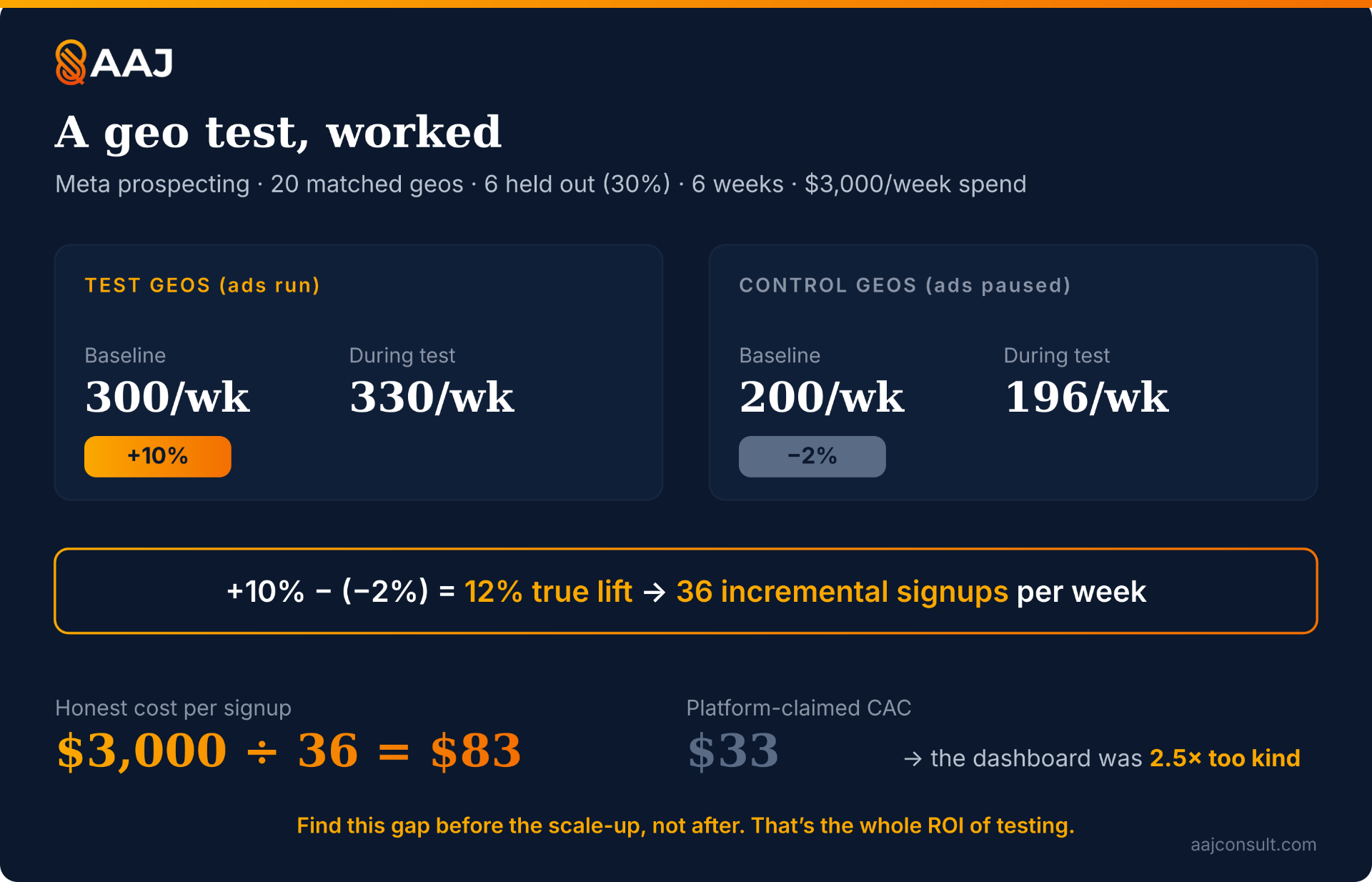
A B2B SaaS spends $3,000/week on Meta prospecting across its test geos. It matches 20 geos, holds out 6 (30%) as control, and pauses Meta there for six weeks.
Pre-period baseline: test geos 300 signups/wk, control geos 200 signups/wk. During the test: test geos 330 signups (+10%); control geos 196 signups (−2% — the market softened slightly, which is exactly why you have a control).
Difference-in-differences: +10% − (−2%) = 12% relative lift. In absolute terms: 300 × 12% = 36 incremental signups per week that exist because Meta ran. Cost per incremental signup = $3,000 ÷ 36 ≈ $83. Meanwhile the platform claimed 90 conversions — a platform-reported CAC of $33. Both numbers are "true" in their own universe; only one belongs in your unit economics.
What makes a test trustworthy
Pre-register everything. Hypothesis, geos, duration, primary metric, and the decision you'll make at each outcome — written down and locked before launch. Power it honestly: you want a couple hundred weekly conversions per arm. Freeze the machine: bids, creative, targeting, landing pages — untouched for the duration. Mid-test "optimizations" are how teams spend six weeks learning nothing.
The test menu (geo isn't the only option)
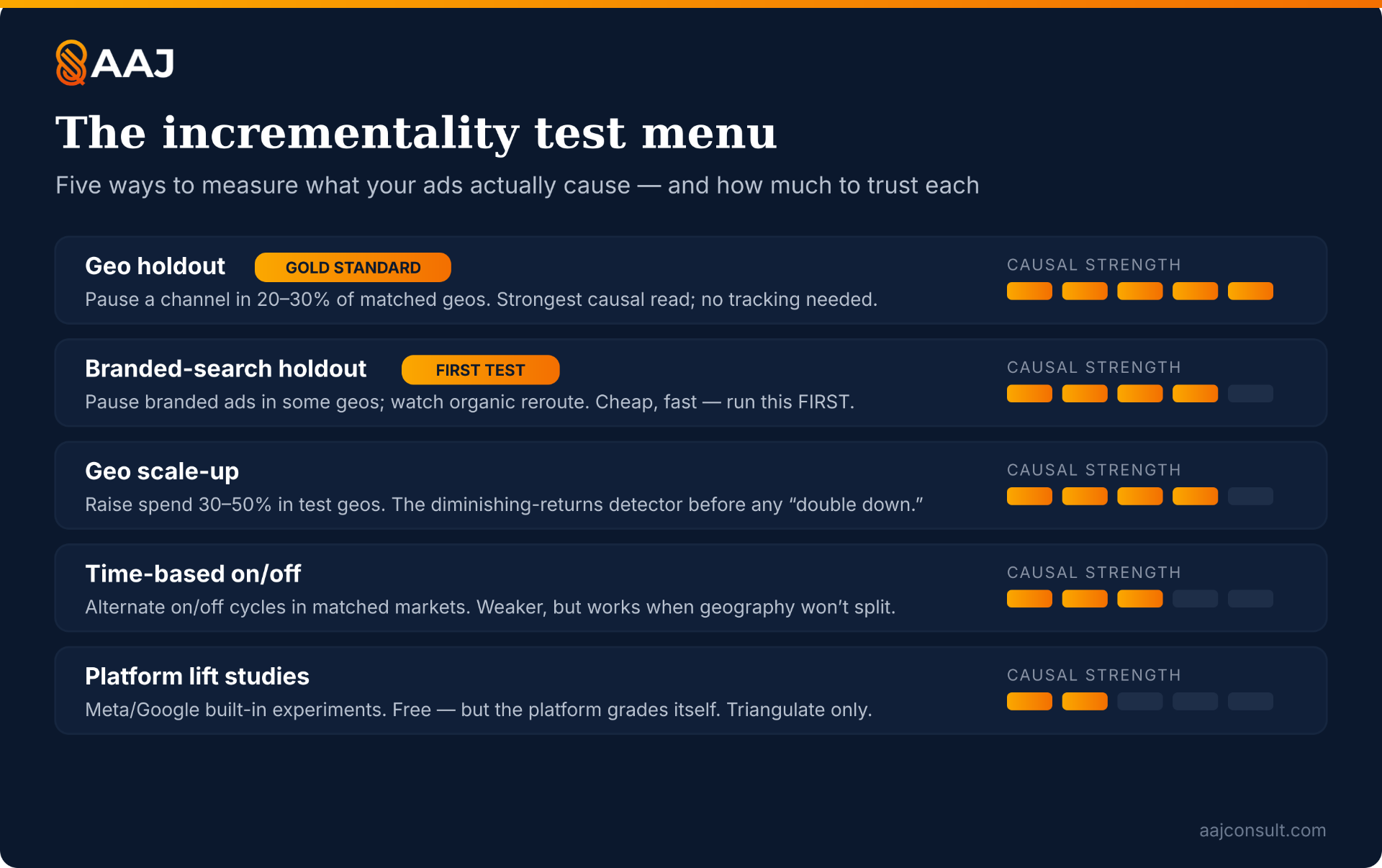
Geo holdout — the gold standard: strongest causal read, no tracking required. Geo scale-up — the diminishing-returns detector; run it before believing any "pour more into the winner" plan. Time-based on/off — alternate weeks on/off in matched markets; weaker but workable when geography is concentrated. Platform lift studies — built into Meta, Google, LinkedIn; free and better than nothing, but the platform is still grading its own homework. Branded-search holdout — should usually be your first test: cheap, fast, and tests the line item most likely to be padding.
Reading the result — and acting on it
Decide the decisions in advance. Lift ≥ MDE and cost per incremental conversion ≤ target → scale ~20% and retest in one to two quarters. Lift below MDE → reallocate 15–25% of budget, iterate creative or targeting, retest. Branded search shows most conversions persist organically → reclaim budget without ceremony. Test disagrees with your model → the test wins, every time — this test-then-recalibrate loop is exactly how MMM-Lite and incrementality work as a system.
When a startup actually needs this
Not at $5K/month across two channels — at that size, your budget is the experiment. The test earns its overhead when a channel is taking a meaningful share of budget on faith, you're about to scale a "winner" only a platform's own attribution has vouched for, or a model told you something expensive and you'd like a second opinion. One test per quarter on your most consequential channel is the whole cadence a Seed–Series B company needs.
Your first test, concretely
Pick the channel you'd most hate to be wrong about — for most startups, branded search first. Write the one-page pre-registration, match and split your geos, hold out 20–30%, run 4–8 weeks untouched, read the diff-in-diff, and do the thing you committed to.
If you want the scaffolding pre-built, the free MMM-Lite Starter Kit includes the pre-registration template and decision rules — and the MMM-Lite Engagement runs your first test with you. See also our companion piece on dark social and the Marketing Budget Planner.
Want senior marketing to own the measurement plan with you on a monthly cadence? See AAJ's Fractional Marketing Leadership.
Part of the Analytics, Experiments & Budget hub - see the other 21 resources on this topic.