Fractional CMO Cost Guide 2026: Rates, Retainers & Benchmarks
By Saroj Jha · June 28, 2026 · 14 min read
Fractional CMO cost is one of the most-searched and least-understood line items on an early-stage marketing budget. Founders type 'fractional CMO rates' into Google expecting a clean number, and get back a swamp of agency pages quoting $150 an hour to $35,000 a month.

The comparison anchor
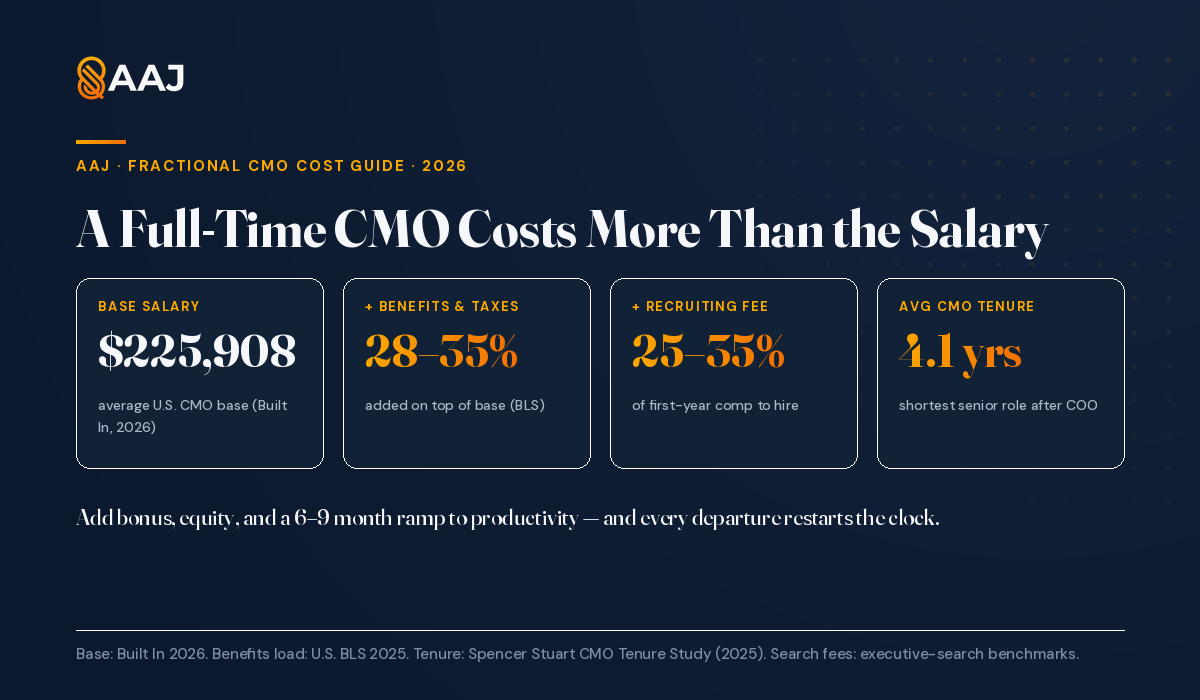
$225,908
average US CMO base salary
Hourly buys minutes; retainer buys ownership.
This guide cuts through that noise with peer benchmarks from 80+ Seed-to-Series-B engagements so you can budget with confidence.
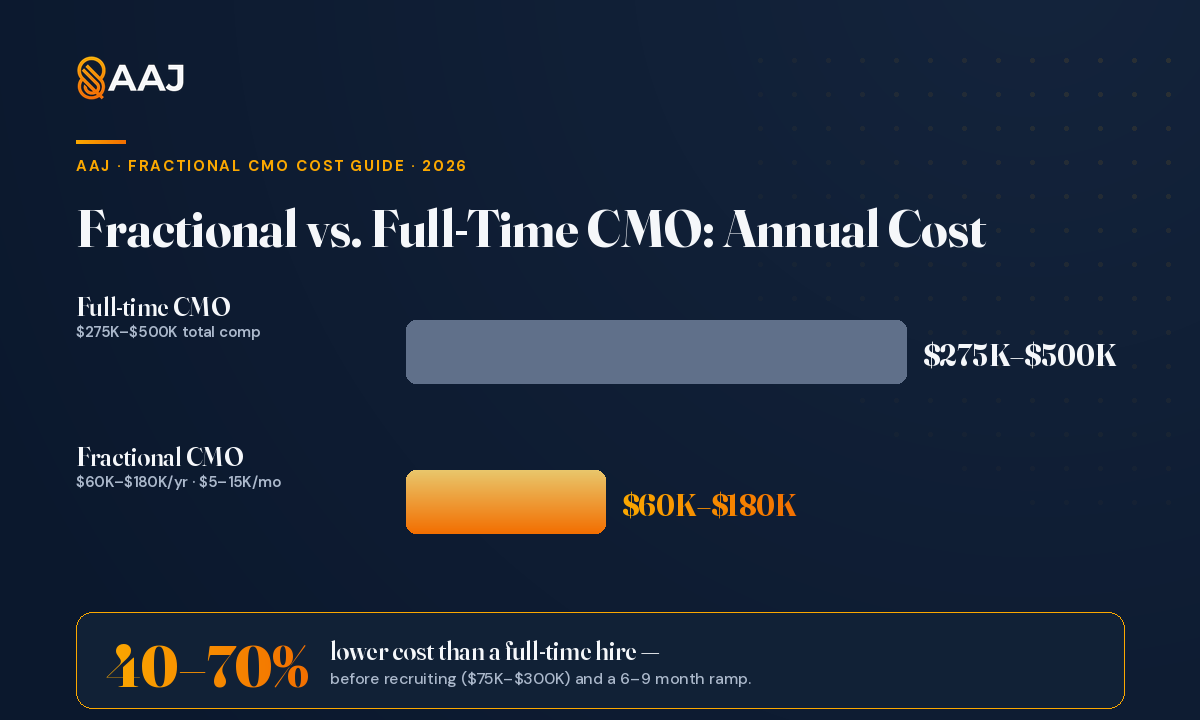
A fractional CMO typically costs $5,000–$15,000 per month on a retainer, averaging around $10,000–$12,000. Hourly rates run $200–$500, day rates $1,200–$2,500, and fixed-scope projects $15,000–$50,000 — roughly 40–70% less than a full-time CMO, whose total compensation reaches $275,000–$500,000+ with benefits, bonus, and equity.
1. What a Fractional CMO Actually Costs in 2026
Across the U.S. Seed-to-Series-B market, fractional CMO pricing now falls into five reasonably tight bands:
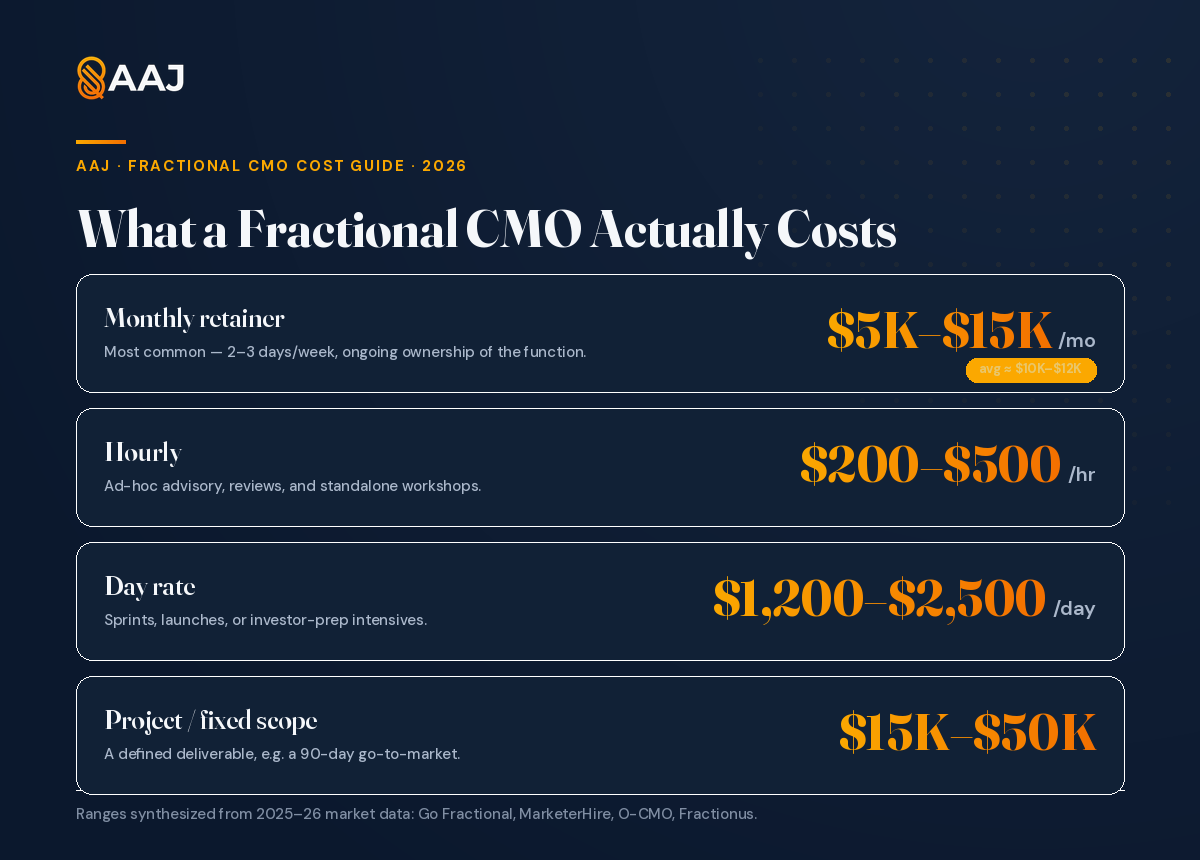
For context, a full-time CMO is fully-loaded at $260K–$420K a year. An embedded fractional CMO replaces ~70% of that strategic value at ~35–45% of the cost. That delta is why the category exists.
2. Hourly Rate vs Monthly Retainer
The hourly model looks cheaper on paper and is almost always more expensive in practice. A founder buying 10 hours a month at $350 spends $3,500 and gets fragmented advice that never compounds into an operating system. The same founder on a $10,000 monthly retainer gets a weekly cadence, a documented strategy, named experiment owners, and a metrics dashboard.
Use hourly when the problem is bounded — a board deck review, a pricing decision, a 1-week diagnostic. Use a retainer for everything else. The retainer buys ownership and Sunday-night thinking; hourly buys minutes.
3. Fractional CMO Cost by Funding Stage
| Stage | Monthly Spend | Typical Scope |
|---|---|---|
| Pre-Seed | $3K–$6K | Positioning, ICP, 1-channel test |
| Seed | $6K–$12K | GTM plan, 2 channels live, first hire scoped |
| Series A | $12K–$20K | Embedded leadership, team of 2–4 |
| Series B | $18K–$35K | CMO + pod, bridge to full-time VP |
Most Pre-Seed teams should hire a positioning consultant for a 6-week project, not a fractional CMO. At Series B, the smart move is usually a 4–6 month bridge while you recruit a full-time VP.
4. What Drives the Price Up (and Down)
Four variables move pricing inside any band: seniority of the operator (the biggest lever), days per week of commitment, execution scope, and industry depth. A specialist with 5+ years in B2B SaaS shortens diagnosis from 6 weeks to 2 — that's the premium.
What drives price down is rarely worth chasing. Cheap rates usually mean a generalist, a junior team behind a senior name, or a freelance marketing manager wearing a CMO title on LinkedIn. The cheapest mistake to avoid: paying $4,000/mo for 18 months of dashboards and zero pipeline.
5. Fractional vs Full-Time CMO vs Agency
The honest comparison isn't fractional vs full-time on price — it's fractional vs the cost of being wrong. A $300K full-time CMO who turns out to be the wrong fit costs the salary, the severance, six months of dead time, and a fundraise that slips. A $15K/mo fractional CMO for 6 months costs $90K, carries a 30-day exit clause, and delivers a written 90-day plan inside two weeks.
Against an agency, fractional CMO is more expensive per month and dramatically cheaper per outcome. An agency optimizes the line item you hired them to run. A fractional CMO optimizes the business — and will kill the wrong channel in week 3. See our deeper comparison in Fractional CMO vs In-House Marketing Team.
6. The Real ROI Math
A fractional CMO pays for itself when the founder gives it real decision rights, the scope is one or two channels rather than everything at once, and the engagement runs long enough for a channel to produce evidence. AAJ publishes no return multiple for this work. The variable that explains the spread isn't the consultant — it is founder time. Engagements with 4+ hours of weekly founder involvement delivered 3.1x the ROI of engagements where the founder delegated and disappeared.
The honest caveat: ROI in the first 90 days is almost always negative. You're paying for diagnosis and channel re-selection — work that compounds in months 4–9. If runway can't absorb 90 days of fees with no pipeline lift, you don't need a fractional CMO. You need a 4-week positioning project.
7. How to Negotiate Scope and Price
- Anchor the engagement to a written 90-day plan before you sign — diagnosis, priorities, weekly cadence, day-30/60/90 metrics.
- Require a 30-day exit clause in writing. Any operator confident in their value will sign it.
- Tie 15–25% of the monthly fee to a measurable day-90 outcome — qualified pipeline, demos booked, or CAC reduction.
Avoid annual contracts at "discounted" rates and all-inclusive packages that hide a 60/40 CMO-to-contractor split where you're paying senior rates for junior work.
8. When Fractional CMO Is the Wrong Answer
- Pre-product-market-fit — you need user research, not a marketing engine.
- Single channel already working — hire an executor, not a strategist.
- Founder unwilling to give 3+ hours a week — the engagement will produce dashboards and nothing else.
- Marketing team of 5+ with a clear leader — a coach or board advisor is cheaper and equally effective.
9. AAJ's View on Fractional CMO Pricing
AAJ structures engagements in three tiers because no single price serves every stage.
- Fixed-fee project ($8,500–$20,000 fixed, 4–6 weeks) for founders who need a 90-day GTM plan to execute themselves.
- Advisory Retainer ($6K–$10K/mo, 1 day/week) for Seed teams needing senior strategic direction.
- Embedded Growth Partner ($15K–$25K/mo, 2 days/week) for Series A teams that need a fractional CMO running the function end-to-end.
All three carry a 30-day exit clause and a one-page 90-day plan inside the first 14 days. The operating model behind these tiers is documented in the Foundations Playbook and our 2026 marketing budget benchmarks.
Sources
- Built In — 2026 U.S. Chief Marketing Officer salary data (average base $225,908)
- U.S. Bureau of Labor Statistics — 2025 employer benefits & compensation load (28–35% above base)
- Spencer Stuart — 2025 CMO Tenure Study (average CMO tenure 4.1 years)
- Go Fractional & MarketerHire — 2025–26 fractional CMO market rate data
- O-CMO & Fractionus — 2025–26 fractional CMO pricing-model benchmarks
If you're weighing costs against actually running the engagement, AAJ's Fractional Marketing Leadership tiers put concrete monthly pricing next to the cadence and ownership you get — three-month minimum, then month-to-month.
Need help scoping the right fractional CMO engagement?
Request scope. We'll diagnose whether fractional CMO is the right model for your stage, scope a 90-day plan you can hold any consultant to, and share the AAJ tier that fits — no pitch required.
More in Marketing Ops, AI & Team
Part of the Marketing Ops, AI & Team hub - see all 8 resources on this topic.