Go-to-Market Strategy Examples: 10 B2B Startup Launches Analyzed
By Saroj Jha · June 18, 2026 · 22 min read
The most-studied B2B go-to-market strategy examples — Slack, Notion, Gong, Figma, Airtable, Linear, Snowflake, Drift, Webflow, Datadog — share one pattern. Each picked a single motion, matched it to a sharply defined ICP, and concentrated on one or two channels for years.

From this article
Snowflake’s playbook would have killed Notion.
For the underlying framework, see the AAJ B2B GTM strategy from scratch guide and the broader marketing strategy for startups playbook. The 10 examples below are the case material — read them as variations on those frameworks, not as templates to copy line-for-line.
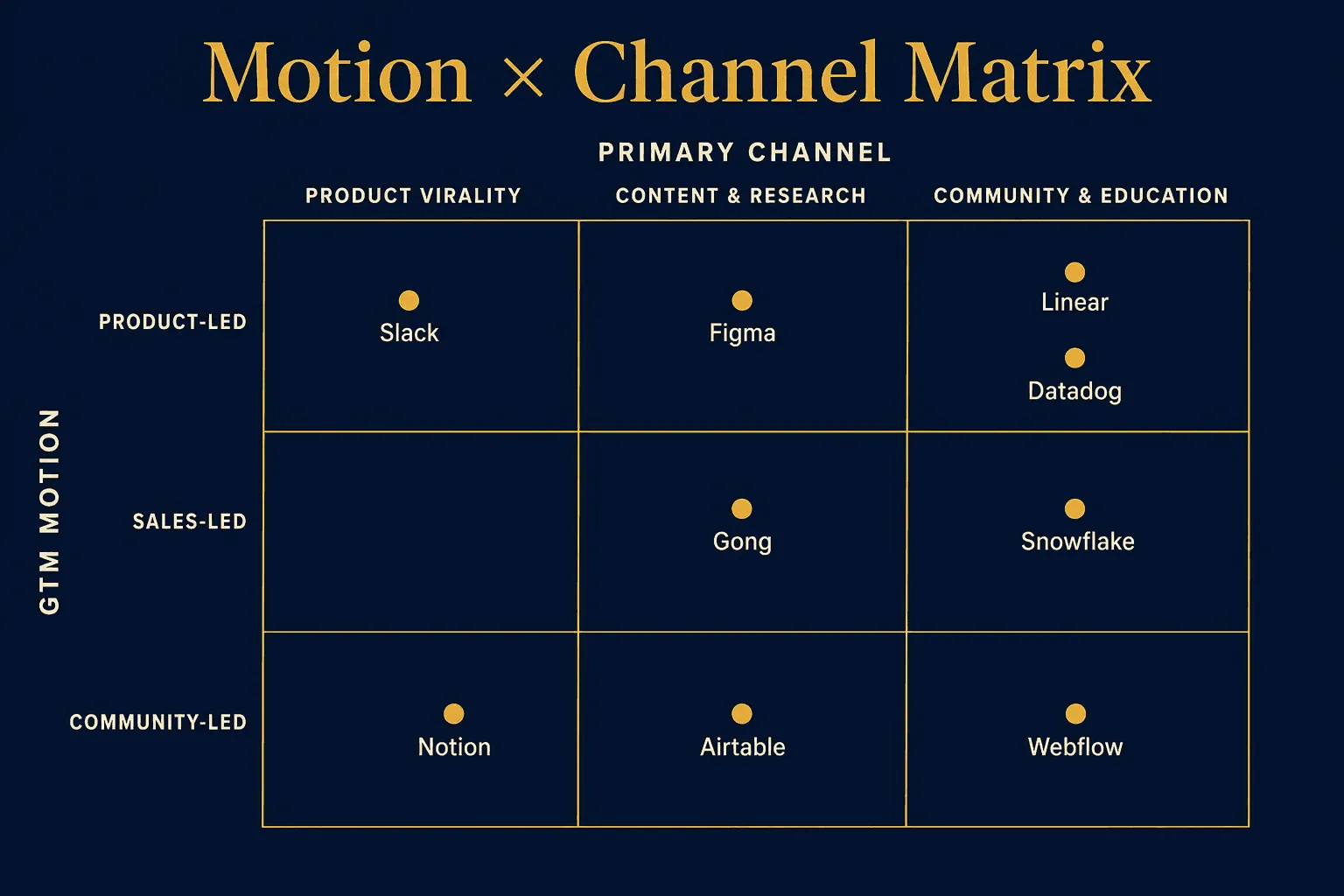
How to read these GTM examples
Before the case studies, a quick frame. Every working GTM resolves into four decisions, and the difference between examples is how each company answered them in sequence:
- Who exactly is the wedge buyer, and what trigger makes them urgent?
- Product-led, marketing-led, sales-led, community-led, or ecosystem-led?
- The one or two channels where that buyer is most concentrated and receptive.
- Free, freemium, consumption, per-seat, or enterprise — chosen to remove friction at commitment.
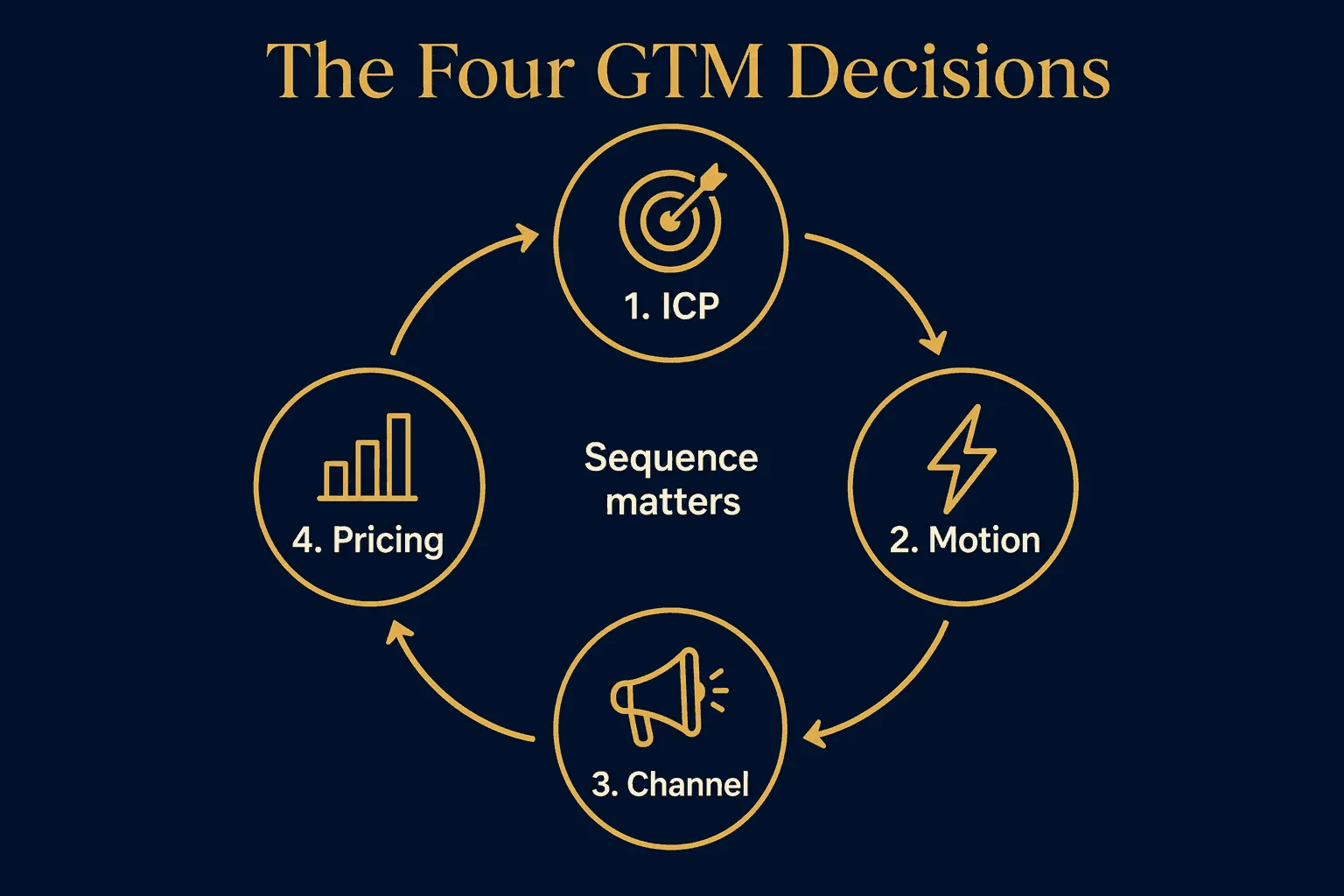
The companies below are not interchangeable. Snowflake's playbook would have killed Notion; Notion's playbook would have stalled Snowflake. Match shape to shape before stealing anything.
1Case StudySlack — invite-only beta + viral team adoption
- ICPSmall product and engineering teams already drowning in email and Skype.
- MotionProduct-led, team-by-team.
- ChannelFounder relationships and curated beta invites.
- PricingFreemium with a generous message-history cap.
Stewart Butterfield's team had spent two years building a multiplayer game (Glitch) that didn't work. The internal chat tool they'd built to ship the game did. The GTM was almost entirely about manufacturing demand before public launch: they invited 45 friendly companies to a private preview, used the feedback to harden the product, and then launched in February 2014 with a press tour framing Slack as "the end of email." Within 24 hours, 8,000 companies had signed up; within a year, 500,000 daily active users.
What's transferable: The invite-only waitlist wasn't a growth hack — it was a research instrument. Slack used it to find which team archetypes adopted fastest, then wrote messaging for those archetypes specifically.2Case StudyNotion — community, templates, and ambassador-led growth
- ICPIndie makers, designers, and early-stage operators who already lived in productivity tools.
- MotionCommunity-led PLG.
- ChannelTwitter/X, YouTube creators, the Notion template gallery, and a structured ambassador program.
- PricingFree for individuals, paid for teams.
Notion rebuilt the product twice and nearly ran out of money before community-led growth caught fire in 2018–2019. The flywheel: power users built public templates → templates ranked for long-tail search ("Notion personal CRM template", "Notion content calendar") → new users imported the template and brought their team → the team upgraded to paid. The ambassador program formalized the highest-output community members into a global advocacy network.
What's transferable: When your product is a blank canvas, the GTM job is to fill the canvas in public. Templates, tutorials, and creator partnerships compounded for Notion in a way paid acquisition never did.3Case StudyGong — category creation with original research
- ICPVPs of Sales at mid-market and enterprise B2B SaaS companies.
- MotionSales-led with marketing-led demand creation on top.
- ChannelLinkedIn (executive thought leadership), original data research, and outbound SDR teams.
- PricingAnnual enterprise contracts.
Gong didn't enter the "call recording" category — it created a new one called Revenue Intelligence. The wedge was a stream of free, data-driven research reports ("the State of Sales", anonymized analyses of millions of recorded calls) that became the default LinkedIn content for sales leaders. By the time a VP of Sales was ready to buy, Gong had spent 18 months earning the right to be the only vendor on the shortlist.
What's transferable: Category creation requires proprietary data and the patience to spend 12–24 months teaching the market a new vocabulary before monetizing it.4Case StudyFigma — multiplayer design and the browser bet
- ICPIndividual designers inside companies still standardized on Sketch.
- MotionProduct-led, individual-then-team.
- ChannelDesigner Twitter, conference sponsorships, and direct evangelism.
- PricingFree for individuals, per-editor for teams, enterprise on top.
Figma spent four years on an unsexy bet — that design tools should run in the browser — before launching publicly in 2016. The GTM exploited a single insight: design was the last creative discipline still trapped in single-player desktop software. Designers brought Figma into companies the way Slack got into them, one project at a time. By the time enterprise IT noticed, the designers had already migrated.
What's transferable: When your product unlocks collaboration, the GTM is whoever brings the second user. Design every interaction to make sharing the path of least resistance.5Case StudyAirtable — horizontal freemium with use-case marketing
- ICPOperators in marketing, HR, and product who had outgrown spreadsheets but didn't want to write code.
- MotionPLG with templated use cases.
- ChannelSEO around use-case queries ('editorial calendar template', 'applicant tracking spreadsheet') and content marketing.
- PricingFree, paid per-seat, enterprise.
Airtable's GTM problem was that "a spreadsheet-database hybrid" is an unbuyable category. The solution: stop selling the platform and start selling the use case. Every landing page, template, and ad campaign answered one specific job — content calendars, product roadmaps, applicant tracking, event planning — and let users self-discover the platform underneath.
What's transferable: Horizontal products need vertical messaging. Pick the five highest-intent use cases, build a landing page and template for each, and let SEO and self-serve do the rest.6Case StudyLinear — quality-led developer GTM
- ICPHigh-craft product and engineering teams frustrated with Jira's bloat.
- MotionProduct-led with founder-led narrative.
- ChannelPublic method documents, a public changelog with weekly velocity, and founder presence on Twitter/X.
- PricingPer-seat with a generous free tier.
Linear's GTM bet is unusual: it competes on craft. The team publishes a public "Linear Method" describing how they build software, ships a changelog every week that reads like a product magazine, and resists every feature request that would dilute the experience. The result is a strong opinion that earns mindshare among the exact audience — opinionated founders and CTOs — that becomes the buyer.
What's transferable: When your category is crowded with feature-bloated incumbents, "we made the best-feeling product in this category" is a defensible GTM. But it requires the team to actually be world-class at craft.7Case StudySnowflake — consumption pricing and the data cloud wedge
- ICPMid-market and enterprise data teams locked into legacy Teradata, Oracle, or on-prem Hadoop.
- MotionSales-led with partner ecosystem.
- ChannelCloud partner co-sell (AWS, Azure, GCP), systems integrators, and conference dominance (Snowflake Summit).
- PricingConsumption — pay for the storage and compute you use.
Snowflake's structural advantage was pricing: consumption-based billing matched the elasticity of cloud, made procurement easy, and aligned vendor incentives with customer success. The GTM amplified that with deep partner integration (every major BI tool and ETL vendor ships a Snowflake connector by default) and a category narrative — "the data cloud" — that elevated the conversation above SQL warehouses.
What's transferable: Pricing model can be a GTM weapon. If your category is dominated by a rigid model (perpetual licenses, per-seat at scale), an aligned model (consumption, outcomes-based) can be the wedge.8Case StudyDrift — conversational marketing and category creation
- ICPB2B marketing leaders running marketing automation and feeling the conversion ceiling of long forms.
- MotionMarketing-led inbound with mid-market SDR.
- ChannelDavid Cancel's LinkedIn presence, the Hypergrowth conference, a published book (Conversational Marketing), and a podcast network.
- PricingFree, paid tiers, enterprise.
Drift's GTM was a thought-leadership flywheel. The founders argued — loudly and consistently for three years — that traditional forms were broken and "conversation" was the future. The Hypergrowth conference became the gathering point for the category they were inventing. By the time competitors caught up to the product, Drift owned the narrative.
What's transferable: If you have founder-level conviction about a category shift, lean into it. Conferences, books, and podcasts are not vanity assets — they are demand-creation infrastructure.9Case StudyWebflow — education-led growth via Webflow University
- ICPFreelance web designers and small agency founders who could design but couldn't code.
- MotionCommunity-led PLG, then upmarket to teams.
- ChannelWebflow University (free video courses), YouTube, designer community Discord and forums.
- PricingFree starter, paid sites, then Workspaces and Enterprise.
Webflow University is one of the most-studied content GTM assets of the last decade — hundreds of free, professionally produced lessons that teach the product and the category simultaneously. Designers who finished a course often became evangelists who pulled their employers onto the platform, which created the natural land-and-expand path into agencies and in-house teams.
What's transferable: Education is the most durable form of content marketing. If your product has a learning curve, investing in structured curriculum (not blog posts) compounds for years.10Case StudyDatadog — developer-first land-and-expand
- ICPDevOps and SRE engineers responsible for production reliability.
- MotionProduct-led trial, then sales-led enterprise expansion.
- ChannelDeveloper-facing technical content, conferences (Dash, AWS re:Invent), and integrations marketplace.
- PricingPer-host with usage modifiers, then a la carte products on top.
Datadog's wedge was infrastructure monitoring — a single, painful job — sold to engineers via a free trial that was genuinely useful in 15 minutes. Once the engineering team standardized, Datadog expanded across the observability stack (APM, logs, RUM, security) inside the same account. The integrations marketplace (now 600+) makes Datadog the path of least resistance in nearly every cloud-native architecture.
What's transferable: A small, painful wedge that lands in 15 minutes is more valuable than a comprehensive platform that takes a quarter to deploy. Land cheap, expand rich.Patterns across all 10 examples
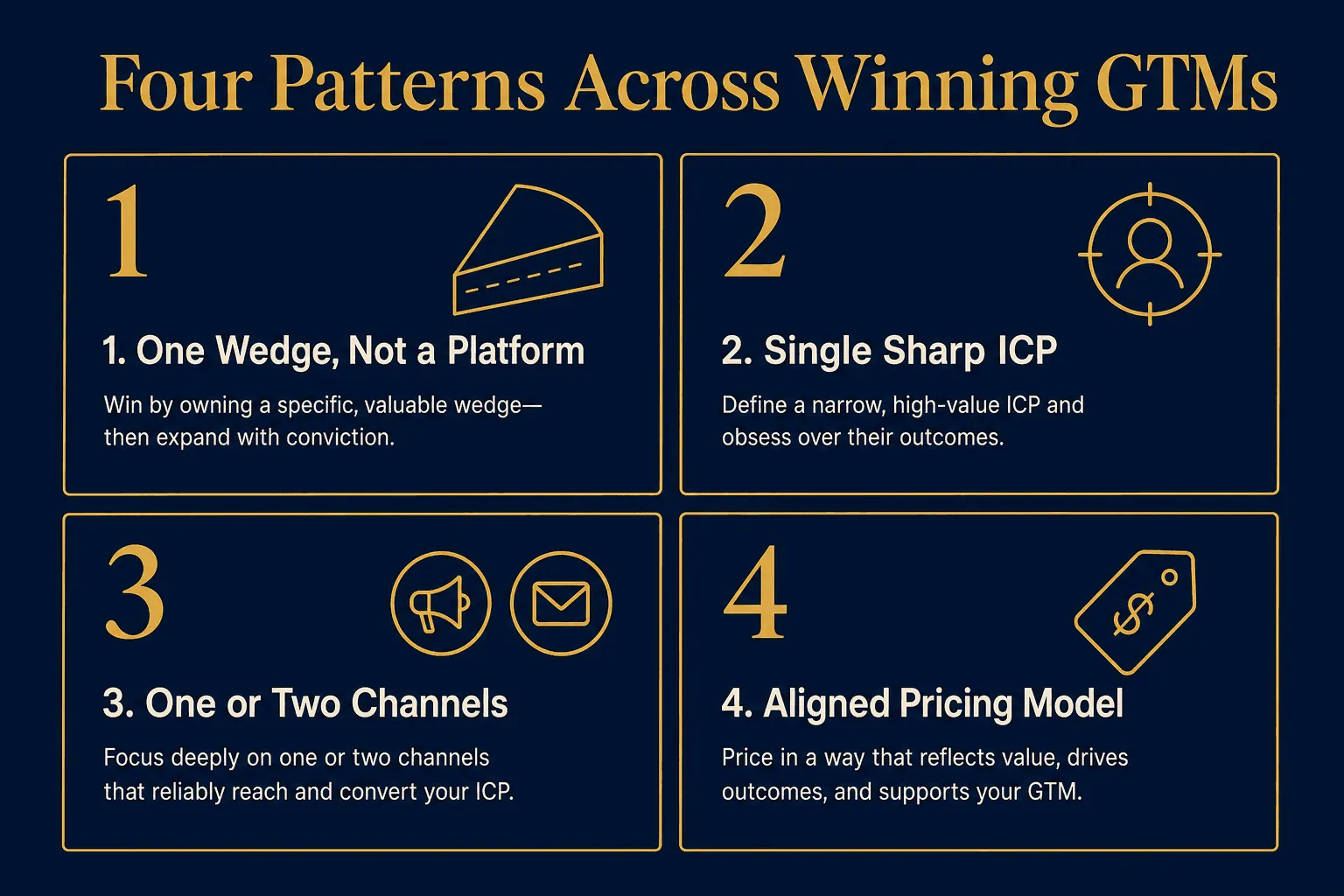
- 1One wedge, not a platform.Every winner started with a single painful job for a single buyer. Platform stories came later, after the wedge was profitable.
- 2Channel concentration for years.No example ran more than two real channels in its first 24 months. Slack on viral team adoption. Gong on LinkedIn. Webflow on University. Concentration beats coverage at the GTM-fit stage.
- 3Pricing as a GTM weapon.Freemium (Slack, Notion, Figma), consumption (Snowflake, Datadog), and free education (Webflow) were strategic choices, not afterthoughts.
- 4Narrative ownership.Every category leader either created a category (Gong, Drift, Snowflake) or owned a strong opinion within an existing one (Linear, Figma). Vague "we do X and Y and Z" positioning never appears in any of these stories.
How to apply this to your startup
Don't copy any of these playbooks line-for-line — your context is different. Instead, run this five-step adaptation:
- Map your shape. ACV, buyer (individual / team / committee), sales cycle, and product complexity. This narrows you to two or three of the 10 examples above.
- Pick the closest example. Read its first 24 months in detail. Document the order in which it made ICP, channel, pricing, and team decisions.
- Steal the sequence. The order of decisions transfers; the specific tactics rarely do.
- Run a 90-day proof window. Validate one channel and one motion before adding a second. Use the AAJ marketing strategy framework and the B2B GTM from scratch guide as the operating system.
- Resist diversification. When something starts to work, the temptation is to add channels. The examples above suggest the opposite: go three layers deeper on the one working channel first.
Need a sanity check on which example matches your shape? AAJ runs a $3,500 Positioning & Message Sprint in 10 business days that maps your ICP, motion, and channel to a defensible 90-day plan — grounded in the same patterns above.
Sources & Further Reading
The insights in this article draw on research and thinking from these reputable sources:
First Round Review — How Slack Got Its First 10,000 Users
Operator deep-dive on Slack's invite-only beta strategy, the famed Tiny Speck team-feedback loop, and the demand engine that pre-built the launch waitlist.
https://review.firstround.com/ →
Notion — Official Brand & Growth Story
Notion's published origin story covering the community-led growth motion, template gallery, and ambassador program that turned power users into the primary acquisition channel.
https://www.notion.so/about →
Gong — Revenue Intelligence Category Creation
Gong's category-design playbook for Revenue Intelligence, including the role of original research (the State of Sales report) and LinkedIn-led demand creation.
https://www.gong.io/resources/ →
Figma — Multiplayer Design and the Browser Bet
Figma's product-led GTM grounded in browser-first collaboration, free-for-individuals pricing, and enterprise expansion via designer-led adoption.
https://www.figma.com/blog/ →
Airtable — From Spreadsheet to Connected Apps Platform
Airtable's transition from a horizontal freemium spreadsheet to a platform with templates, community use cases, and enterprise sales motion.
https://www.airtable.com/blog →
Linear — A Quality-First GTM Manifesto
Linear's public method documents and changelog cadence as a GTM asset — winning developer mindshare through craft, restraint, and opinionated product design.
https://linear.app/method →
Snowflake — Consumption Pricing and the Data Cloud Wedge
Snowflake's consumption-based pricing, partner ecosystem, and proof-driven enterprise sales motion that built the modern data warehouse category.
https://www.snowflake.com/en/why-snowflake/ →
Drift — Conversational Marketing and the No-Forms Movement
Drift's category-creation GTM around conversational marketing, anti-form thought leadership, and the Hypergrowth conference as a demand-creation flywheel.
https://www.drift.com/blog/ →
Webflow — No-Code Web Design with Education-Led Growth
Webflow University as the centerpiece of a GTM that converted designers into evangelists, then upgraded freelancers into teams and enterprise customers.
https://webflow.com/blog →
Datadog — Land-and-Expand in Cloud Observability
Datadog's bottom-up developer-first GTM, free trial wedge into infrastructure monitoring, and disciplined expansion across the observability stack.
https://www.datadoghq.com/blog/ →
Lenny's Newsletter — Case Studies on Notion, Figma, Airtable, Linear
Practitioner interviews with growth leaders at the companies analyzed, covering early ICP decisions, channel sequencing, and pricing pivots.
https://www.lennysnewsletter.com/ →
Map these examples to your startup
Positioning & Message Sprint — 10 business days to a working GTM plan
AAJ's Positioning & Message Sprint adapts the right GTM example to your shape — ICP, motion, channel, pricing, and a 90-day operating cadence with KPIs. Immediately actionable.
Request scope →More in Go-to-Market & Growth Planning
Part of the Go-to-Market & Growth Planning hub - see all 12 resources on this topic.