Incrementality Testing for Startups: Prove Your Ads Actually Work
Incrementality testing measures the conversions your marketing actually caused — separating them from the ones that would have happened anyway. You change spend in a controlled way (usually by region), hold everything else steady, and measure the difference. The gap between test and control is your true lift: not clicks touched, not conversions claimed by a platform's attribution model, but revenue that exists because the campaign ran.
That distinction — caused versus touched — is where startup budgets quietly leak. Every ad platform grades its own homework, and every platform's model is generous to itself. The most expensive version of this is branded search: industry holdout tests consistently find that 60–80% of "paid" branded conversions would have arrived through organic anyway. If you've never tested it, there's a decent chance you're paying full price for customers who were already walking through the door.
Why this went from enterprise luxury to table stakes
Three forces converged. Signal loss came first: iOS privacy changes, cookie deprecation, and link-stripping made user-level attribution progressively fictional — the neat multi-touch journey in your dashboard is now a model's guess about a mostly invisible path. Platform inflation was always there but became undeniable: when every channel's dashboard claims credit for the same conversion, adding up platform-reported revenue routinely "proves" you earned more than you actually did. And CFO scrutiny closed the loop: in a capital-efficient era, "the platform says ROAS is 4" stopped surviving board meetings. Experimental evidence — we turned it off and revenue dropped X% — is the only measurement language finance fully trusts, because it's the same logic as a clinical trial.
The market responded: by 2025, over half of brands and agencies were running incrementality tests, and the practice is now widely described as the causal foundation of modern measurement — the ground truth that calibrates everything else, including media mix models. Conveniently, the workhorse method needs no vendor, no user tracking, and no data science team. It needs geography, discipline, and 4–8 weeks of patience.
How a geo lift test actually works
The workhorse design is the geo holdout: divide your market into geographic units (US DMAs, or regions/cities elsewhere), match them on baseline performance, then hold back 20–30% of them as a control while the rest keep (or change) the treatment. After 4–8 weeks, compare the change in test geos against the change in control geos — a difference-in-differences read that cancels out seasonality, news cycles, macro shifts, and everything else that hit both groups equally.
Three design details do most of the quality work. Matching: pair geos on baseline conversion volume and trend before randomizing — a control group that was already growing faster than test will manufacture fake results in either direction. Pre-period: you want clean history (ideally several months) so you know each geo's normal behavior; the pre-period is what the "difference in differences" differences against. Unit choice: bigger units (states, DMAs) are cleaner but fewer; smaller units (cities) give you more statistical material but leak more (people commute, travel, share). Startups usually land on the biggest units that still give them 15–25 usable geos.
Two directions, two questions: Turn it off (holdout) — pause a channel in control geos. If conversions there barely dip, you just found budget to reclaim. If they crater, the channel earned its keep — now you know by how much. Turn it up (scale test) — boost spend 30–50% in test geos. Did conversions rise proportionally, or have you hit diminishing returns? This is the test that tells you whether "double the winning channel" is a plan or a wish.
The math, worked
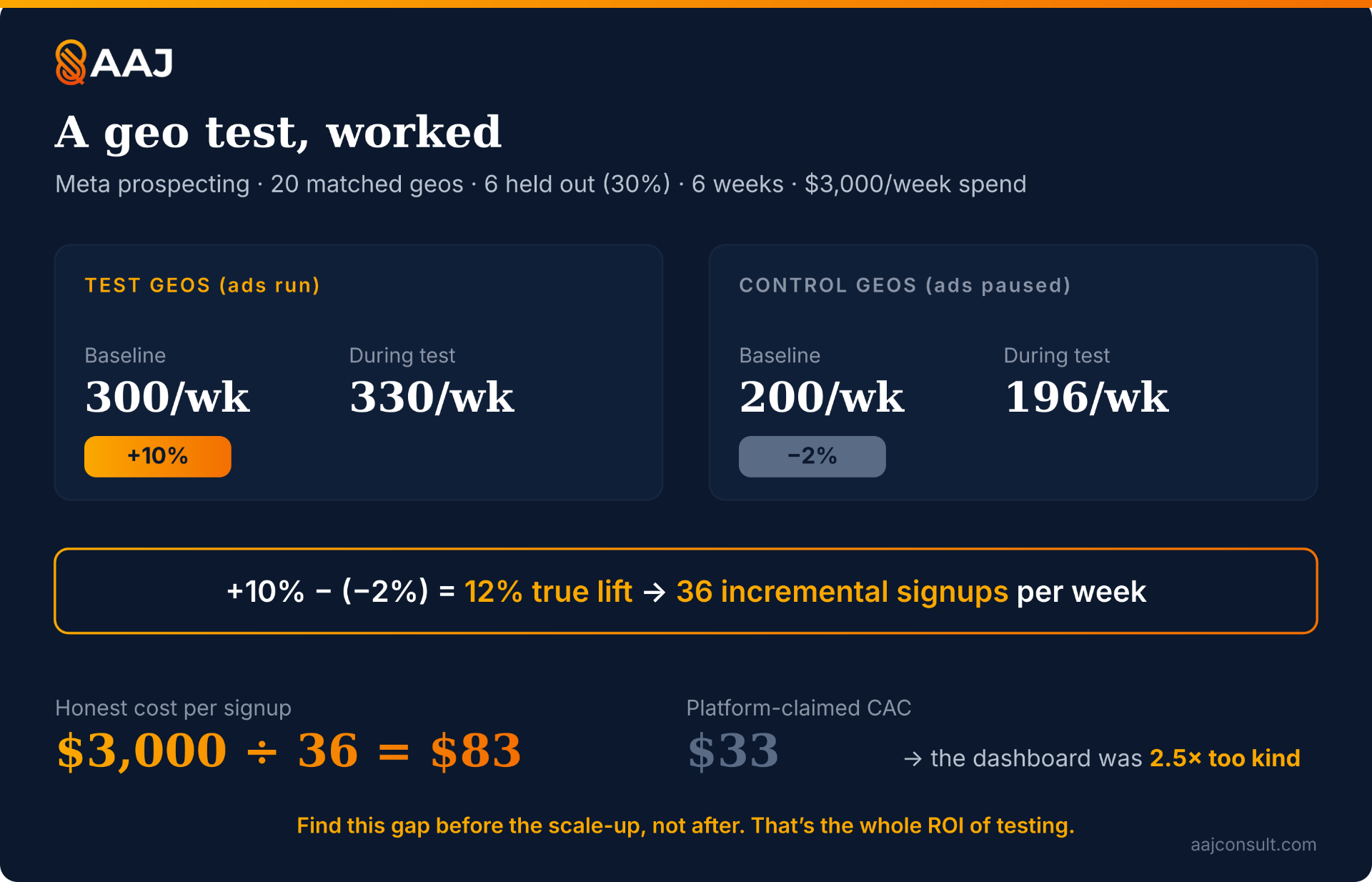
Concrete beats abstract, so here's a full read-through with clean numbers. A B2B SaaS spends $3,000/week on Meta prospecting across its test geos. It matches 20 geos, holds out 6 (30%) as control, and pauses Meta there for six weeks.
Pre-period baseline (weekly average): test geos 300 signups, control geos 200 signups. (Arms don't need equal size — the method compares each arm to itself.)
During the test (weekly average): test geos 330 signups (+10% vs their own baseline); control geos 196 signups (−2% vs theirs — the market softened slightly, which is exactly why you have a control).
Difference-in-differences: +10% − (−2%) = 12% relative lift attributable to the channel. In absolute terms: 300 × 12% = 36 incremental signups per week that exist because Meta ran.
The honest economics: cost per incremental signup = $3,000 ÷ 36 ≈ $83. Meanwhile the platform dashboard claimed 90 conversions that week — a platform-reported CAC of $33. Both numbers are "true" in their own universe; only one belongs in your unit economics. If a signup is worth $250 to you, incremental ROAS is (36 × $250) ÷ $3,000 = 3.0 — a channel worth keeping, at 2.5× the cost the dashboard implied. That gap, discovered before a scale-up instead of after, is the entire ROI of testing.
What makes a test trustworthy (and what quietly ruins one)
The rigor is mostly discipline, not math. Pre-register everything. Hypothesis, geos, duration, primary metric, and the decision you'll make at each outcome — written down and locked before launch. No peeking, no early stopping, no swapping metrics when the first read disappoints. An unregistered test is a story; a registered one is evidence.
Power it honestly. Small startups' biggest failure mode is testing below the noise floor. Rough heuristic: you want a couple hundred weekly conversions per arm — if your geos are too thin, aggregate them or extend the test rather than shipping a result you can't distinguish from randomness. Design to detect a lift you'd actually act on (10–20% relative is typical).
Freeze the machine. Bids, creative families, targeting, landing pages — untouched for the duration. Mid-test "optimizations" are how teams spend six weeks learning nothing. Expect contamination, handle it in analysis. Control geos will see some spillover; difference-in-differences absorbs most of it. Just don't run a viral referral push mid-test. Guardrails, then patience. Pre-set a pause condition (e.g., CAC running more than two standard deviations above trailing baseline for two straight weeks) — otherwise let it finish. The tests that fail are the ones someone touched.
The test menu (geo isn't the only option)
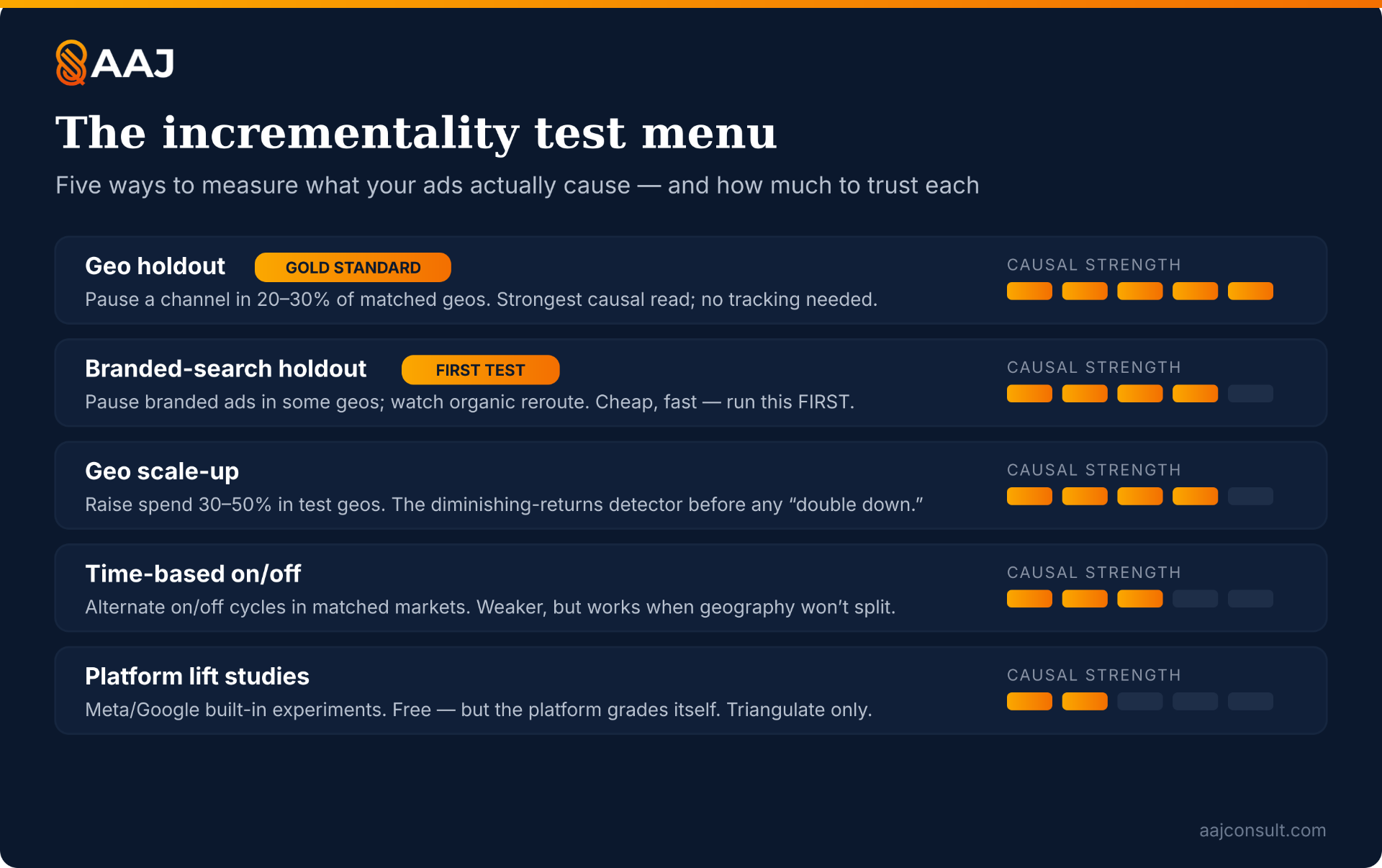
Geo holdout — the gold standard above: strongest causal read, no tracking required, works for any channel with regional control. Geo scale-up — same machinery, spend increased instead of paused; the diminishing-returns detector. Run it before believing any "pour more into the winner" plan.
Time-based on/off — alternate two weeks on, two weeks off in matched markets, several cycles. Weaker (time confounds creep in), but workable when your geography is too concentrated to split. Platform lift studies — Meta, Google and LinkedIn offer built-in conversion-lift experiments. They're free and better than nothing, with one structural caveat: the platform is still grading its own homework. Use them to triangulate, not to conclude. Branded-search holdout — the special case that should usually be your first test: pause branded paid search in a subset of geos and watch how many conversions re-route through organic. It's cheap, fast, high-volume, and tests the line item most likely to be padding.
Reading the result — and actually acting on it
Decide the decisions in advance, then obey them. Lift ≥ MDE and cost per incremental conversion ≤ target → scale the channel ~20%, and book a retest in one to two quarters (incrementality decays as audiences saturate). Lift below MDE → the channel isn't pulling incremental weight as currently run. Reallocate 15–25% of its budget toward your highest-marginal-return channel, and queue one creative or targeting iteration before any final verdict — then retest.
Branded search shows most conversions persisting organically → reclaim that budget without ceremony. Keep a small defensive floor only if competitors bid your name aggressively. Test disagrees with your model → the test wins, every time. Recalibrate the model's expectations for that channel; this test-then-recalibrate loop is exactly how MMM-Lite and incrementality work as a system.
The step where measurement programs actually break isn't design or analysis — it's the morning after, when the result contradicts someone's favorite channel. This is why the pre-registered decision matters more than the pre-registered metric: you're not just committing to a measurement, you're committing to doing the thing the measurement says.
When a startup actually needs this
Not at $5K/month across two channels — at that size, your budget is the experiment, and benchmark-guided planning does more per hour invested. The test earns its overhead when three things are true: a channel is taking a meaningful share of budget on faith, you're about to scale a "winner" that only a platform's own attribution has vouched for, or a model told you something expensive and you'd like a second opinion. One test per quarter on your most consequential channel is the whole cadence a Seed–Series B company needs.
Your first test, concretely
Pick the channel you'd most hate to be wrong about (for most startups: branded search first, then the biggest paid line). Write the one-page pre-registration — goal, design, geos, duration, MDE, guardrails, and the pre-committed decision for each outcome. Match and split your geos, hold out 20–30%, run 4–8 weeks untouched, read the diff-in-diff, and do the thing you committed to.
If you want the scaffolding pre-built, the free MMM-Lite Starter Kit includes the pre-registration template and decision rules alongside the model — and the MMM-Lite Sprint runs your first test with you: pre-registered, properly powered, and read out with the reallocation memo attached. See also our companion piece on dark social and the Marketing Budget Planner.