SaaS Pricing Models in 2026: Seat-Based vs. Usage-Based vs. Hybrid
By Saroj Jha · July 6, 2026 · 10 min read
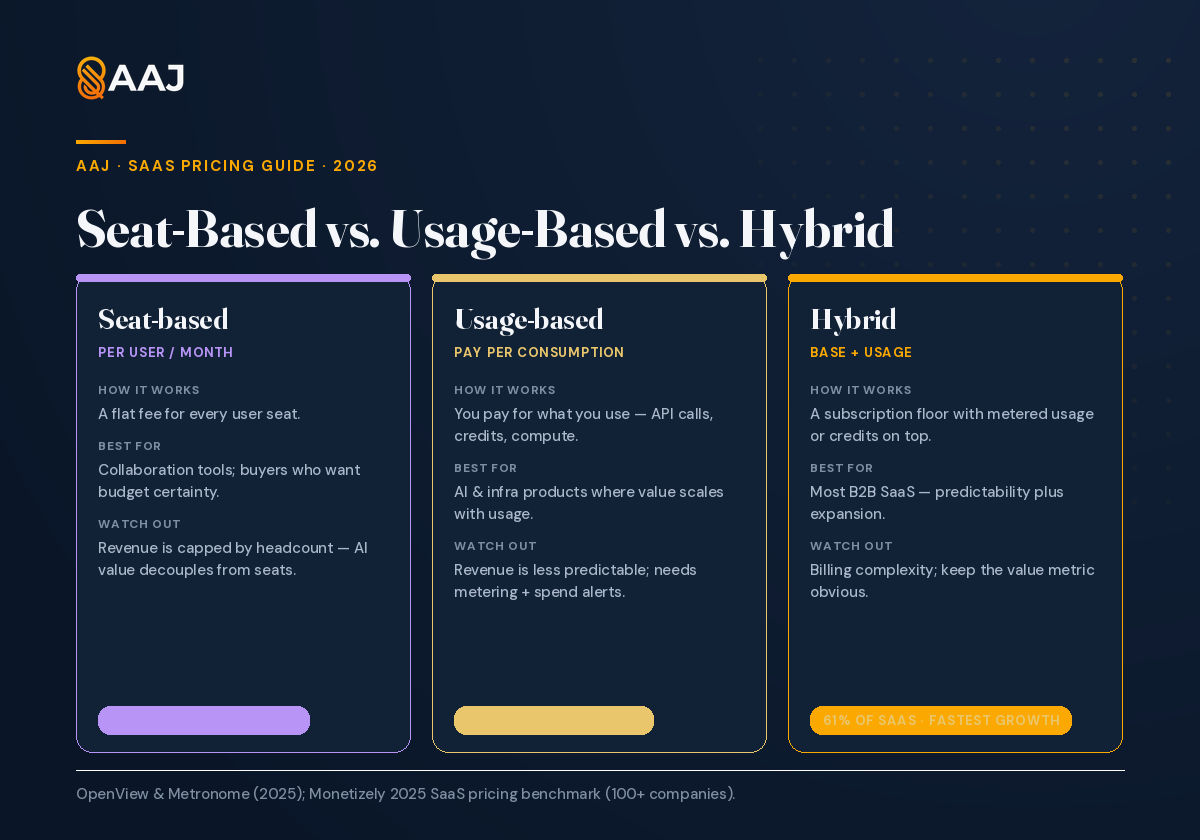
The three SaaS pricing models are seat-based (a flat fee per user), usage-based (you pay for what you consume), and hybrid (a subscription floor plus metered usage on top). In 2026, hybrid is winning.

The pricing shift
85%
of SaaS leaders now use usage-based pricing
Expansion built into the model, not bolted on afterward.
That's the short answer. The longer one matters, because picking a pricing model is one of the few decisions that changes your growth math permanently — and most founders make it once, early, and never revisit it. This guide gives you the current data, the trade-offs, and a way to choose a model you can actually defend.
What are the three SaaS pricing models?
Nearly every SaaS pricing page is a variation on three underlying ideas.
Seat-based (per-user) pricing charges a flat monthly fee for every user who logs in. It's the model that built SaaS: simple to quote, easy to budget, easy to benchmark. You grow revenue by adding seats.
Usage-based (consumption) pricing charges for what a customer actually uses — API calls, credits, compute minutes, records processed, messages sent. Revenue rises and falls with consumption, so it tracks the value delivered rather than the number of logins.
Hybrid pricing combines the two: a subscription base (for predictability and a revenue floor) plus a usage or credit layer on top (for expansion). It's the blend that most fast-growing SaaS companies have converged on, and for AI products it's quickly becoming the default.
Where is SaaS pricing actually heading in 2026?
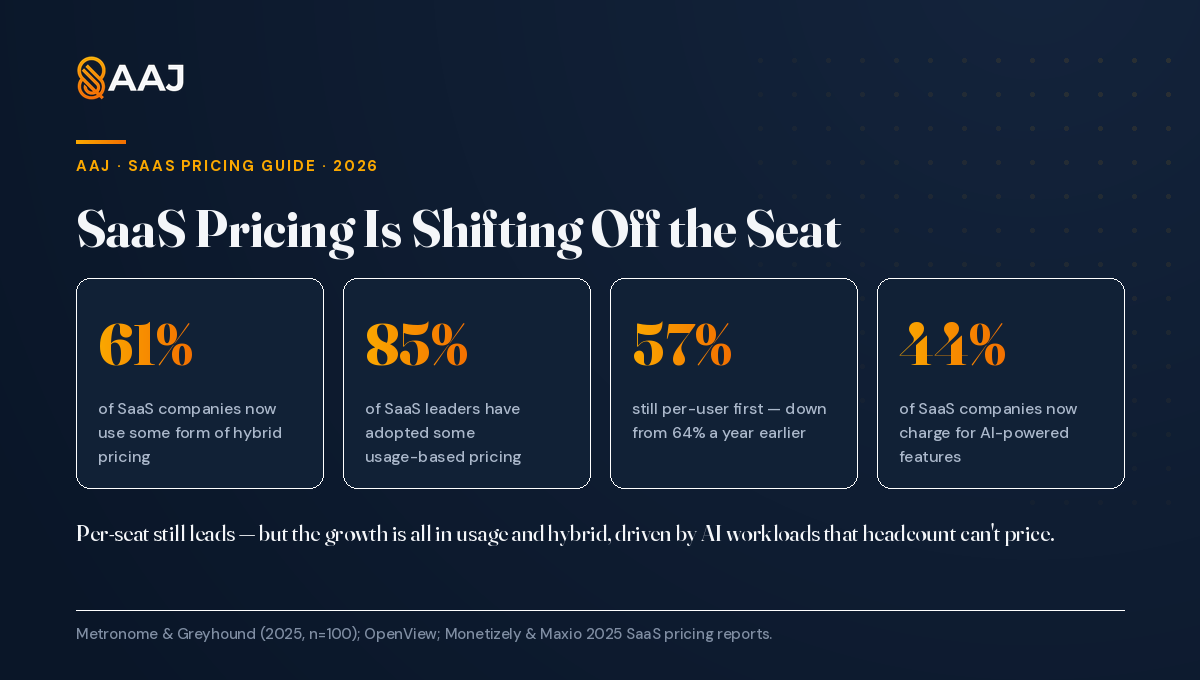
Per-seat pricing is still the most common primary model — but it's shrinking while usage and hybrid grow quickly. About 85% of SaaS leaders now use some form of usage-based pricing (Metronome, 2025), 61% run some form of hybrid model (OpenView), and per-user-first pricing fell from 64% to 57% in a single year (Monetizely, 2025). At the same time, 44% of SaaS companies now charge for AI-powered features (Maxio, 2025).
Three forces are driving the shift. First, enterprise buyers are tired of paying for seats that go unused and want pricing aligned to consumption. Second, AI workloads broke the seat: a single user can trigger thousands of tokens, credits, or agent actions in minutes, so headcount stops being a sensible proxy for value. Third, the momentum is compounding — roughly 78% of companies using usage-based pricing adopted it within the last five years, and nearly half in the last two (Metronome, 2025). Looking forward, IDC projects that 70% of software vendors will move away from pure per-seat pricing by 2028.
This isn't a settled market. Among the 500 largest SaaS and AI companies with transparent pricing, there were more than 1,800 pricing changes in 2025 alone — about 3.6 per company. The direction of travel is clear even if the destination isn't: value is increasingly priced by consumption and outcomes, not by how many people hold a login.
Which pricing model grows fastest?
Hybrid. Across 316 SaaS companies, hybrid models posted a 21% median growth rate, ahead of pure subscription (19%) and pure usage-based (18%) (Benchmarkit, 2025). The growth gap is modest — but the retention gap is not. Hybrid companies report roughly 38% higher net revenue retention than pure-subscription peers (Chargebee, 2025), and consumption-led companies grow revenue about 8 percentage points faster than flat-rate businesses on average (OpenView).
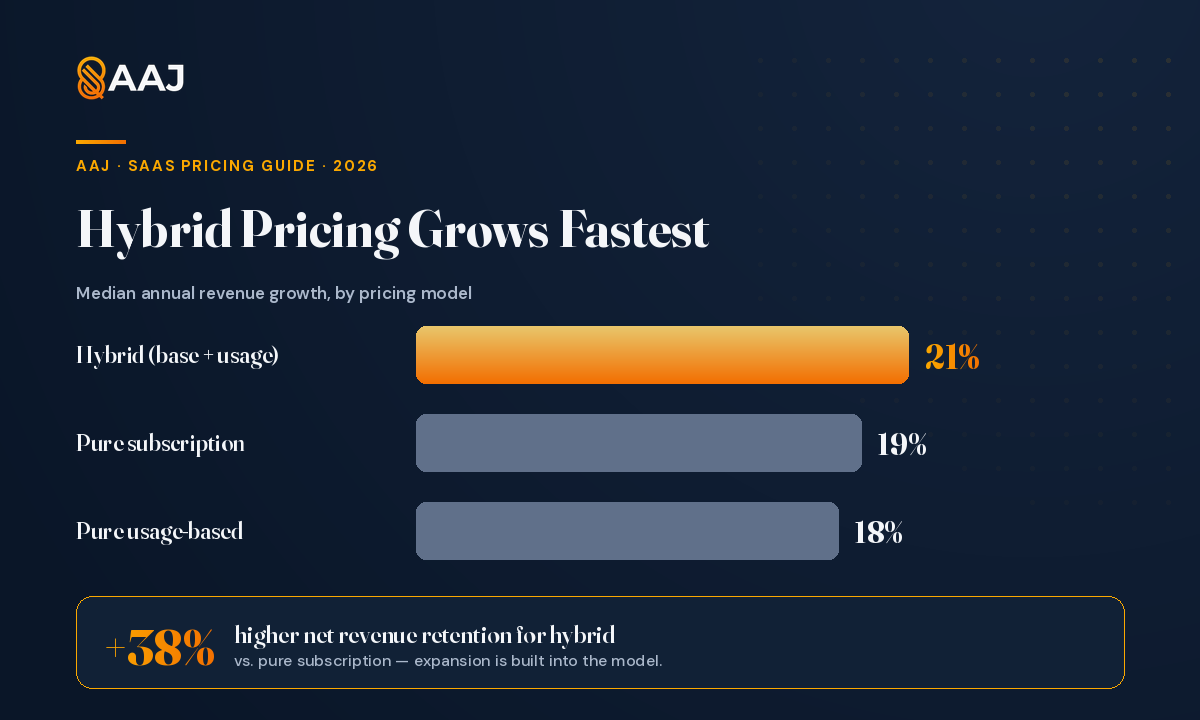
The reason is structural. In a well-designed usage or hybrid model, the unit you bill for is the unit of value — so revenue expands automatically as customers succeed, without a manual upsell motion or a renewal renegotiation. That's why net revenue retention runs higher: growth from your existing base is engineered into the pricing, not chased quarter by quarter. It's also why repricing is such high-leverage work — a single well-executed pricing and packaging change lifts median net revenue retention by about 14% (OpenView). This is the part worth internalizing: the right model doesn't just capture more today, it makes the math compound.
Seat-based vs. usage-based vs. hybrid: which fits your product?
The best model is the one whose billing unit matches how your product creates value.
Seat-based still wins for pure collaboration tools — project management, shared docs, communication — where value genuinely scales with the number of people working together, and where buyers prize budget certainty. Its weakness is a hard ceiling: revenue is capped by headcount, and any AI-driven value is decoupled from the thing you charge for.
Usage-based fits infrastructure and AI-native products — APIs, data, compute, anything where one customer's consumption can be 100x another's. It aligns cost with value beautifully, but revenue is less predictable and it demands real instrumentation: metering, spend dashboards, and proactive alerts so customers are never surprised by a bill.
Hybrid fits most B2B SaaS, which is exactly why 61% have adopted it. The subscription base gives you a predictable floor and clean forecasting; the usage or credit layer captures expansion as customers grow. The cost is complexity — you're now running two billing logics — and the discipline it requires is keeping the value metric obvious.
How should AI-native startups price?
If your product runs AI, per-seat pricing quietly loses money. Most AI-monetizing companies have already moved: among those charging for AI features, roughly half use a hybrid model, typically with credits layered onto a base plan. Credit-based pricing more than doubled among the top 500 SaaS companies in 2025 — from 35 companies to 79, a 126% jump (Kyle Poyar, Growth Unhinged). HubSpot folded AI credits into its existing per-seat tiers; Salesforce priced Agentforce by the conversation.
Two rules keep AI pricing from backfiring. First, charge for a unit the buyer can map to value — one enrichment, one conversation, one generation. Credits only work when the customer can mentally convert one credit into one unit of value; otherwise you've recreated the confusion of opaque enterprise pricing. Second, priced well, AI features command a 25–50% premium over equivalent non-AI functionality — but only when you can show a measurable efficiency gain, not just an "AI" label.
How to choose a model you can defend
You don't need to predict the future of pricing. You need a decision you can explain to your board and revisit as you scale.
- Start from the value metric. What does the customer get more of when they get more value from you? More users? More outputs? More automated tasks? That answer points at the model. If value scales with people, seats can work; if it scales with consumption, it can't.
- Match the model to how value scales, not to what's easy to bill. Ease of billing is a solvable tooling problem. A pricing model misaligned with value is a permanent tax on growth.
- At Seed, keep it simple. A clean subscription with one or two tiers beats a clever usage model your first customers can't predict. Don't price for the company you'll be in three years.
- At Series A/B, layer in usage or credits once you can instrument it — this is where hybrid starts paying off in retention and expansion.
- Instrument before you price. You cannot charge for what you cannot measure. If your value metric is hard to track in real time, fix the telemetry first.
- Review pricing quarterly, not annually. Companies that revisit pricing quarterly grow meaningfully faster than those who set it and forget it. Pricing is a system to run, not a decision to make once.
For a deeper framework and the willingness-to-pay math behind these choices, see our SaaS Pricing & Packaging playbook, and model the revenue impact of a change with the Pricing & ARPU Modeler.
What breaks when you switch models
Moving off seats is high-leverage, but it fails in predictable ways. Surprise bills are the number-one killer — usage pricing without spend dashboards and proactive alerts erodes exactly the trust it was meant to build. Variable-revenue forecasting becomes mandatory; 73% of companies on usage models actively forecast it, because a consumption model you can't predict spooks your own finance team as much as your customer's. And the oldest trap still applies: over-discounting to force adoption. Around 80% of SaaS companies discount by 25% or more to win deals, and those customers churn at three to five times the rate — a pattern we cover in the pricing mistakes that quietly kill startup growth. A new model won't save pricing you're afraid to hold.
Sources
- Metronome & Greyhound Capital — State of Usage-Based Pricing 2025
- OpenView Partners — SaaS Benchmarks research (hybrid ~61%, +14% median NRR after repricing)
- Benchmarkit / Maxio — 2025 SaaS Pricing Trends Report (316 companies)
- Chargebee — 2025 State of Subscriptions Report
- Monetizely — 2025 SaaS Pricing Benchmark Study
- Kyle Poyar, Growth Unhinged / PricingSaaS 500 Index
- IDC (70% of vendors moving off pure per-seat by 2028) and Gartner
Repricing on the roadmap this quarter?
Request scope. We'll pressure-test your model against the seat / usage / hybrid decision, map it to your value metric, and leave you with a 90-day repricing plan you can hold your team to.
Part of the Pricing & Monetization hub - see the other 4 resources on this topic.