How to run a webinar that creates pipeline, not just registrants
By Saroj Jha · September 22, 2026 · 6 min read
I've run webinars that filled a registration list and produced nothing else. A good turnout, some polite questions, a recording nobody watched, and no conversations the following week. It felt like it worked, and it didn't.
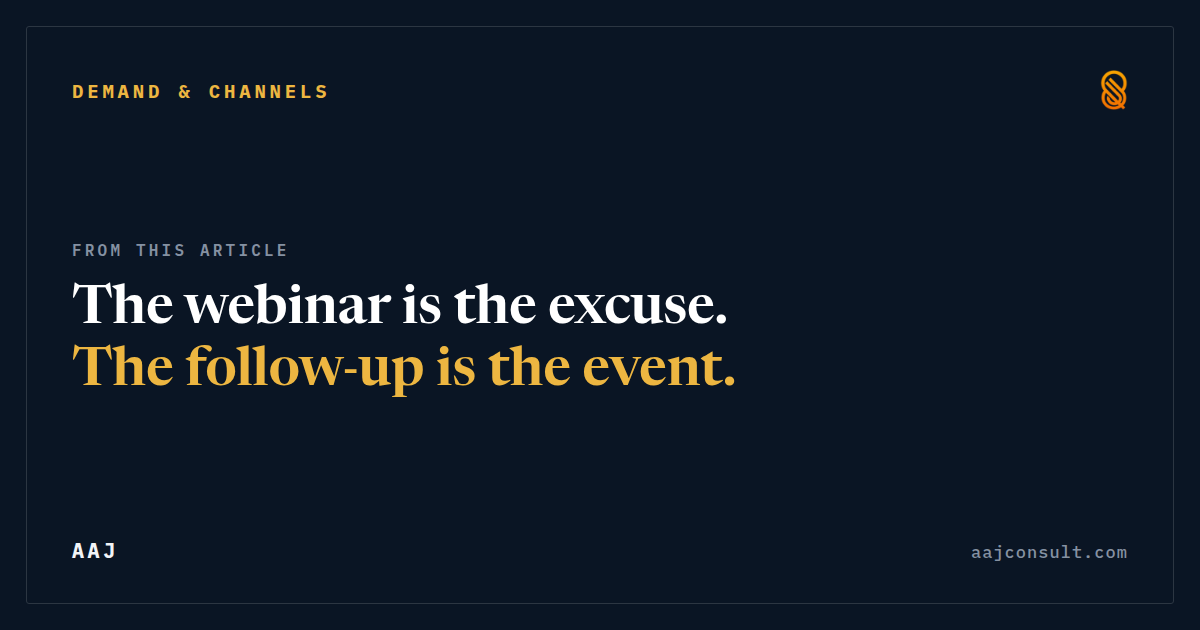
The problem was never the webinar itself. It was treating the hour on screen as the goal, when the hour is only the excuse to start a conversation.
Short answer: a webinar creates pipeline when it answers one problem your buyer already has, for an audience you've chosen on purpose, and when the follow-up is planned before the invitations go out. Judge it on the conversations it starts, not on how many people registered.
Why most startup webinars disappoint
They're built backwards. The team picks a date, then a topic, then a guest, then promotes it to everyone. Registrations become the goal because they're the first number anyone sees.
But registrations measure the invitation, not the session. A large list of people who half-remember signing up tells you the title was appealing. It says nothing about whether anyone will buy.
Decide the job before the topic
Every webinar should do one of three jobs:
- Start conversations with new buyers. The audience is people who don't know you yet, often reached through a partner.
- Move open deals forward. The audience is prospects already talking to you, and the session answers their last objections.
- Help existing customers get more value. The audience is customers, and the aim is adoption and expansion.
Each job needs a different audience, topic and follow-up. A session that tries to do all three does none of them well.
Pick a problem, not a theme
"The future of B2B marketing" is a theme. "How to decide which channel to cut when budget shrinks" is a problem. Buyers make time for problems they have this quarter.
The best topics come from sales calls. Look for the question prospects ask most often, or the objection that stalls deals. If it comes up in conversation, it will fill a room.
Keep the format simple
One problem, one framework and time for questions. I aim for about thirty minutes of content and the rest for questions.
- Open with the problem in the audience's own words.
- Walk through how you'd solve it, with a real worked example.
- Show the tool, template or checklist they can use afterwards.
- Leave the questions open, and answer them properly.
Sell once, at the end, and say plainly what the next step is. People can tell the difference between teaching and a disguised demo.
Promote to the right people, not the most people
A smaller audience of the right buyers beats a large list of the wrong ones. Personal invitations from your team to the accounts you want work better than broad announcements.
A partner who serves the same buyer can double your reach, as long as you agree in advance who follows up with whom. I cover how to set that up in the Partner Co-Marketing Playbook.
The follow-up is the real event
Plan the follow-up before you send the first invitation. Within a day, send everyone the recording and the tool you showed. Then split the list:
- People who asked a question. Reply personally, referring to what they asked.
- People who attended. Offer the next useful thing, such as a short assessment or a template.
- People who registered but didn't come. Send the recording with a short summary of the key point.
A webinar with fifty of the right attendees and a planned follow-up will usually beat one with five hundred and a generic "thanks for joining" email.
How to judge it
Use your own numbers. I track three things:
- Conversations started in the two weeks after the session.
- The share of attendees who match your ideal customer.
- Questions asked live, because they show what the market wants to know next.
If the room was full and the conversations didn't follow, the topic attracted the wrong people or the follow-up asked for too much, too soon.
Sources & further reading
This article describes AAJ's own method and contains no external statistics.
- Partner Co-Marketing Playbook — AAJ. Running a joint webinar with a partner.
- Earned Media Playbook — AAJ. Turning a strong session into coverage.
- Dark Social: Where B2B Demand Actually Happens Now — AAJ. Why the follow-up often happens where you can't see it.
More in PR, Partnerships & Events
Part of the PR, Partnerships & Events hub - see all 4 resources on this topic.
- Playbook: Earned Media Playbook
- Article: How to pitch a journalist when nobody has heard of your startup
- Playbook: Partner Co-Marketing Playbook
- Free tool: Webinar Pipeline Planner
Also useful in Go-to-Market & Growth Planning, Sales & Pipeline.