Product Launch Checklist for Startups: 15 Things Teams Forget
By Saroj Jha · May 8, 2026 · 18 min read
Most startups don't fail their launch because of a bad idea or weak tech. They fail because the go-to-market details are fuzzy: who it's for, how it's priced, how it's supported, and what happens after launch week.

- 1Positioning
- 2Readiness
- 3Launch
- 4Follow-through
launch week is the third phase, not the whole plan
Four phases of readiness
They over-invest in the announcement, under-invest in onboarding.
Use this product launch checklist for startups as a practical guide. Assign an owner and a due date to each item before you launch.
- 15Launch essentials
- 4Phases of readiness
- 6–8Weeks to plan
- 30/60/90Day success windows
What's inside
01Define clear, testable positioning02Design onboarding for a fast "aha"03Make pricing and packaging obvious04Get ready for the support spike05Cover legal, privacy, compliance basics06Build a repeatable demo story07Capture early customer proof08Create a realistic conversion model09Set up measurement before you launch10Test infrastructure and limits11Be honest about "core" vs "coming soon"12Share an internal FAQ with the team13Plan post‑launch nurture14Adapt assets to each launch channel15Write a "what if it goes sideways?" planFoundations: Get the story straight
1Define Clear, Testable Positioning
Most teams have a tagline; few have positioning that actually lands. If your team can't say it out loud — consistently — your marketing and sales will feel scattered. For a deeper framework, see the Foundations Playbook.
Your one‑sentence positioning answers:
- ForWho is this for? (specific role, industry and company size)
- WhoWhat situation or pain are they in?
- Our product is aWhat category are you in?
- ThatWhat is the primary outcome or benefit?
- UnlikeWhat are they doing today (competitor or workaround)?
- WeWhat makes you different?
- Write a one‑sentence positioning statement
- Validate it in 5–10 prospect conversations
- Align homepage, sales deck, and demo around it
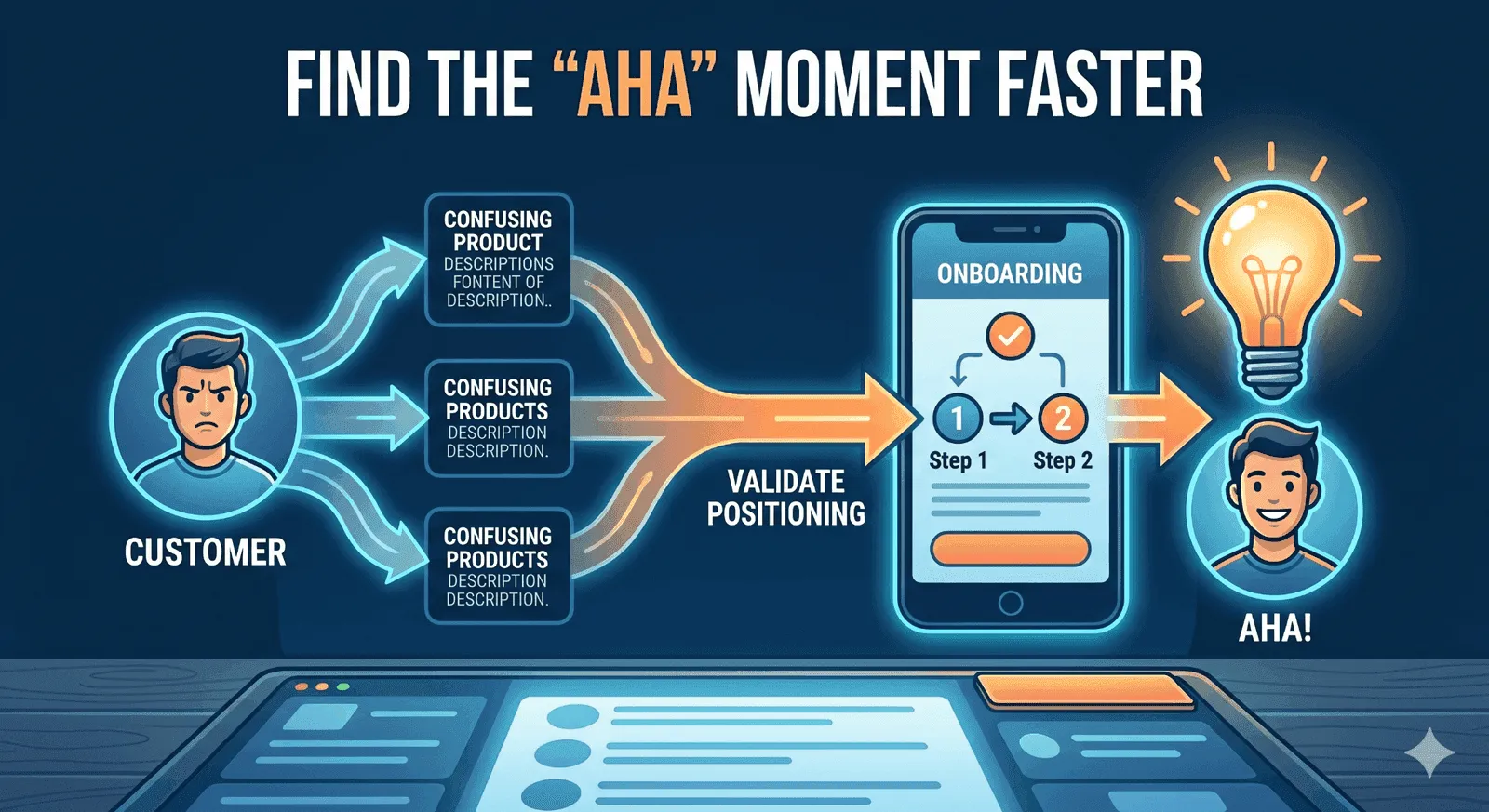
Design Onboarding for a Fast "Aha" Moment
Launch traffic is valuable. Confusing onboarding wastes it. Watch real users sign up and note where they hesitate or get stuck — fix those friction points before launch. Our Customer Onboarding & Retention Playbook walks through this in detail.
Ask: what should a new user accomplish in the first 5 minutes? How quickly can they feel core value? What can you pre‑configure so they don't start from a blank screen?
Action checklist- Strip non‑essential sign‑up fields
- Add starter templates or demo data
- Create a short in‑product guide to one key workflow
- Send a first email pointing to the next best step — not a feature list
Make Pricing and Packaging Obvious
"We'll figure out pricing later" is one of the most expensive launch mistakes. If pricing is vague or hidden, prospective customers pause or walk away. See the pricing mistakes that quietly kill startup growth for common traps to avoid.
You don't need perfect pricing. You need a public offer people can understand in under a minute.
Action checklist- Publish a pricing page with 2–4 plans (or a clear "Contact sales" path)
- Define what each plan includes and excludes
- Decide who can approve discounts — and up to what amount
- Test understanding with people outside your team
Get Ready for the Support Spike
A launch means questions, edge cases, and bugs. "We'll all watch the inbox" is not a plan. A calm, fast response builds more trust than a perfectly polished website.
Decide: who owns each channel (email, chat, social, helpdesk), when you'll respond, and how you'll handle setup questions, feature gaps, and known limitations.
Action checklist- Assign owners to each support channel by name
- Define launch‑week response time targets
- Prepare canned responses for the top 10 likely questions
- Decide which problems trigger immediate hotfixes
Cover Legal, Privacy, and Compliance Basics
B2B customers will ask about terms, privacy, and security earlier than you think. If you can't answer the basics, some teams simply can't buy from you — no matter how good the product is.
You don't need full enterprise compliance on day one — but you do need clarity on where data is stored, which vendors you use, and how long you retain it.
Action checklist- Review ToS and Privacy Policy with a startup‑savvy lawyer (or solid templates)
- Publish a short "Security & Privacy" page in plain language
- Create a one‑pager FAQ for sales and support
Story & proof: Make it easy to say yes
6Build a Repeatable Demo Story
Knowing your product is not the same as knowing how to show it. The goal is not to show everything — it's to help your ideal customer quickly see why this matters to them. If your landing page is the "demo before the demo," our guide on why landing pages convert at 1% is a great companion read.
Your demo narrative: customer's problem → "before" picture → 2–3 core flows that fix it → pricing, ROI, and clear next steps.
Action checklist- Write a 10–15 minute demo script
- Create a 5–10 slide deck aligned with your positioning
- Record a 2–4 minute self‑serve demo video and embed it on your site
- Train founders and sales on the same story arc
Capture Early Customer Proof
Founders often wait for big logos or full case studies. You don't need that to launch. Even small, credible wins help prospects feel safer trying something new.
Line up beta or design‑partner customers willing to share a name, logo, and a one‑sentence quote.
Action checklist- Identify 3–5 early customers to feature
- Ask explicitly for logo use and a one‑sentence quote
- Write 2–3 short "before/after" blurbs and add them to your site
- Share previews so they feel good about how they're presented
Be Honest About "Core" vs "Coming Soon"
Nothing frustrates early customers more than feeling misled about what's ready. You can be ambitious without over‑promising.
Draw clear lines:
- CoreProduction‑ready and fully supported
- BetaAvailable, but with known caveats
- Near‑term roadmapRealistic next 1–3 months
- Out of scopeWhat you're explicitly not doing right now
- List features under each bucket
- Make sure marketing copy reflects current reality
- Prepare a simple "What's next" page
- Train sales and support to talk honestly about gaps
Share an Internal FAQ With the Whole Team
If your own team can't answer basic questions clearly, prospects will feel it. Consistency builds trust, especially in early calls.
Cover: who it's for (and not for), the problems you solve best, top objections, refund/cancellation policy, and known limitations.
Action checklist- Write a 2–3 page FAQ in simple language
- Pin it in your internal tools and walk the team through it
- Review it together a few days before launch
- Update it after the first week based on real questions
Measurement & resilience: Don't fly blind
10Create a Realistic Traffic and Conversion Model
"Hoping for a big launch" is not a strategy. A simple model makes your assumptions explicit so you can learn from them.
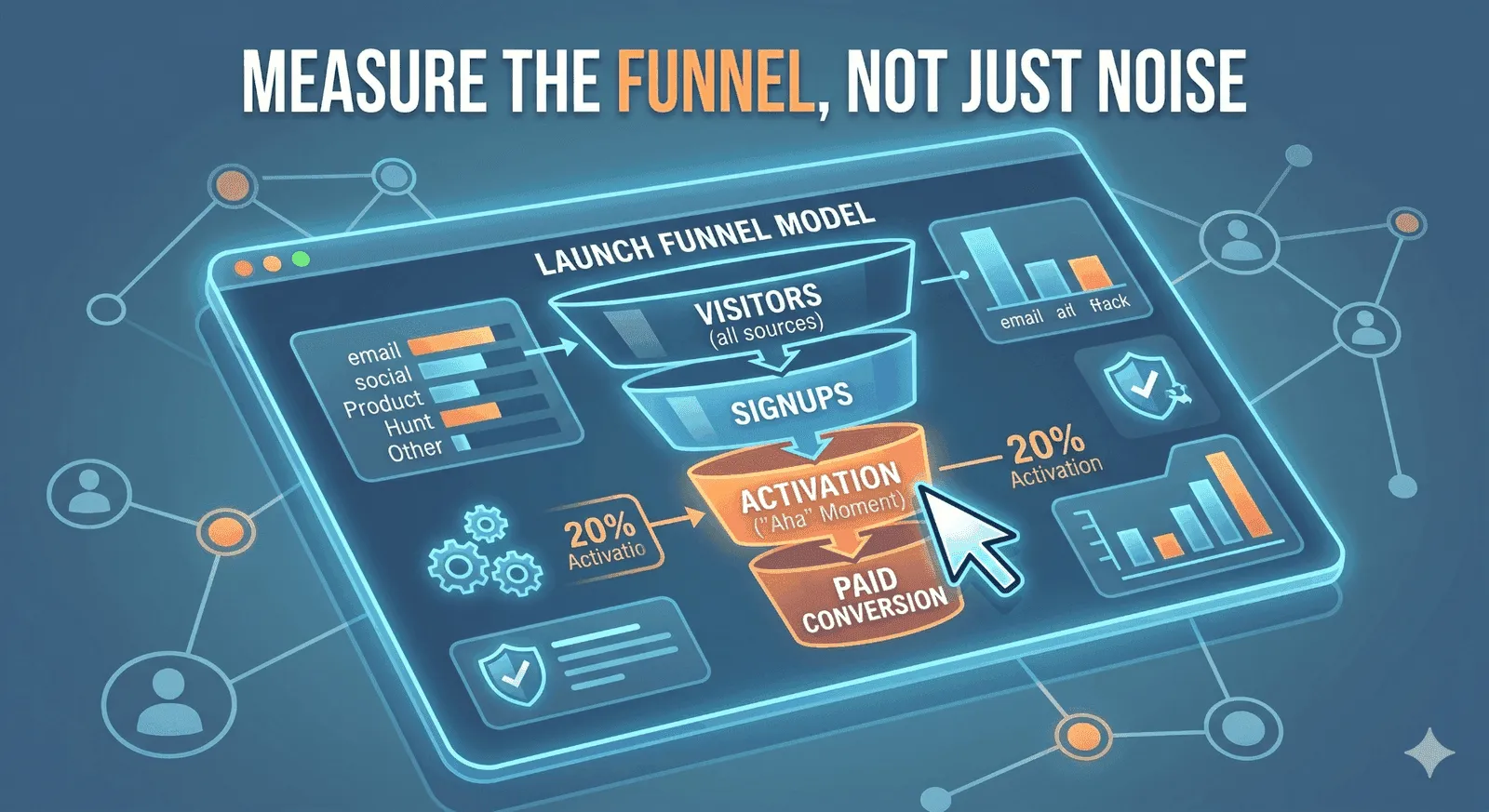
Map: where will visitors come from, how many you expect from each channel, and what % will sign up → activate → convert to paid in 30–60 days.
Action checklist- Build a one‑page spreadsheet for your launch funnel
- Review numbers as a team and challenge assumptions
- Decide which metrics define success at launch and at 30/60/90 days
Set Up Measurement Before You Launch
You only get one "first launch cohort." Don't waste the data. Our Analytics & Attribution Playbook and complete marketing analytics guide cover the setup end-to-end.
At minimum, track:
- AcquisitionWhere signups came from
- ActivationWho reached the "aha" — and how quickly
- EngagementWho completed core workflows and returned
- RevenueWho converted to paid, from which channel
- Install GA4 or a product analytics tool
- Track sign‑ups, key actions, and upgrades as events
- Tag or segment "Launch Week" users
- Build a basic dashboard with your top 3 product and top 3 marketing metrics
Test Infrastructure and Limits
Nothing kills launch momentum like outages and 500 errors. Plan for graceful degradation, not complete failure.
Know what happens if traffic spikes, if one user pushes the system hard, and where your bottlenecks are: database, third‑party APIs, background jobs.
Action checklist- Run a basic load test that simulates launch traffic
- Check and respect rate limits on external services
- Implement sensible limits for heavy operations
- Decide what to temporarily disable if needed (non‑critical features, heavy jobs)
Launch & beyond: Convert attention into customers
13Plan Post‑Launch Nurture (Not Just Launch Day)
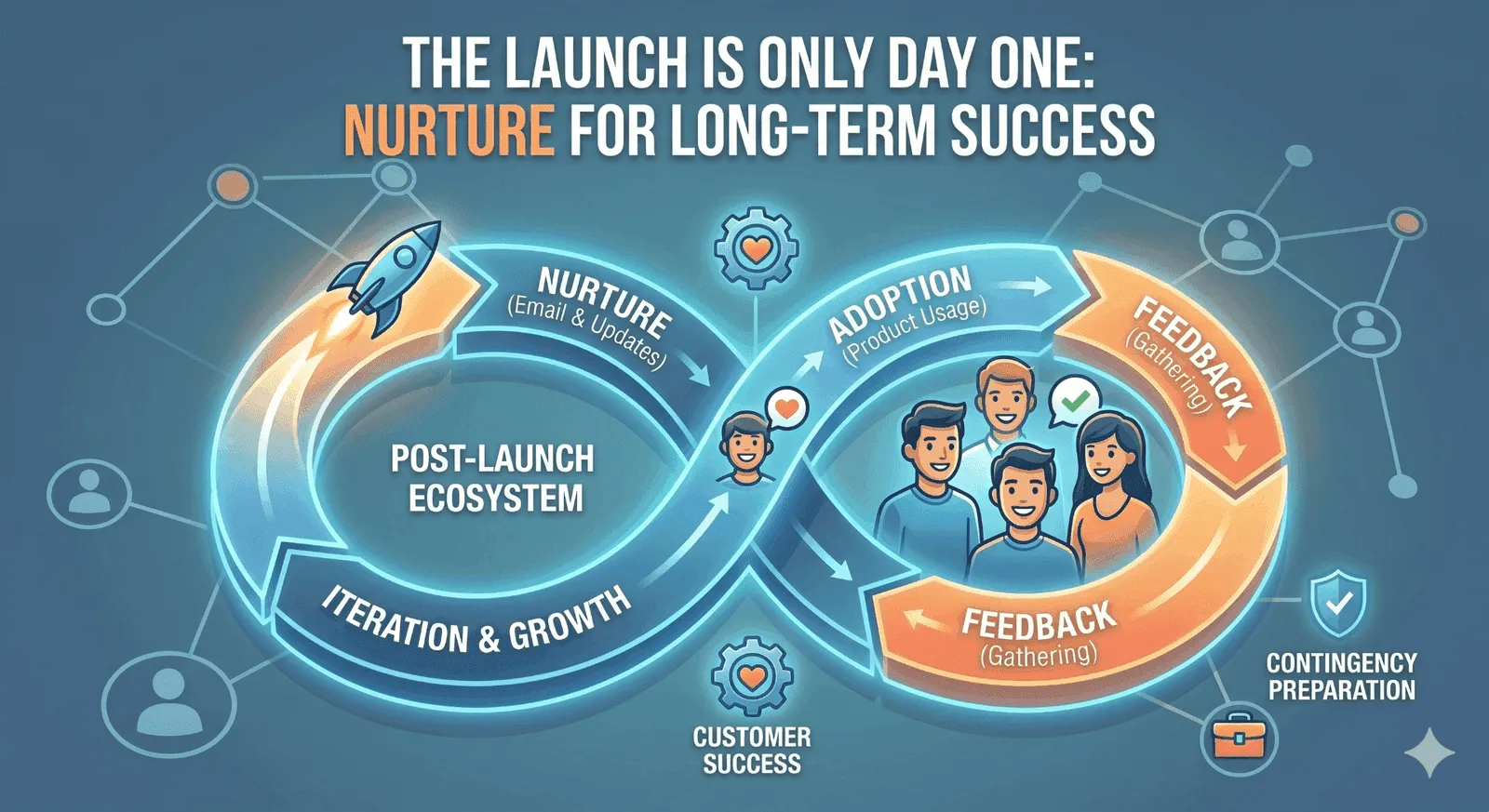
A launch is not a one‑day event. It's the start of a learning and conversion cycle. Without a plan, most launch signups end up as "that tool I tried once." Pair this with a demand creation strategy so attention keeps compounding after launch week.
Think through: how you'll engage new signups, re‑engage the ones who never activated, and support early paying customers so they succeed.
Action checklist- Build sequence: sign‑up → activation
- Build sequence: activation → first value → paid
- Plan a "two weeks after launch" update with what you've already shipped
- Decide where you'll publish ongoing product updates
Adapt Assets to Each Launch Channel
Copy‑and‑pasting one generic message everywhere lowers impact. Keep the core message consistent, but adjust how you tell it. See our omnichannel marketing strategy for how to align channels without diluting the story.
Each channel has its own culture:
- WebsiteClear hero, crisp subhead, one primary CTA
- Product HuntStrong tagline, short benefits, founder story
- SocialShort, personal posts; visuals; who it's for and why now
- EmailOne focused story, one main CTA — not a packed newsletter
- Write channel‑specific headlines and short descriptions
- Create images and short videos sized for each platform
- Prepare founder posts in their own voice — not just brand posts
- Line up partners and communities to share your launch
Write a "What If It Goes Sideways?" Plan
Launches are emotional. A simple contingency plan keeps you grounded — and makes you look calm and competent under pressure.
Pre‑decide responses for:
- Low trafficWho can help amplify? What backup activities can you run?
- Bugs appearWhich features can you safely disable? How will you communicate timelines?
- Harsh feedbackHow will you gather and synthesize it? Who replies, in what tone?
- Write a one‑page "worst‑case" document with concrete actions
- Decide who has final say on urgent trade‑offs (e.g., pausing sign‑ups)
- Prepare short messages to acknowledge issues publicly
The 15‑item launch checklist, at a glance
Print it, share it with your team, and assign an owner to each row.
- 01Positioning defined, written, and tested
- 02Onboarding tuned to a fast "aha" moment
- 03Pricing and packaging simple and public
- 04Support plan and response times set for launch week
- 05Legal, privacy, and basic security documentation in place
- 06Standard demo story, deck, and video created
- 07Early customers lined up with quotes and logos
- 08Traffic and conversion model built and reviewed
- 09Analytics and key events implemented; launch cohort tagged
- 10Infrastructure and limits tested; graceful fallbacks ready
- 11"Core vs coming soon" clearly defined and communicated
- 12Internal FAQ shared with the whole team
- 13Post‑launch nurture emails and updates planned
- 14Channel‑specific copy and creative prepared
- 15Contingency plan written for low traffic, bugs, and tough feedback
A strong launch is less about the size of the announcement and more about how ready you are when attention finally arrives. Handle these 15 often‑forgotten items well, and you dramatically increase the odds that your next product launch turns interest into long‑term customers.
Frequently asked questions
- What should a startup focus on before a product launch? — Focus on clear positioning, a fast and simple onboarding flow, understandable pricing, a launch‑week support plan, and basic legal/privacy readiness. These create the foundation for every other launch activity to work.
- How early should I start planning a product launch? — For most startups, 6–8 weeks is ideal. You can compress to 2–4 weeks if you're experienced and running a smaller beta launch — but onboarding, pricing, analytics, and support should never be last‑minute.
- How do I measure whether my product launch was successful? — Track signups from launch channels, activation rate (how many reached a meaningful action), trial‑to‑paid conversion in the first 30–60 days, feedback quality, and retention and engagement of the launch cohort over time.
- What is the most common mistake startups make when launching? — They over‑invest in the announcement and under‑invest in onboarding and follow‑up. People hear about the product, try it once, hit friction, and never come back.
- How can early‑stage startups launch without a big marketing team? — Start small but structured: clarify who it's for, tighten onboarding, publish simple pricing, prepare a solid demo, and personally reach out to your best potential early adopters. A smaller, well‑run launch often outperforms a noisy, unprepared one.
Related resources from AAJ
Product Launch Playbook (B2B) →Structured pre‑launch, launch‑day and post‑launch framework.Product Launch Playbook (B2C) →Hype building, influencers and launch‑day activation for consumer brands.Foundations Playbook →Positioning, messaging and channel strategy in a 60–90 day GTM sprint.Customer Onboarding & Retention →Reduce churn and accelerate the path to your product's 'aha' moment.Analytics & Attribution Playbook →Measurement frameworks, events and dashboards that survive launch week.Demand Gen & Performance Marketing →Scalable acquisition systems for the months after launch.Pricing mistakes that kill startup growth →Common packaging traps that quietly suppress conversion.Why your landing page converts at 1% →A 7‑day plan to move from ~1% to 3–5% conversion.Modern marketing tech stack for startups →Stage‑by‑stage tool selection from pre‑seed to Series A+.Demand creation strategy for B2B →Turn launch attention into a repeatable demand engine.Plan a launch that converts attention into customers
Share your product, target market, and rough launch date. On a 30‑minute call with Aaj, we'll turn this checklist into a concrete plan with the next 3–5 highest‑leverage moves for your team.
Sources & Further Reading
The insights in this article draw on research and thinking from these reputable sources:
Y Combinator — Launch Guides for Startups
Founder-focused playbooks on launching products, including positioning, beta programs, and post-launch follow-up.
https://www.ycombinator.com/library →
First Round Review — Product Launch Playbooks
In-depth essays from operators on running effective product launches, onboarding, and early customer development.
https://review.firstround.com/ →
Product Hunt — Launch Guide
Practical guidance on preparing and running a launch on Product Hunt, including assets, scheduling, and community engagement.
https://www.producthunt.com/launch →
Reforge — Growth & Onboarding Essays
Strategic guidance on activation, onboarding, and converting early traffic into long-term users.
https://www.reforge.com/blog →
Lenny's Newsletter — Launch & GTM
Practical, founder-tested advice on launches, positioning, pricing experiments, and early traction strategies.
https://www.lennysnewsletter.com/ →
HubSpot — Product Launch Strategy Guide
Step-by-step guidance on building a launch plan, from internal alignment through external announcement and follow-up.
https://blog.hubspot.com/marketing/product-launch-checklist →
More in Go-to-Market & Growth Planning
Part of the Go-to-Market & Growth Planning hub - see all 14 resources on this topic.
- Playbook: Product Launch Playbook
- Template: The Launch Plan Checklist
- Playbook: 90-Day Growth Playbook
- AI agent skill: Campaign Orchestrator