Stop chasing the click: how startups can win with zero-click marketing
By Saroj Jha · August 14, 2026 · 14 min read
Zero-click marketing is a content strategy that delivers the main value of an article, video or framework directly on the platform where the audience discovers it. For startups it builds awareness, trust and demand without requiring every user to click through.

Where the clicks went
374 / 1,000
US Google searches that reach the open web
Content's value no longer equals the traffic it sends you.
For years, startup marketing followed a familiar formula: publish content, attract visitors, generate clicks, convert visitors into leads. That formula still works in some situations. It is no longer sufficient.
People discover brands, evaluate expertise, and form opinions without leaving the platform they are using. A potential customer may learn from a LinkedIn post, watch a demonstration on YouTube, save an Instagram carousel, ask ChatGPT for recommendations, or read a search-generated summary — without ever visiting the company's website.
The consequence is uncomfortable but clarifying: the value of content is no longer determined only by the traffic it sends to your website.
Key takeaways
- Zero-click marketing is not anti-website or anti-SEO. It is anti-dependency on the click.
- Platforms reward content consumed natively; search results and AI answers increasingly resolve questions in place.
- Judge content against its objective: reach, attention, utility, authority, demand, revenue — not sessions alone.
- One article can become five native assets without diluting the idea.
- Borrow attention from platforms, then earn permission to build an owned relationship.
What is zero-click marketing?
Zero-click marketing is a strategy in which the audience can consume the main value of a piece of content without leaving the platform. Examples include:
- A complete marketing framework in a LinkedIn document post
- A short product tutorial on YouTube or Instagram
- A detailed answer inside a Reddit discussion
- A practical checklist in an email newsletter
- A founder's insight shared as a native social post
- A Google Business Profile update answering a common customer question
- A useful response generated by an AI search or recommendation system
The objective is not necessarily to eliminate clicks. It is to stop treating the click as the only meaningful outcome. A zero-click post succeeds when it teaches something useful, demonstrates expertise, creates recognition and trust, generates real discussion, causes people to remember or recommend the brand, and leads to a future search, visit, inquiry, or purchase.
The click may happen later — or not at all. The immediate purpose is to create value and strengthen the relationship.
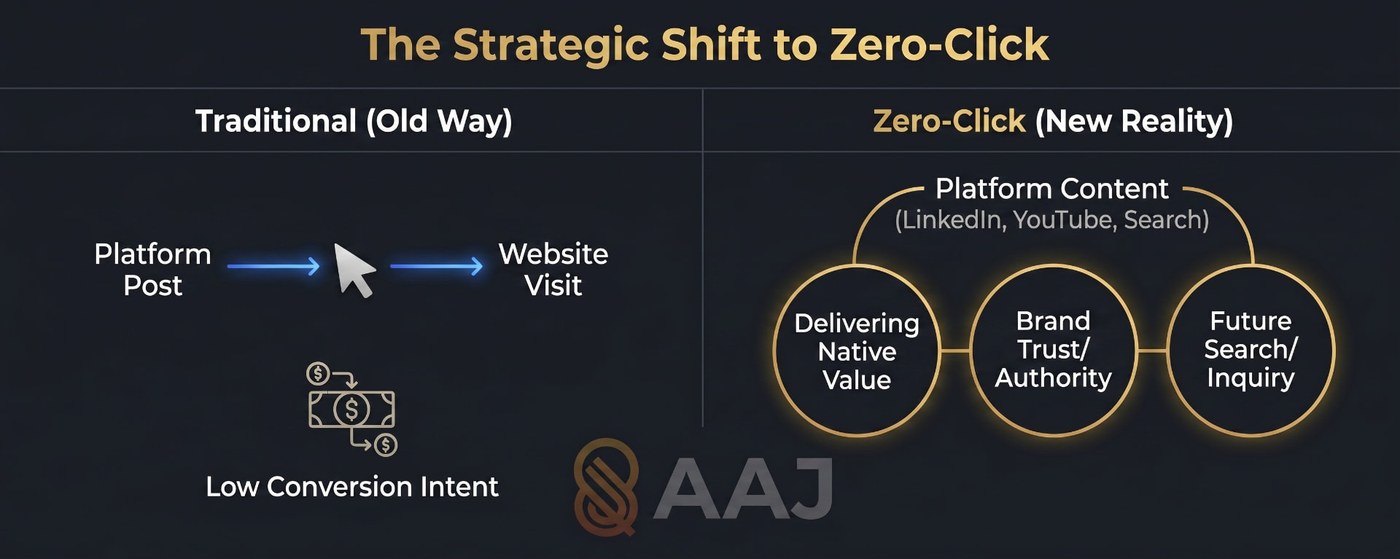
Why is click-focused marketing becoming less effective?
1. Platforms want users to stay on the platform
Social networks make money when users remain active inside their environments, so they generally favour content that encourages reading, watching, commenting, saving, sharing, messaging, following, and continuing the session. A post that immediately sends users away may receive less distribution than one that keeps them engaged natively.
This does not mean every external link is suppressed. Platform performance depends on content quality, audience behaviour, relevance, account history, and engagement. But a short caption followed by a website link is not a distribution strategy.
2. Search results increasingly answer questions directly
Most searches now end without a click: SparkToro's 2024 Zero-Click Search Study found that of every 1,000 US Google searches, only 374 clicks reach the open web (360 in the EU).
Users often find what they need through featured snippets, knowledge panels, local packs, product results, "people also ask" sections, video previews, and AI-generated overviews. Research from SparkToro and Datos has repeatedly highlighted the growth of zero-click searches — searches that end on the results page. The exact percentage varies by device, query type, market, and methodology, but the direction is clear: search visibility and website traffic are no longer the same thing.
3. Audiences are overwhelmed by low-value content
"Ten tips for better marketing." "The ultimate guide to social media." The problem is not the topics; it is that many articles are generic, repetitive, and produced primarily to capture search traffic. Readers have become good at spotting content written to rank. They want specific examples, original observations, practical methods, honest limitations, data, and a clear point of view.
4. Customer journeys are not linear
A prospect may see a social post, search for the founder, watch a video, read reviews, ask peers, encounter the brand again weeks later, return through a branded search, and then get in touch. The first impression rarely produces a measurable click, but it shapes later behaviour — which makes it dangerous to judge every activity by last-click performance. The same problem, measured properly, is covered in dark social and B2B demand generation.
What does existing research tell us?
Several strands of marketing research support the move toward zero-click strategies.
Search behaviour is becoming more self-contained
Studies by SparkToro, Similarweb, Datos, and other search analysts have examined the proportion of searches that do not result in an external click. Although estimates differ, they generally show that many searches end within the search environment itself.
That pattern is most pronounced for the queries a results page can satisfy on its own: definitions and simple factual questions, weather and sports, local business information, product comparisons, "how to" instructions, and navigational or transactional searches where the user already knows what they want.
For marketers, this means ranking is no longer only about receiving a visit. A result that is seen but never clicked still builds brand recognition and perceived expertise, places the company inside a consideration set, seeds future branded searches, and contributes trust that is drawn on during an eventual buying decision.
Social media reach is influenced by native engagement
Platform research and creator-economy analysis consistently show that content performance is shaped by engagement signals rather than outbound clicks: watch time and completion rate, comments, shares and saves, replies, profile visits, and repeat consumption of the same creator's work. None of those signals are website sessions, which is precisely the point — a post can be strategically valuable even when it generates no immediate referral traffic.
For instance, a founder's post may receive 20,000 impressions, 300 saves, and several high-quality comments but only 20 website visits. If those saves increase future recognition among the right audience, the post may have performed better than a link post producing 100 low-intent visits.
Brand effects are often delayed
Marketing effectiveness research has long distinguished between short-term activation and long-term brand building. Short-term campaigns generate measurable responses such as clicks and form submissions. Brand activity works more slowly but leaves more durable effects: awareness, mental availability, trust, preference, pricing power, and greater conversion efficiency later on.
Zero-click marketing is usually a form of brand building combined with demand creation, so its impact tends to surface downstream rather than in the same reporting week — as direct traffic, branded searches, inbound messages, referral conversations, higher conversion rates, and a lower dependence on paid acquisition.
This is why startups should assess content across multiple time horizons rather than expecting every post to produce an immediate lead.
Does this mean your website stops mattering?
No — and zero-click marketing does not mean "never include a link". This distinction is important.
Zero-click marketing is not anti-website, anti-SEO, or anti-conversion. It is anti-dependency on the click.
A website remains essential for detailed service information, case studies, pricing, and product documentation, and it is still where lead capture, scheduling, and e-commerce actually happen. It also carries the legal and trust information buyers look for, holds the search visibility a company owns outright, and is the only surface where first-party data can be collected.
The strategic change is that the social post, video, or community answer should stand on its own rather than functioning as a teaser. A zero-click version might say:
Most retention problems are not caused by poor customer service.
They are caused by a weak "second-use" experience.

Ask these three questions:
1. What must the customer do after the first purchase?
2. How quickly do they experience the product's core value?
3. What reminder helps them return before the problem becomes urgent?

If customers do not have a reason to return, discounts will only delay churn.
The article link can still be provided, but the user has already received a useful insight. We also covered customer retention and the difference between NRR and GRR in a separate article.
Which native formats work on which platform?
The same underlying idea can be reused everywhere, but its presentation should be native to the platform.
| Platform | Effective native formats |
|---|---|
| Frameworks, document posts, founder perspectives, professional case studies | |
| Carousels, short video, visual checklists, before-and-after examples | |
| TikTok | Demonstrations, explanations, customer problems, behind-the-scenes |
| YouTube | Tutorials, comparisons, product walkthroughs, interviews |
| Detailed answers, transparent experiences, technical explanations | |
| X | Concise arguments, threads, observations, real-time commentary |
| Curated insights, analysis, recommendations, practical guidance |
What are the five principles of zero-click marketing?
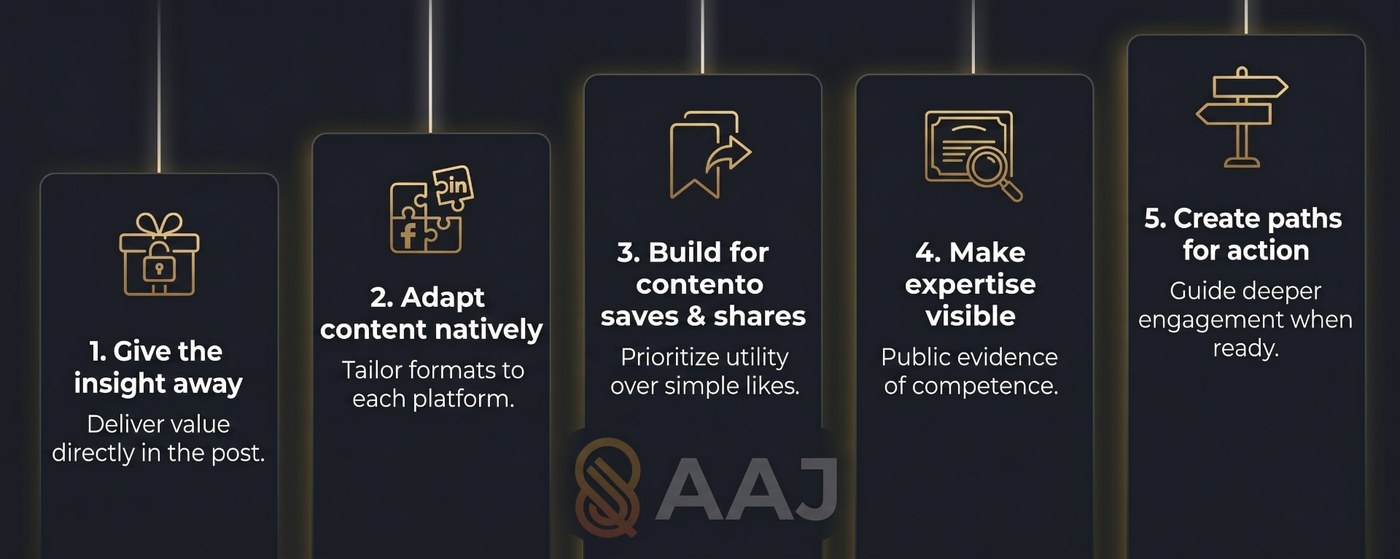
Principle 1: Give the insight away
Do not hide the central idea behind a link. A useful post answers at least one question: what should the audience do, what mistake should they avoid, what should they measure, what decision should they reconsider, or what process can they apply immediately? A good test — if the link disappeared, would the post still be worth reading? If not, the content is too dependent on the click.
Principle 2: Adapt the content to the platform
Do not paste the same article introduction onto every channel. Consumption patterns differ, and the format carries as much weight as the argument. Use the table above as the default mapping.
Principle 3: Build for saves and shares, not only likes
Likes are easy to generate and weak as a business signal. Saves and shares indicate utility. Checklists, templates, decision trees, frameworks, definitions, examples, and troubleshooting steps get saved. Strong opinions, surprising data, relatable problems, and advice that helps a colleague get shared. Ask: is this useful enough for someone to keep, or to send to another person?
Principle 4: Make expertise visible
Zero-click marketing converts expertise into public evidence. Instead of "we help startups improve their marketing," publish "three positioning mistakes we see in early-stage SaaS companies," or "how we decide whether a startup is ready to invest in paid acquisition." The more specific the content, the easier it is for the right audience to recognise competence.
Principle 5: Create a path for deeper action
A zero-click post should be complete and can still offer a next step: follow for more, comment with your experience, save this checklist, message us for the template, join the newsletter, watch the demonstration, explore the case study. Match the ask to intent — inviting a cold audience to book a sales call creates friction where "save this" would not.
How do you write a zero-click post?
- Start with a specific problem. Not "marketing is important for every business," but "your startup does not have a traffic problem — it has a message problem if visitors cannot explain what you do after reading your homepage."
- Challenge a common assumption. More traffic will not fix unclear positioning. A larger audience is not always a better audience. More content is not more authority.
- Provide a usable framework. For example, evaluate a channel with four questions: does it reach the right audience, can you publish there consistently, can performance be measured beyond clicks, and does it suit your buying cycle?
- Add evidence or an example. A customer pattern, an anonymised result, a before-and-after, a short experiment, a credible quotation. Do not invent statistics; if a claim cannot be supported, present it as an observation.
- End with a low-friction action. "Review your last ten social posts. How many delivered the main insight directly, and how many simply asked people to click?"
How do you turn one blog article into zero-click content?
Suppose a startup publishes "How to build a go-to-market strategy." That article becomes several native assets — content atomisation, in practice.
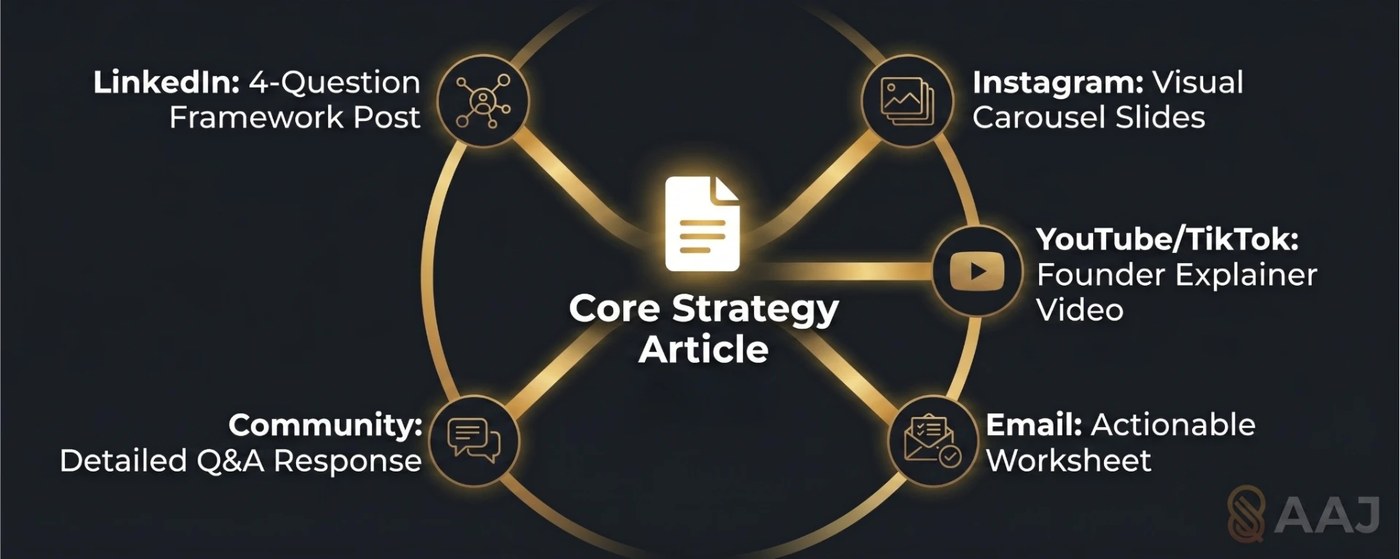
- LinkedIn post. Core idea: a go-to-market strategy is not a channel plan. It answers who has the problem, why it is urgent now, why they will trust your solution, and what the easiest way to start is. "Should we use LinkedIn ads or Google Ads?" is a channel question, not a strategy question.
- Carousel. Five slides: the four questions, common mistakes, a weak target market, a stronger target market, and a validation exercise.
- Short video. The founder: "before spending on acquisition, ask whether your customer can describe your product in one sentence."
- Email. A worksheet that helps readers answer the four questions.
- Community answer. The complete framework as a reply, without immediately directing readers to the website.
The original article still exists as the deeper resource; the idea now travels across several discovery environments. If you want the operational version of this, AAJ's content calendar and repurposing tracker is the planning surface for it.
How do you measure zero-click marketing?
Measurement is the hard part. Analytics platforms are optimised for trackable events; zero-click influence is distributed across channels and delayed in time. Use a broader framework with five layers.
- Distribution. Impressions, reach, video views, unique viewers, follower growth, search impressions, mentions, share of voice.
- Attention. Average watch time, completion rate, time spent, document-post views, carousel progression, repeat views.
- Value. Saves, shares, high-quality comments, replies from target customers, direct messages, newsletter subscriptions, template requests, citations.
- Authority. Backlinks, brand mentions, earned media, speaking invitations, partnership inquiries, branded search growth, returning visitors.
- Commercial. Influenced leads, assisted conversions, direct inquiries, branded traffic, conversion rate of returning visitors, CAC, sales-cycle length, lead quality, influenced revenue.
One question on the lead form does more work than most dashboards: how did you first hear about us? — with options for LinkedIn, YouTube, search, recommendation, podcast, newsletter, event, and other. It will not give perfect attribution. It will reveal influence analytics cannot see.
A simple zero-click reporting model
You do not need a complex attribution system. A six-row monthly dashboard is enough to find patterns instead of assigning false precision.
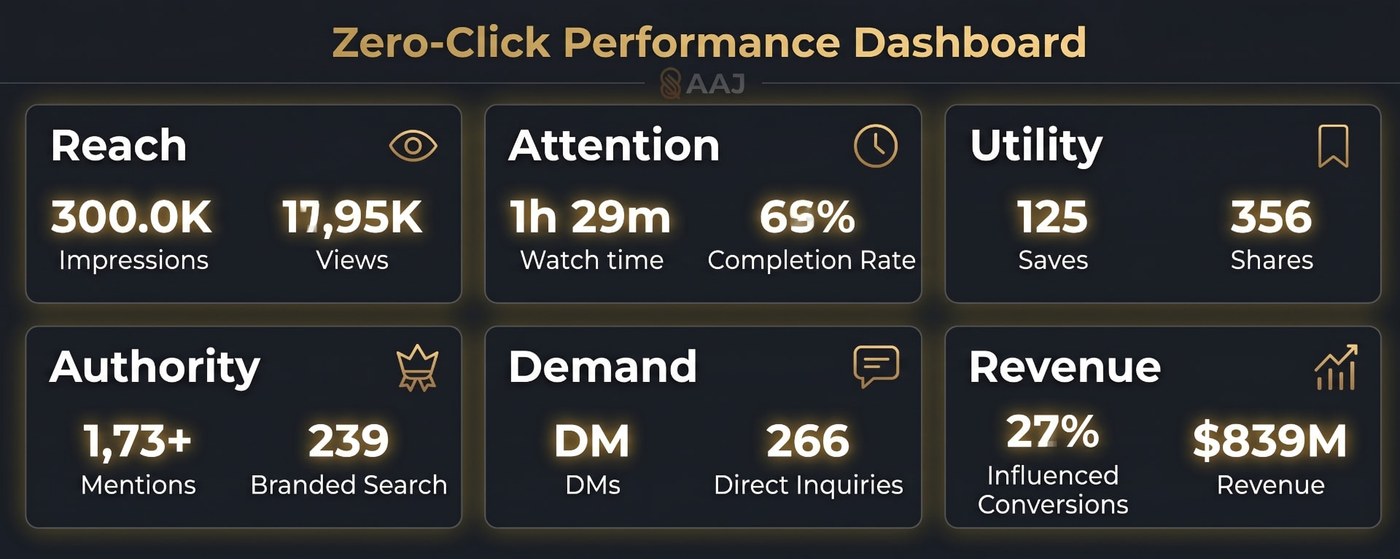
| Category | Example measures |
|---|---|
| Reach | Impressions, unique viewers, follower growth |
| Attention | Watch time, completion rate, average reading time |
| Utility | Saves, shares, meaningful comments |
| Authority | Mentions, invitations, branded searches |
| Demand | Direct messages, inquiries, content-assisted leads |
| Revenue | Opportunities, conversions, influenced revenue |
Patterns emerge quickly: practical frameworks generate saves, founder opinions generate comments and profile visits, customer examples generate direct inquiries, short video generates reach, and detailed case studies assist late-stage conversions. That is what should guide the content mix. The broader question of which numbers to trust is covered in how do I know if marketing is working?
What are the common mistakes?
- Treating zero-click content as a teaser. "We explained this in detail in our article, click here" is not zero-click content. "Here is the most important part of the explanation" is.
- Removing every call to action. The point is not to eliminate conversion opportunities, only to keep the ask proportionate.
- Chasing vanity engagement. Ten comments from relevant decision-makers can be worth more than 10,000 impressions from people who will never buy.
- Publishing generic advice. Zero-click content competes directly for attention; generic content gives nobody a reason to stop, save, or remember you.
- Assuming platform tactics are permanent. Algorithms change. The durable principles — be useful, clear, credible, consistent — do not.
- Neglecting owned channels. Borrow attention from platforms, then earn permission to build a lasting relationship through email, community, documentation, and original research.
A 30-day zero-click experiment
You can test this without changing the whole marketing programme.
- Week 1 — audit. Classify the last 20 posts as promotional, educational, opinion, social proof, product, or community. Record whether each carried an external link and how it performed.
- Week 2 — publish natively. Two educational posts, one checklist, one founder opinion, one customer-problem analysis, one short video. The link is not the centre of any of them.
- Week 3 — test the ask. Compare no CTA, "save this," "share with your team," "comment with your experience," "message us for the template," and "follow for more." Measure response quality, not just quantity.
- Week 4 — compare. Reach, attention, saves, shares, meaningful comments, profile visits, direct messages, qualified leads, branded searches.
The aim is not to prove one format always wins. It is to learn which format serves which objective, so a reach-focused video is no longer judged by the same standard as a conversion-focused case study.
What role does AI play in zero-click discovery?
AI adds another layer to the same environment. People use assistants to summarise topics, compare providers, generate recommendations, build shortlists, and find answers without visiting multiple websites. That does not make content irrelevant; it raises the bar on what content has to be: original, clear, citable, well structured, factually reliable, specific, and attached to a recognisable expert or organisation.
Original research, first-hand case studies, proprietary frameworks, transparent experiments, benchmarks, and detailed implementation guides all travel well in this environment. What decides whether an engine names you is covered in what is GEO, and what the evidence says about AI citations and why doesn't ChatGPT recommend my company?
What startups should do now
- Stop treating every social post as an advertisement for a blog article.
- Publish the key insight directly, in the native format.
- Use links selectively for deeper intent, not as a substitute for value.
- Measure saves, shares, attention, conversations, and branded demand.
- Lead with distinctive expertise instead of generic marketing advice.
- Convert platform attention into owned relationships through email, community, and direct conversation.
The old question was: how many people clicked? The better questions are whether the right people saw you, understood what you do, learned something useful, remembered the brand, trusted the expertise, saved or shared the content — and whether the interaction contributed to a future business decision.
The click still matters. It simply should not be the only thing that counts.
Saroj Jha runs AAJ, a marketing consultancy for Seed–Series B startups. If your content is producing reach but no demand, a 30-minute working session will tell you which layer is leaking. Book a strategy call.
Sources & Further Reading
The insights in this article draw on research and thinking from these reputable sources:
SparkToro — The Zero-Click Search Study
Analysis of the share of searches that end without a click to an external website, and how it varies by device and query type.
https://sparktoro.com/blog/2024-zero-click-search-study-for-every-1000-us-google-searches-only-374-clicks-go-to-the-open-web/ →
Datos and SparkToro — Google search behaviour analyses
Clickstream research showing variation in click-through behaviour by device, query type and search intent.
https://datos.live/ →
Similarweb — search and digital market analyses
Research on search-result behaviour, traffic distribution and shifts in how discovery happens online.
https://www.similarweb.com/blog/insights/ai-news/zero-click-searches/ →
Google Search Central — AI features and your website
Google's own documentation on how AI Overviews and AI Mode use your pages, and what controls publishers have.
https://developers.google.com/search/docs/appearance/ai-features →
Google Search Central — Creating helpful, reliable, people-first content
Guidance on structured, original content and search-result features — the qualities that make content extractable.
https://developers.google.com/search/docs/fundamentals/creating-helpful-content →
Ehrenberg-Bass Institute — mental availability research
Work emphasising why being easily noticed and remembered in buying situations matters more than immediate response.
https://www.marketingscience.info/ →
Les Binet and Peter Field, IPA — The Long and the Short of It
Evidence on the balance between short-term activation metrics and delayed brand effects — the core measurement argument here.
https://ipa.co.uk/knowledge/publications-reports/the-long-and-the-short-of-it →
LinkedIn — Creator and content best practices
Platform-level guidance emphasising native formats, dwell time and meaningful engagement over outbound clicks.
https://www.linkedin.com/help/linkedin/answer/a522991 →
AAJ — What is GEO? What the evidence actually says about AI citations
Companion post on how answer engines choose which sources to cite, and what the research does and does not establish.
https://aajconsult.com/blog/what-is-geo-ai-citations →
AAJ — Why doesn't ChatGPT recommend my company?
Companion post on the facts an AI engine needs before it can name you in a recommendation.
https://aajconsult.com/blog/why-doesnt-chatgpt-recommend-my-company →
Part of the AI Search & Agent Readiness hub - see the other 11 resources on this topic.