Paid Media Test Log: Plan Each Test, Read It Once, Keep What You Learn
The Paid Media Test Log helps you write every paid test down before it starts, read it once on the date you set, and see what your budget taught you. It flags tests decided before their read-out date and shows what share of decided budget led to a roll-out.
 Saroj Jha October 11, 2026 6 min read Share
Free. No spam — just the template (and the occasional growth playbook). Unsubscribe anytime.
See the worked exampleExcel .xlsx, opens in Google Sheets · No macros · Free · Pre-seed to Series B
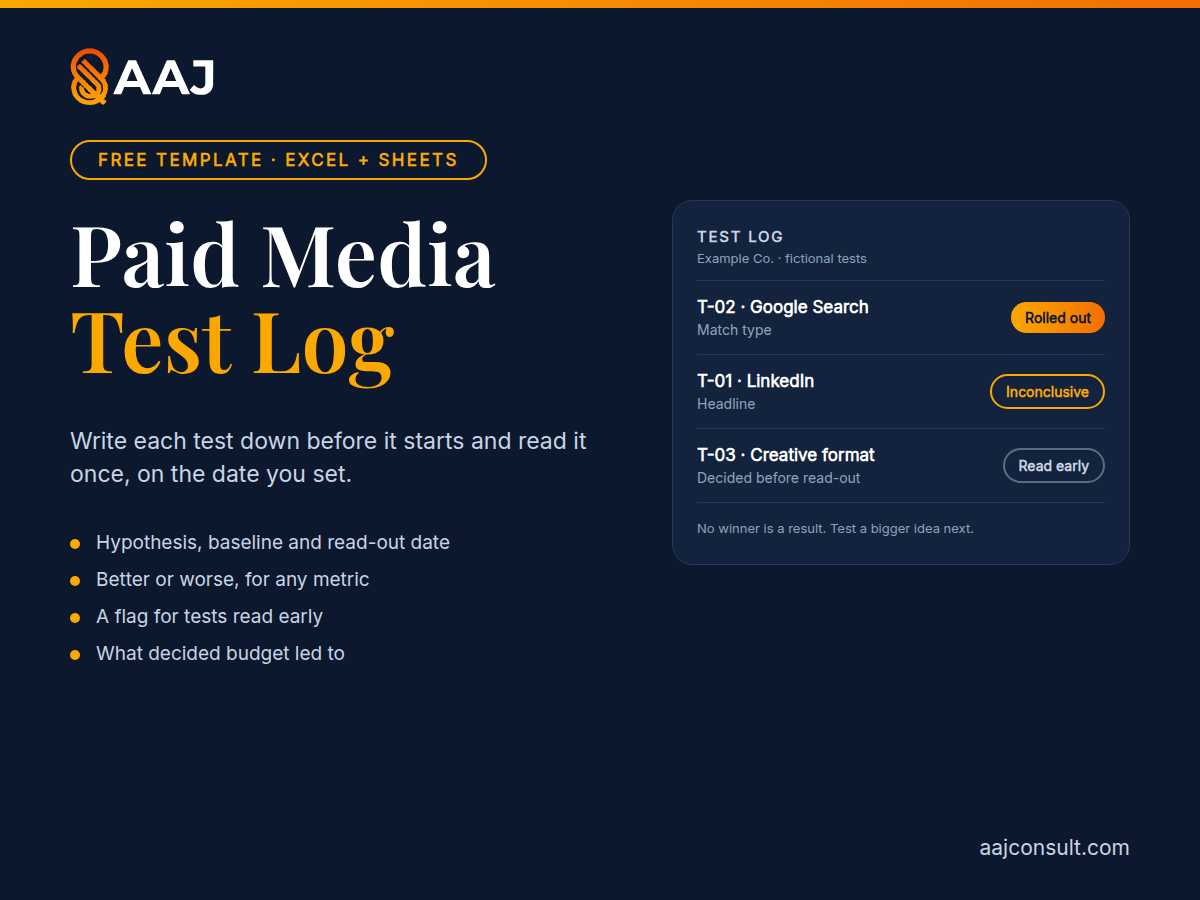
When I ask a founder what their paid tests taught them, the answer usually lives in someone’s memory of a dashboard. Tests were read the day they looked good, nobody wrote down the baseline, and the same idea gets tested twice a year apart.
This log is the record behind every targeting and creative decision. Build the audience first with its companion, the Paid Audience Spec Builder, size each test in the A/B Test Significance Calculator, and keep the result here.
What’s inside
- Tests. Forty rows: channel, hypothesis, the one variable changed, start and read-out dates, budget, primary metric, whether lower is better, baseline, the smallest change worth detecting, result, change against the baseline, better or worse, significant, decision, decision date, a read-early flag and what you learned.
- Summary. Decided tests and their share of decided budget, tests still running or with no decision, the share rolled out, inconclusive and read early, and a table by channel.
- Example Co. (fictional). Four tests and the Summary they produce, with live formulas.
How to use it, step by step
- Plan the test before you spend (10 minutes). Write the hypothesis as “we believe … because …” and change one thing. Choose the metric that pays, say whether lower is better, and enter the baseline from the ad you would keep.
- Run it to the read-out date. Leave the decision as “running” and do not read it early.
- Read it once (10 minutes). Enter the result, check it in the calculator, and record whether it was significant, the decision and the date.
- Review the Summary monthly (10 minutes). See how much decided budget led to a roll-out and how many tests were inconclusive or read early.
Do this: decide the read-out date when you plan the test, not when the numbers look interesting.
Worked example: Example Co.
Running case · Example Co. (fictional)
The running case: Example Co. (fictional). Example Co. sells an AI code-review assistant, the same fictional company as in the Paid Audience Spec Builder. All its tests, figures and dates are illustrative.
| Test | Channel | What changed | Decision |
|---|---|---|---|
| T-01 | Headline | Inconclusive | |
| T-02 | Google Search | Match type | Rolled out |
| T-03 | Creative format | Re-test (flagged: read early) | |
| T-04 | Offer | Running |
Example Co., the Summary. $9,500 of budget is decided: 32% rolled out, 26% to re-test and 42% inconclusive. $5,000 is still running. One decided test in three was read early, on clicks alone, so it goes back as a re-test rather than a win.
Who it’s for
Founders and first marketers at seed to Series B startups who run paid tests on any channel and want a record they can trust: what was tested, against what, read when, and what it led to.
Use this on AAJ
- Paid Audience Spec Builder: build the audience, and check it can learn, before you test.
- A/B Test Significance Calculator: size and read each test.
- Paid Media Budget Allocator: set each channel’s budget.
- A/B Testing: The Complete Guide for Startups and Incrementality Testing for Startups: how to test, and whether the ads caused the result.
- Digital Advertising Playbook: the wider paid plan.
- Ad Creative Testing skill: sizes and reads creative tests in your AI agent.
Frequently asked questions
What should a paid media test log record?
Before the test: the hypothesis, the one thing that changed, the metric that pays, its baseline, the smallest change worth detecting, the budget and the read-out date. After it: the result, whether it was significant, the decision, the date you decided and what you learned.
Why does reading a test early matter?
AAJ's ad-creative-testing skill treats a test read before it reaches its planned size as unclean, because early looks inflate false winners. The log flags any decision dated before the read-out date, and the Summary shows how many decided tests were read early.
What if lower is better for my metric?
Set 'Lower is better?' to Yes for metrics such as cost per trial or cost per demo. The log then reads a fall as better and a rise as worse.
Is an inconclusive test a failure?
No. No winner is a result: the change you tested was too small to matter at your budget. Test a bigger idea next rather than running a flat test longer. A high inconclusive share usually means tests were sized by hope, so size the next one before you spend.
Which channels does it cover?
Google Search, Microsoft Ads, LinkedIn, Meta, TikTok, YouTube, Capterra/G2, Reddit and Other. The list lives on the Summary sheet and feeds the dropdown, so the two cannot drift apart.
Is the template free, and what format is it?
Free, in exchange for an email address. It is an Excel .xlsx that opens in Excel and Google Sheets, with no macros.
Write the test down before you spend
Excel .xlsx, opens in Google Sheets · No macros · Free
What this resource helps you do
Log every paid test before it starts with its hypothesis, baseline and read-out date, flag tests read early, and see what share of decided budget led to a roll-out.
Get the log from AAJ's free marketing templates library.
More in Paid Media
Part of the Paid Media hub - see all 17 resources on this topic.
- AI agent skill: Ad Creative Testing
- Article: Billboards, Radio, Print and Sponsorships
- Playbook: Digital Advertising Playbook
- Article: Google Ads for B2B Startups
Also useful in Analytics, Experiments & Budget.