Sales Process Workbook: Stages, Qualification and Everyone Who Has to Say Yes
The Sales Process Workbook helps you write sales stages a deal can fail, score every first call on the same seven checks, and map everyone who has to say yes. A short deal log turns your own stage dates into conversion and days-in-stage numbers, so your stall rules come from your history, not from a benchmark.
 Saroj Jha October 11, 2026 7 min read Share
Free. No spam — just the template (and the occasional growth playbook). Unsubscribe anytime.
See the worked exampleExcel .xlsx, opens in Google Sheets · No macros · Free · Pre-seed to Series B
Most early pipelines I review have stages named after feelings: “interested”, “engaged”, “hot”. A deal moves forward because the last call went well, nobody knows who else has to agree, and the forecast is a guess dressed as a number.
This workbook is the working file behind the Discovery Call Guide. It holds the same seven checks, the stages a deal has to earn, and a buying committee sheet with starting roles for AI products, B2B SaaS, school districts, clinics and hospitals, and self-serve buyers. Below I show what is inside, how to use it, and one fictional company worked through it.
What’s inside
- Stages. Entry and exit criteria for each stage, an owner, an age-out limit and where deals stall, with deals in each stage, the share that moved forward and median days calculated from the deal log.
- Qualification. The Discovery Call Guide’s seven checks, with the evidence from the call and weights from 0 to 3, read by AAJ’s rule.
- Buying committee. One row per person or role: what they care about, what they must believe, the evidence that answers it, influence, stance, last contact and next step. A Gap column names what is missing on each row.
- Deal review. Ten questions for every open deal, every week, each pointing to where the answer lives.
- Deal log. The date each deal entered each stage and the outcome, with no amounts, so it does not duplicate your forecast.
- Role presets. AAJ’s starting roles for five buyer types, each with a prompt of what to check and the evidence that often answers it.
- Example Co. (fictional). Every sheet filled in, with live formulas.
How to use it, step by step
- Write your stages (20 minutes). For each stage, write what must be true for a deal to enter and to leave it, as facts a deal can fail. The four stage names are editable defaults.
- Qualify every first call (5 minutes). Answer the seven checks with the evidence from the call.
- Map the buying committee (15 minutes). Pick the buyer type to load the starting roles, then add one row per person or role, even before you know the name.
- Review each deal weekly (10 minutes a deal). Answer the ten questions in facts from the deal, not impressions.
- Log stage dates (2 minutes a deal). The Stages sheet then shows conversion, median days and deals over the age-out limit.
AAJ’s rules of thumb in the workbook (not benchmarks)
| Rule | What it says |
|---|---|
| Qualification | 6 or 7 yeses of 7 is qualified, 4 or 5 is a follow-up with a named purpose, 3 or fewer is a polite no. If you change the weights, the same shares of the total weight apply (6/7 and 4/7). |
| When you are unsure | If you are not sure, the answer is No. |
| Median days in stage | Trust a stage’s median only after about ten deals have passed through it. |
| Age-out limit | Set it near twice the stage’s median days. Leave it blank until you have that history. |
Do this: leave the age-out limits blank until about ten deals have passed through a stage. A limit you made up is a benchmark in disguise.
Worked example: Example Co.
Running case · Example Co. (fictional)
The running case: Example Co. (fictional). Example Co. sells an AI assistant that drafts support-ticket replies from a customer’s own help articles, to support teams at mid-market B2B software companies. It renamed one default stage to “Pilot” and added a “Security and AI review” stage, which shows the defaults are editable. Every prospect, person, date and number is illustrative.
- Deal log: nine fictional prospects give five open deals, one of them with no stage date yet and one over its age-out limit.
- Qualification: Prospect A scores 5 of 7, a follow-up with a named purpose, the same result as the Discovery Call Guide’s example.
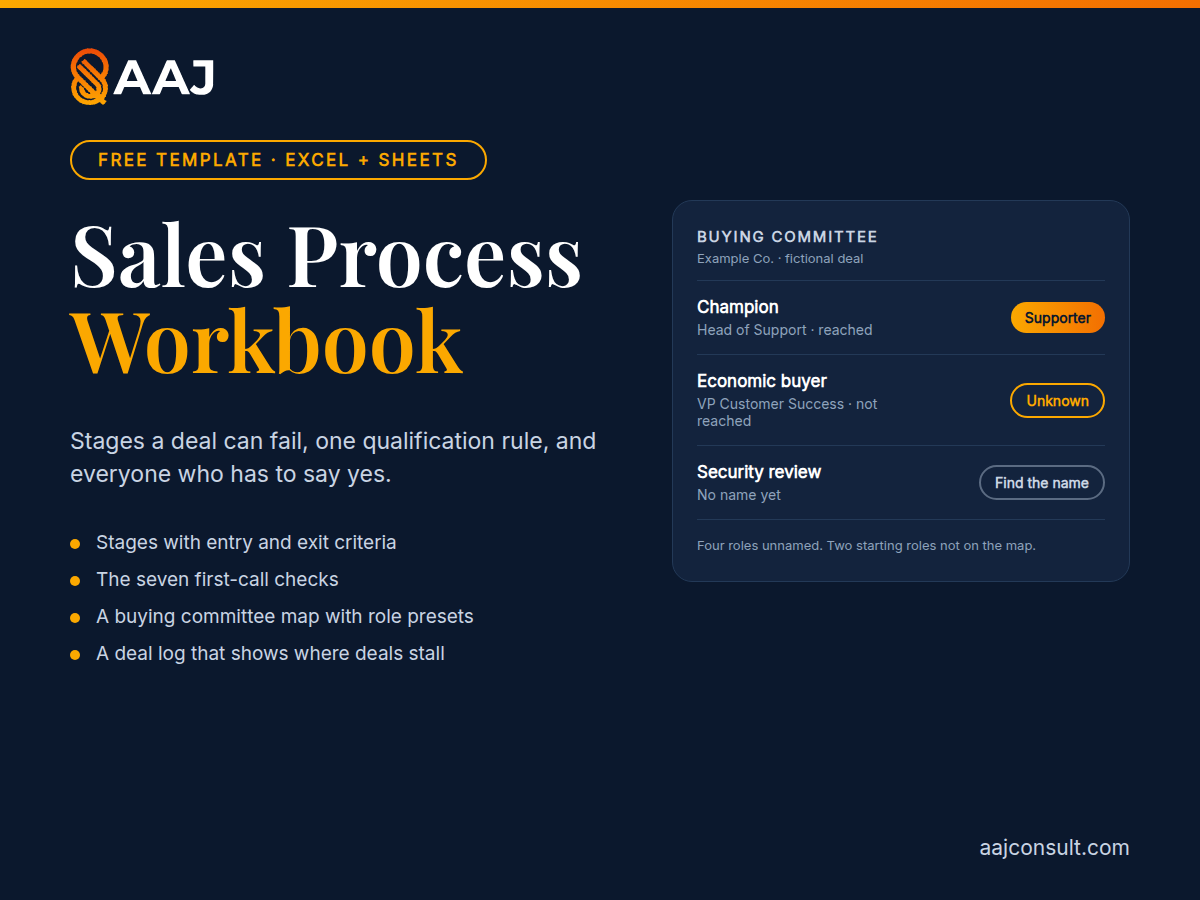
- Buying committee: eight rows for an AI product sold to enterprise. Four roles have no name yet, two named people have not been reached, the economic buyer is named but not reached, and two starting roles are not on the map.
Example Co., what the map says. The champion is on side, but security, AI governance, privacy and procurement have no names yet, and the VP who signs has not been reached. The weekly review turns that into two actions: ask the champion for the missing names this week, and propose a call with the VP. The deal stays out of the forecast until it qualifies.
Who it’s for
Founders and first sales hires at seed to Series B startups who sell to a committee rather than one person. The role presets cover AI products sold to enterprises, mid-market B2B SaaS, US public school districts, clinics and hospitals, and self-serve buyers. If your forecast is the question, pair it with the Sales Pipeline & Forecast Tracker; this workbook does not hold amounts.
Use this on AAJ
- Discovery Call Guide: the first call, with the same seven checks.
- The B2B Buying Committee: how to market to everyone who signs off.
- Sales Pipeline & Forecast Tracker: amounts, probabilities and the forecast.
- ICP Fit Scorer: score the account before the call.
- Battlecard Builder and Win-Loss Analyzer: answers to objections, and the reasons you win and lose.
- Pilot-to-Contract Planner: school, clinic and design-partner pilots.
- Security Questionnaire Answer Library: evidence for IT and security reviewers.
- Marketing AI Products Playbook, How to Sell EdTech to School Districts and MedTech Marketing Playbook: the buyers behind the presets.
- Sales Process Design skill: the same method, run by your AI agent.
Frequently asked questions
What makes a good sales stage?
Entry and exit criteria written as facts a deal can fail, such as 'the economic buyer has agreed to a pilot with a date'. If a deal cannot show the exit criteria, it has not left the stage, however good the last call was.
How long should a deal sit in a stage before I worry?
Use your own history, not a benchmark. AAJ's rule of thumb: trust a stage's median days only after about ten deals have passed through it, then set the age-out limit near twice that median. Until then, leave the limit blank.
Who belongs on the buying committee map?
Everyone who has to say yes or can say no: the user, the champion, the economic buyer, IT and security, procurement, finance, legal and anyone else your deals run into. Add the role before you know the name; the empty rows show who you still have to meet.
Are the role presets for schools and hospitals rules?
No. They are AAJ's starting role lists for five buyer types, with a prompt of what to check for each role. Every account is different: add the roles yours has and drop the ones it does not.
Does it replace a pipeline forecast?
No. The deal log holds stage dates only, so it can show conversion and days in stage. Amounts, probabilities and the forecast belong in the Sales Pipeline & Forecast Tracker.
Is the workbook free, and what format is it?
Free, in exchange for an email address. It is an Excel .xlsx that opens in Excel and Google Sheets, with no macros.
Know where each deal really stands
Excel .xlsx, opens in Google Sheets · No macros · Free
What this resource helps you do
Write sales stages a deal can fail, score first calls on seven checks, map the buying committee with role presets for AI, SaaS, schools and clinics, and see where deals stall from your own dates.
Get the workbook from AAJ's free marketing templates library.
More in Sales & Pipeline
Part of the Sales & Pipeline hub - see all 38 resources on this topic.
- Free tool: Battlecard Builder
- AI agent skill: Buying Committee Map
- Article: How to Align Sales and Marketing at a Startup
- Playbook: ICP & Account-Scoring Playbook
Also useful in Industry Playbooks.