First Marketing Hire Kit: Define the Role, Test on Evidence, Plan the First 90 Days
The First Marketing Hire Kit helps you write the job down before you interview, test every finalist the same way, and decide on evidence. You set the outcomes, must-haves and weights; the kit gives you the take-home brief, the interview questions, a first-90-days plan and an offer checklist.
 Saroj Jha October 10, 2026 7 min read Share Download the free templateSee the worked example
Word .docx, opens in Google Docs · No macros · Free · Pre-seed to Series B
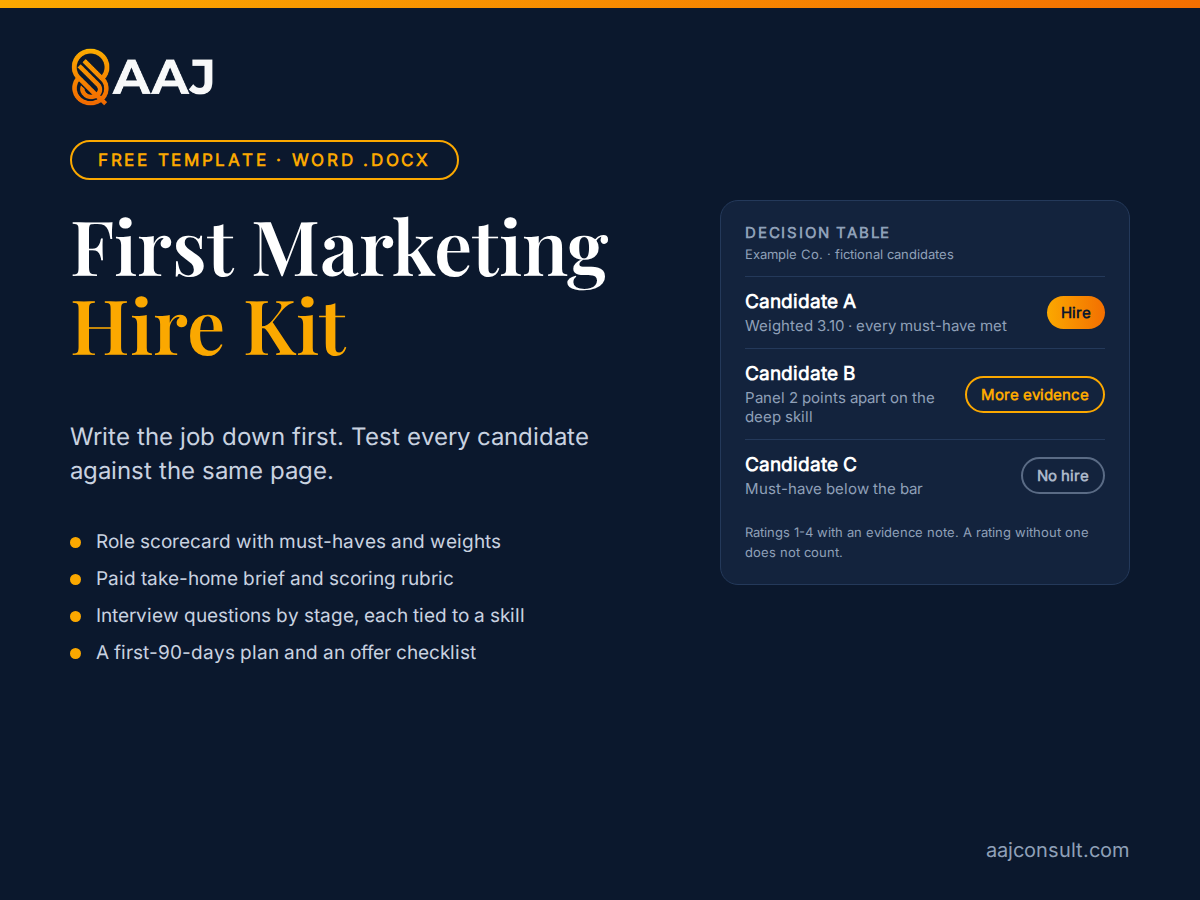
It is the working file for my post on your first marketing hire. Use it once you have decided to hire rather than bring in a fractional leader or an agency; the Marketing Leadership Cost Comparator helps with that decision. In my view, most first-hire mistakes come from hiring before you know what the job is, so the kit starts there. Below the steps, a worked example shows it filled in for one fictional company.
What’s inside
- Signals check. The three signals that say a hire will amplify something already working: retention in one segment, one channel that works, and founder time as the constraint.
- Role scorecard. The role in one table, what the hire must own in months 1 to 6, and up to seven competencies with weights, bars and must-haves.
- Rating sheet and decision table. A 1-to-4 scale with no middle, an evidence note for every rating, and the rules for hire, no hire or more evidence.
- Paid take-home brief. A fill-in brief for a short, paid project on your real situation, with a five-criterion scoring rubric tied to the competencies.
- Interview questions by stage. 17 questions across the founder screen, practitioner deep-dive, take-home review and references, each tied to a competency, with what to listen for and the red flag.
- First 90 days. Diagnose, design, execute: what the hire does, what the founder does, and the day-90 targets to agree before they sign.
- Offer checklist. Fourteen checks before the offer goes out, including the ones to take to counsel.
How to use it, step by step
Steps 1 to 4 happen before you post the role. Steps 5 to 7 run the process.
- Check the signals. Write your evidence for each one. If one is missing, fix that first; a hire will not fix it for you.
- Write the role and the outcomes. Name the channel your last 10 to 20 customers came from, the deep skill behind it, and what the hire must own by months 1, 3 and 6.
- Choose competencies and weights. Keep must-haves to four or fewer and set the bar for each.
- Write the take-home brief and rubric. The same paid, time-capped task for every finalist, scored against a rubric written before you read any answers.
- Interview in four stages. Each interviewer rates straight after their stage, with an evidence note per rating, before talking to the rest of the panel.
- Fill in the decision table and decide. A must-have below its bar is a no; a must-have without evidence, or with interviewers two points apart, needs more evidence. If you use an AI agent, the free first-marketing-hire skill computes it.
- Share the day-90 targets before they sign, then run the offer checklist.
Worked example: Example Co.
Running case · Example Co. (fictional)
The running case: Example Co. (fictional). Example Co. is a seed-stage B2B SaaS startup whose software automates the month-end close for finance teams at companies with 50 to 500 employees. The team is eight people, including two founders and one account executive. Accounting communities brought in 9 of its 14 customers, and the CEO, who wrote the positioning, has run that channel alone. What is missing is time to execute, so Example Co. hires a hands-on marketer and the CEO keeps the strategy. Every competency, weight, candidate and rating below is fictional and illustrative.
The competencies and weights
| Code | Competency | Must-have? | Weight |
|---|---|---|---|
| C1 | Grows the working channel: community and LinkedIn content for finance leaders | Yes, bar 3 | 30 |
| C2 | Understands the finance buyer | Yes, bar 3 | 20 |
| C3 | Plans tests with a measurable pass mark | Yes, bar 3 | 15 |
| C4 | Works hands-on without a team | Yes, bar 3 | 10 |
| C5 | Runs email, website updates and basic tracking | No | 10 |
| C6 | Prioritises and states trade-offs honestly | No | 10 |
| C7 | Bonus skill: paid search | No | 5 |
The decision table after four stages
| Candidate | Weighted score (1 to 4) | Must-haves below bar | Disagreements | Ratings without evidence | Call |
|---|---|---|---|---|---|
| Candidate A | 3.10 | None | None | None | Hire, after references |
| Candidate B | 3.00 | None | C1: CEO 4, practitioner 2 | One on C5; one thin note on C6 | More evidence |
| Candidate C | 2.89 | C2 at 2.00, bar 3 | None | None | No hire |
Candidate C has the strongest basics but described the buyer as “finance people”, and both interviewers who tested it agree, so a must-have is below the bar. Candidate B’s portfolio impressed the CEO, while the practitioner found the channel had been built by someone else; that split on the deep skill has to be talked through before B can be compared fairly. Candidate A clears every bar, so the next step is references on one question: did they grow a channel, or run one someone else built?
Use this on AAJ
- Your first marketing hire: when to hire, who to hire and what they should do first, with the same Example Co. case.
- Marketing Leadership Cost Comparator: a hire, a fractional leader or an agency, on your own numbers.
- Fractional CMO vs in-house marketing team: which shape of help fits each stage.
- Marketing team structure by stage: once the first hire works, how the team grows, with three job descriptions.
- Lead Management Playbook: the lead stages and score a first marketer can own by day 90.
- Lead Scoring and SLA Sheet: the working file for those lead stages.
Frequently asked questions
Should the take-home task be paid?
Yes. I would not ask anyone to do unpaid work on a real problem. Pay every finalist the same fee, cap the task in hours, and say in writing who owns the work. How you pay someone who is not yet an employee is a tax and employment question, so check it with your accountant or counsel.
Does the kit include salary benchmarks?
No. Set cash pay from public wage data for where the person will work, such as the US Bureau of Labor Statistics state and area wage data, adjusted for your stage. My post on the first marketing hire covers the occupations that bracket the role, with sources.
How many must-haves should a first marketing hire have?
Four or fewer: the deep skill behind the channel that already works, and the few basics the first six months cannot do without. More than that is a search for someone who does not exist.
What if two interviewers disagree about a candidate?
If they are two or more points apart on one competency, they saw different people. Put them in one room with their evidence notes before anyone decides. On a must-have, the kit's call is more evidence, not hire or no hire.
What this resource helps you do
Get the kit from AAJ's free marketing templates library.
Who the First Marketing Hire Kit is for
The First Marketing Hire Kit is a free Word template for founders hiring their first marketer, from seed to Series B. It helps you write the job down before you interview, test every finalist the same way, and decide on evidence rather than on how the panel felt. It is the working file for my post on your first marketing hire.
In my view, most first-hire mistakes come from hiring before you know what the job is: a senior leader who expects a team and a budget that do not exist, or a junior coordinator who expects direction nobody has time to give. The kit starts by making you write the job down.
What the kit contains
- A role scorecard. What the hire must own in months 1 to 6, the deep skill behind the channel that already brings in customers, and up to seven competencies with weights, bars and no more than four must-haves.
- A rating sheet and decision table. Ratings from 1 to 4 with no middle, and an evidence note for every rating: what the candidate said or did.
- A paid take-home brief with a five-criterion rubric tied to the competencies, written before any answers are read.
- Seventeen interview questions across a founder screen, a practitioner deep-dive, the take-home review and reference calls. Each is tied to a competency, with what to listen for and the red flag.
- A first-90-days plan that follows AAJ's Diagnose, Design, Execute method: learn, fix the foundations, then grow one channel, with day-90 targets agreed before the candidate signs.
- An offer checklist of fourteen checks.
How the decision works
A must-have below its bar, with the panel agreeing, is a no-hire whatever the total. A must-have with no evidenced rating, or with interviewers two or more points apart, needs more evidence. Then the weighted score is read against a hire line of 3.0. A rating with no evidence note does not count. These are AAJ's rules, not research findings, and you can change them before the first interview. If nobody clears the bar, re-open the search rather than lower it. The free first-marketing-hire agent skill computes the table from your ratings.
What it does not do
The kit contains no salary figures. Set pay from public wage data for where the person will work, such as the US Bureau of Labor Statistics state and area wage data, adjusted for your stage. It is not legal, tax or employment advice. Interview-question limits, pay-range disclosure, reference and background checks, and how to pay a candidate for a take-home all differ by state and country, so check them with counsel. The worked example, Example Co., is fictional.
Related: Marketing Leadership Cost Comparator, Fractional CMO vs in-house marketing team, Lead Management Playbook.
More in Marketing Ops, AI & Team
Part of the Marketing Ops, AI & Team hub - see all 23 resources on this topic.
- Playbook: Agentic AI in Marketing Playbook
- AI agent skill: First Marketing Hire
- Article: Fractional CMO Cost Guide 2026: Rates, Retainers & Benchmarks
- Article: Fractional CMO vs In-House Marketing Team: What Actually Works at Each Growth Stage?
Also useful in Go-to-Market & Growth Planning.