Get the AI Tool Policy for Marketing
- Home
- Resource Hub
- Marketing Ops, AI & Team
- AI Tool Policy for Marketing
A one-page policy your team can adopt this week — approved tools, what never goes into a prompt, and the review gate before anything publishes.
Free. No spam — just the policy (and the occasional growth playbook). Unsubscribe anytime.
Six sections, one page
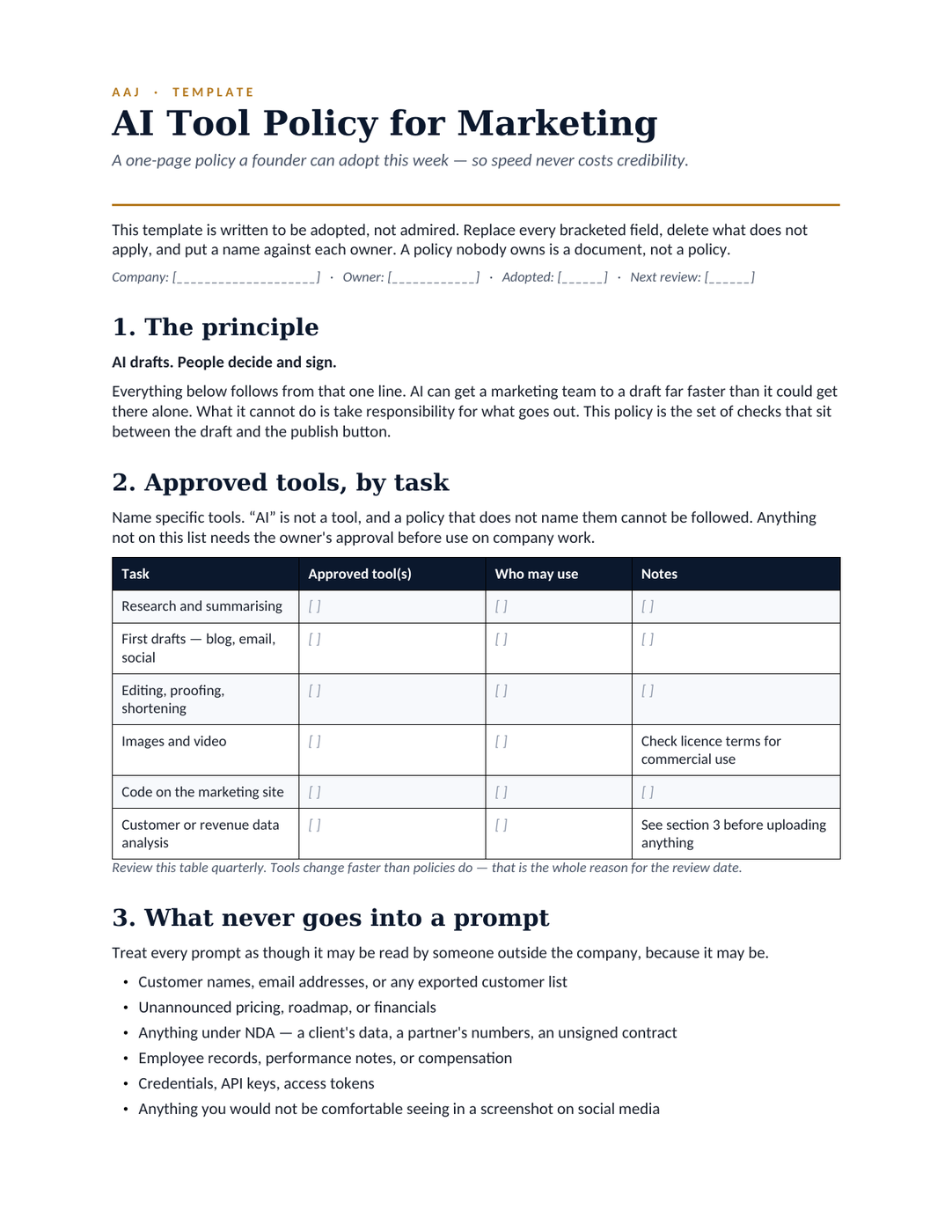
Written to be adopted, not admired. Replace every bracketed field, delete what does not apply, and put a name against each owner.
-
Approved tools, by task
A table you fill in once: research, first drafts, editing, images, site code, customer data — each with the tools that are allowed, who may use them, and any conditions. "AI" is not a tool, and a policy that names none cannot be followed.
-
What never goes into a prompt
Customer lists, unannounced pricing and roadmap, anything under NDA, employee records, credentials. Written as a list your team can scan in seconds, because that is the moment the decision gets made.
-
The one setting to verify, not assume
Whether your plan trains on what you put in. The policy gives you a line to record the answer, who checked it, and when — so it gets re-checked when you change plans.
-
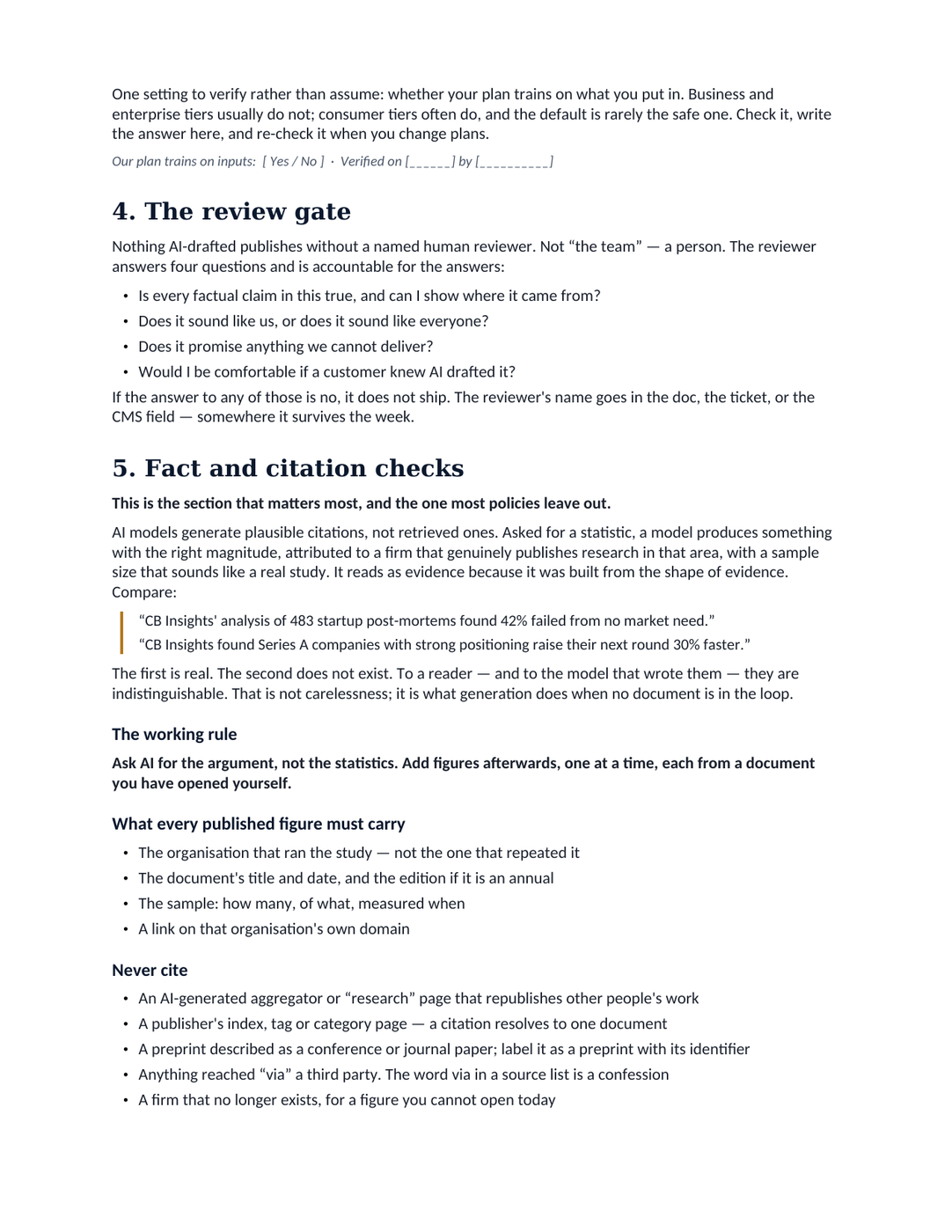
A named review gate
Nothing AI-drafted publishes without a named human reviewer answering four questions. Not "the team" — a person, whose name lands somewhere that survives the week.
-
Fact and citation checks
The section most AI policies leave out. AI models generate plausible citations rather than retrieved ones, so the policy sets the working rule: ask for the argument, not the statistics, and add every figure yourself from a document you opened.
-
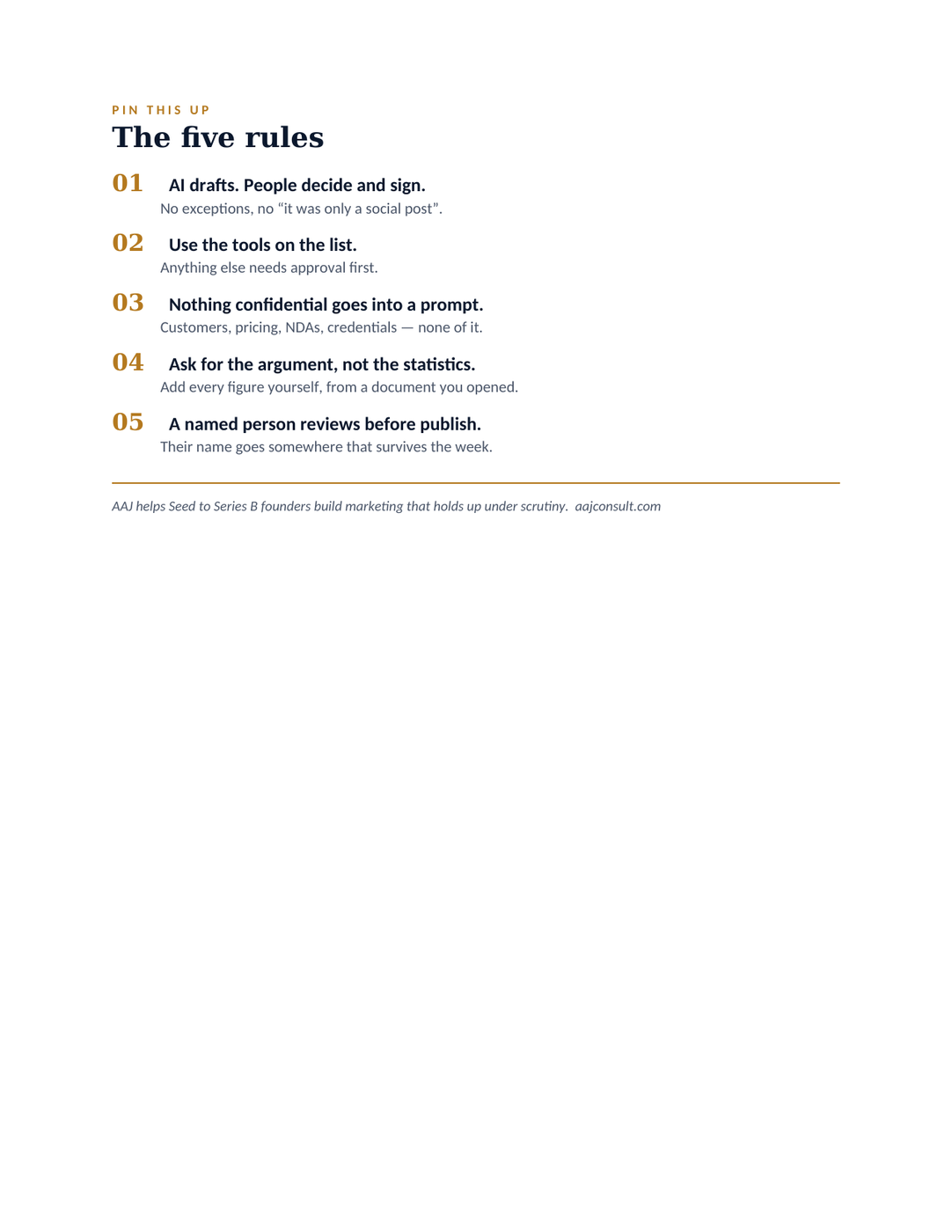
A five-rule summary card
The whole policy compressed to five lines you can pin in Slack or your wiki. People follow the card; the document is what you point at when the card is questioned.
Diagnose → Design → Execute
1Diagnose
Ask who on your team is already using AI, for what, and with what data. Most founders find the answer is broader than they expected.
2Design
Fill in the approved-tools table, name the owner for each row, and set your review date. Delete what does not apply to you.
3Execute
Adopt it, pin the five-rule card where your team works, and run the review gate on the next thing you publish.
Founders whose team started using AI faster than anyone wrote rules for it
I wrote this for the Seed to Series B founders I work with, because the conversation always arrives the same way: the team is already drafting with AI, nobody decided which tools are allowed, and nobody is sure what has been pasted into a prompt. So this policy names the approved tools by task, states what never goes into a prompt, and puts a named person in front of the publish button.
What makes it different is the section most AI policies leave out: fact and citation checks. AI generates plausible citations rather than retrieved ones — a figure with the right shape, credited to a firm that really does publish research, with a sample that sounds real. That is the failure that costs a startup its credibility, so the policy handles it head on. Ask AI for the argument; add every figure yourself, from a document you opened. It fits on one page and you can adopt it this week.
Pairs with the Content Calendar & Repurposing Tracker: this one sets the rules, that one runs the output.
Frequently Asked Questions
Common questions about the AI Tool Policy for Marketing.
What should an AI policy for a marketing team cover?
Four things, and they fit on one page: which tools are approved for which task and who may use them; what may never be pasted into a prompt; who reviews AI-drafted work before it publishes; and how factual claims and citations get verified. Anything longer tends not to be read, and a policy nobody reads is a document, not a policy.
Why does the policy include a fact-checking section?
Because this is where AI-assisted marketing usually fails in public. A model asked for a statistic produces something with the right shape — a plausible figure, attributed to a firm that genuinely publishes research in that area, with a sample size that sounds real. It reads as evidence because it was built from the shape of evidence. The policy's rule is to ask AI for the argument and add every figure yourself, from a document you have opened.
Is this a legal document?
No. It is an operating policy for a marketing team — how AI gets used day to day and what gets checked before work goes out. It is not legal advice and does not replace your counsel's view on contracts, confidentiality obligations or regulated claims.
What format is it, and can I edit it?
It's a Word document (.docx) that also opens in Google Docs. Every bracketed field is meant to be replaced with your own tools, owners and dates, and you are meant to delete the rows that do not apply to you.
Move fast with AI. Keep your credibility.
Want the wider view on AI in marketing? Read the Agentic AI Playbook →
More in Marketing Ops, AI & Team
Part of the Marketing Ops, AI & Team hub - see all 23 resources on this topic.
- AI agent skill: AI Marketing Governance
- Article: Do You Need a Prompt Engineer?
- Article: Privacy and Advertising Rules for Startup Marketers
- Template: The AI Trust Notices Kit
Also useful in Brand & Voice, Content, Copy & SEO.