AI Trust Notices Kit: A Model Change Notice and an AI Trust FAQ
The AI Trust Notices Kit gives you two templates: an email and changelog notice for when the model under your product changes, and an AI trust FAQ for your trust page and sales team. Each has bracketed fields, a fictional worked example and the sentence to use for data. They are templates, not legal advice.
 Saroj Jha October 24, 2026 5 min read Share
Free. No spam — just the template (and the occasional growth playbook). Unsubscribe anytime.
See the worked exampleWord .docx, four pages, opens in Google Docs · No macros · Free · Pre-seed to Series B
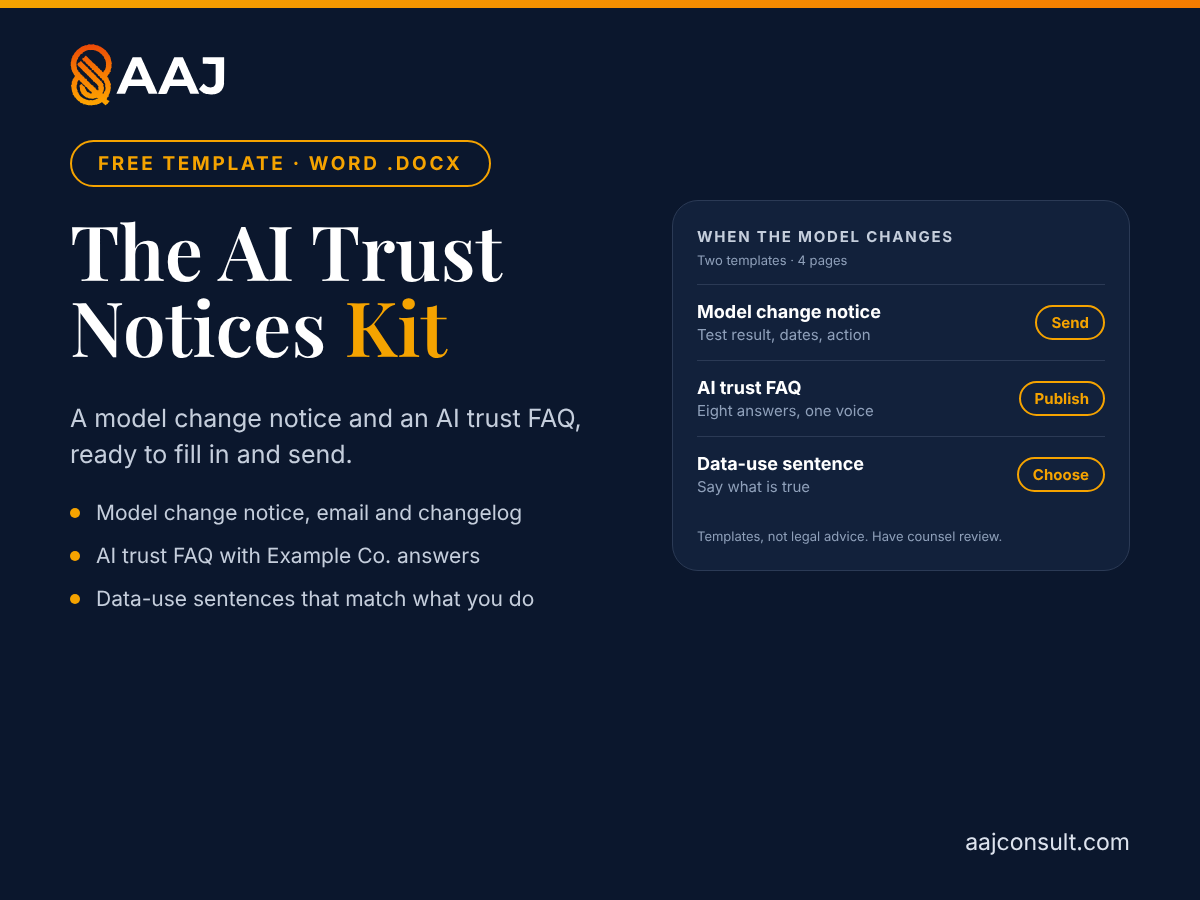
The model under an AI product will change, and customers who rely on its output may notice before you tell them. A buyer will also ask whether the model is biased and what happens to their data. These are the two documents I would have ready before the first of those questions arrives.
Both come from the Marketing AI Products Playbook (Steps 3, 4 and 9). Replace every bracketed item with what is true for your product, and delete any line you cannot support with evidence on file. They are templates, not legal advice: have counsel review them, and set notice periods from your own contracts.
What’s inside
| Part | What it gives you |
|---|---|
| Model change notice | An email and changelog template: switch date, what the test found, what stays the same, what the customer needs to do, and the dates. |
| When to send it | Five kinds of change and what to do for each, from a new provider to a fix users never see. |
| Who to tell, in order | Support and sales first, then the account owner, security contacts, users and the public changelog. |
| AI trust FAQ | Eight questions for your trust page and answer library, each with a field for your answer and a fictional example. |
| Data-use sentences | Four options, one for each way you might use customer data. Pick the one that is true. |
| Claims to avoid | “Unbiased”, “trained on diverse data”, “NIST compliant” and “nothing will change”. |
It ends with six numbered sources, each checked on 24 October 2026.
How to use it, step by step
- Write the FAQ answers first, from your evaluation, your data map and your contracts. Each answer needs evidence on file.
- Pick the data-use sentence that matches what you do. Then check the homepage, data-use page, terms, DPA and questionnaire answers say the same thing.
- Leave the notice period as a bracket until you have read your contracts. Do not copy a number from this page.
- Draft the model change notice before the change, with your test result in your buyer’s units, and send it before customers see a changed result.
- Have counsel review both, then publish the FAQ with a last-updated date and a named owner.
Do this: fill in the FAQ before a buyer asks. Compare it with your Security Questionnaire Answer Library so the two never disagree.
Worked example: Example Co.
Running case · Example Co. (fictional)
The running case: Example Co. (fictional). Example Co. makes a reading-coach app for tutoring centers. A tutor approves every flag the coach raises. The numbers below are illustrative.
| Question | Example Co. (fictional) |
|---|---|
| Is our data used to train models? | Recordings are not used to train any model unless your center joins the noisy-room program. The provider’s contract does not allow training on them. |
| How long do you keep our data? | Recordings 90 days (12 months in the noisy-room program); progress notes until the center closes its account. |
| Is the model biased? | The coach misses more words for children learning English, 1 in 6 against about 1 in 11, so a tutor approves every flag. Not enough recordings from children with speech differences have been tested to say. |
| Who checks the output? | A tutor approves every flag before parents see a report. |
Example Co., the point. The notice leads with what changes for the customer, then the test result on the same 500 recordings, then the action and the dates. It does not say “smarter” or “nothing will change”.
Who it’s for
Founders and marketers at seed to Series B startups that sell a product built on someone else’s model, or on their own, to buyers who ask about change control, bias and data. It gives you the wording and the structure. Whether the wording is right for your contracts and your law is a question for counsel.
Use this on AAJ
- Marketing AI Products Playbook: Steps 3, 4 and 9, which these templates come from.
- AI Tool Policy for Marketing: the internal rules for the AI tools your team uses.
- How to Make Security a Selling Point: the trust page and questionnaires behind the data answers.
- Security Questionnaire Answer Library: one approved answer to each buyer question.
- Marketing Compliance Checklist: the rules behind AI claims and AI disclosure.
Frequently asked questions
Are these templates legal advice?
No. They are general information. Have counsel review every notice before it is sent and every FAQ before it is published, and set notice periods from your own contracts.
How much notice do model providers give before retiring a model?
It differs by provider and by model type. OpenAI says generally available models get at least 6 months, unless safety or compliance concerns require a faster timeline, and preview models may be retired with as little as 2 weeks. Anthropic gives at least 60 days' notice before retiring publicly released models. Google says preview models are deprecated with at least 2 weeks' notice. Read the provider's page before you plan a switch.
Can I tell buyers my model is unbiased?
The kit says not to. A test covers only the groups and cases you tested. In January 2025 the FTC finalized an order that bars IntelliVision from making claims about lack of bias without competent and reliable testing of the technology. Publish the group split and the limits instead.
Can I say my product is NIST compliant?
NIST says its AI Risk Management Framework is intended for voluntary use, so it is a framework, not a certificate. The kit's wording that stays true is that you use the NIST AI RMF and its Generative AI Profile to structure how you test and track bias, followed by the test itself.
What notice period should I put in the template?
The one in your contracts. The template leaves it as a bracket on purpose. Set it from your agreements and from the provider's retirement date, and delete any line you cannot support.
Is the kit free, and what format is it?
Free, in exchange for an email address. It is a four-page Word .docx that opens in Word, Google Docs and Pages.
Send the notice before customers notice
Word .docx, four pages, opens in Google Docs · No macros · Free
Sources
- NIST. Artificial Intelligence Risk Management Framework: Generative AI Profile (NIST AI 600-1), 2024. nvlpubs.nist.gov
- NIST. AI RMF Generative AI Profile page, 2024. nist.gov
- Federal Trade Commission. FTC Finalizes Order Prohibiting IntelliVision from Making Deceptive Claims About Its Facial Recognition Software (January 2025). ftc.gov
- OpenAI. Deprecations. developers.openai.com
- Anthropic. Model deprecations. platform.claude.com
- Google. Gemini API models. ai.google.dev
What this resource helps you do
A model change notice and an AI trust FAQ with bracketed fields, a fictional worked example and four data-use sentences. Templates, not legal advice.
Get the kit from AAJ's free marketing templates library.
What The AI Trust Notices Kit does
A model change notice and an AI trust FAQ with bracketed fields, a fictional worked example and four data-use sentences. Templates, not legal advice.
It is a Word document, free in exchange for an email address. It is a template, not legal advice.
More in Marketing Ops, AI & Team
Part of the Marketing Ops, AI & Team hub - see all 22 resources on this topic.
- AI agent skill: AI Marketing Governance
- Article: Do You Need a Prompt Engineer?
- Article: Privacy and Advertising Rules for Startup Marketers
- Template: The AI Tool Policy for Marketing
Also useful in Website & Conversion, Industry Playbooks.