Get the Brand Voice Guide
- Home
- Resource Hub
- Brand & Voice
- Brand Voice Guide
Voice rules specific enough to check against — plus the block your AI tools read, so the rules can actually be enforced.
A brand voice guide is a short document that records how a company writes: the adjectives that define its tone, the rules its writers follow, the words it never uses, and worked examples showing a weak sentence rewritten. Its purpose is to make voice checkable rather than a matter of opinion.
It also explains why AI-written content doesn't sound like you.
Free. No spam — just the template (and the occasional growth playbook). Unsubscribe anytime.
Rules, examples, and a block a machine can read
Fill it in once, in your own words. Every table has empty rows, and the last page is written for your tools rather than your team.
-
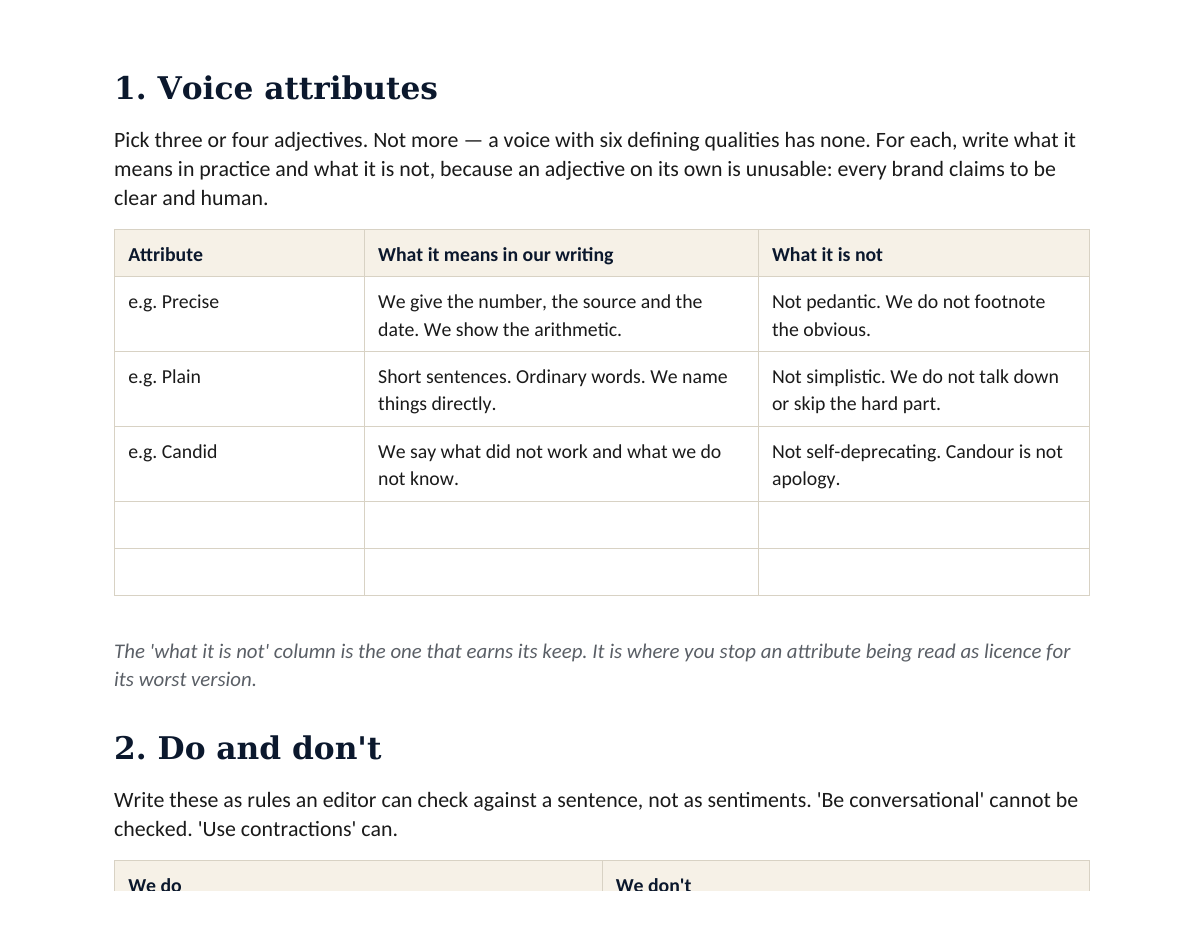
Voice attributes with a 'what it is not' column
Three or four adjectives, each with what it means in your writing and what it is not. The second column is the one that earns its keep: it stops an attribute being read as licence for its worst version.
-
Do and don't rules an editor can apply
Written as rules you can hold a sentence against, not sentiments. "Be conversational" cannot be checked. "Use contractions" can.
-
The words you never use
A list of the filler your category has worn out. It is the shortest section and the one people quote back most often, because it settles an argument in one line.
-
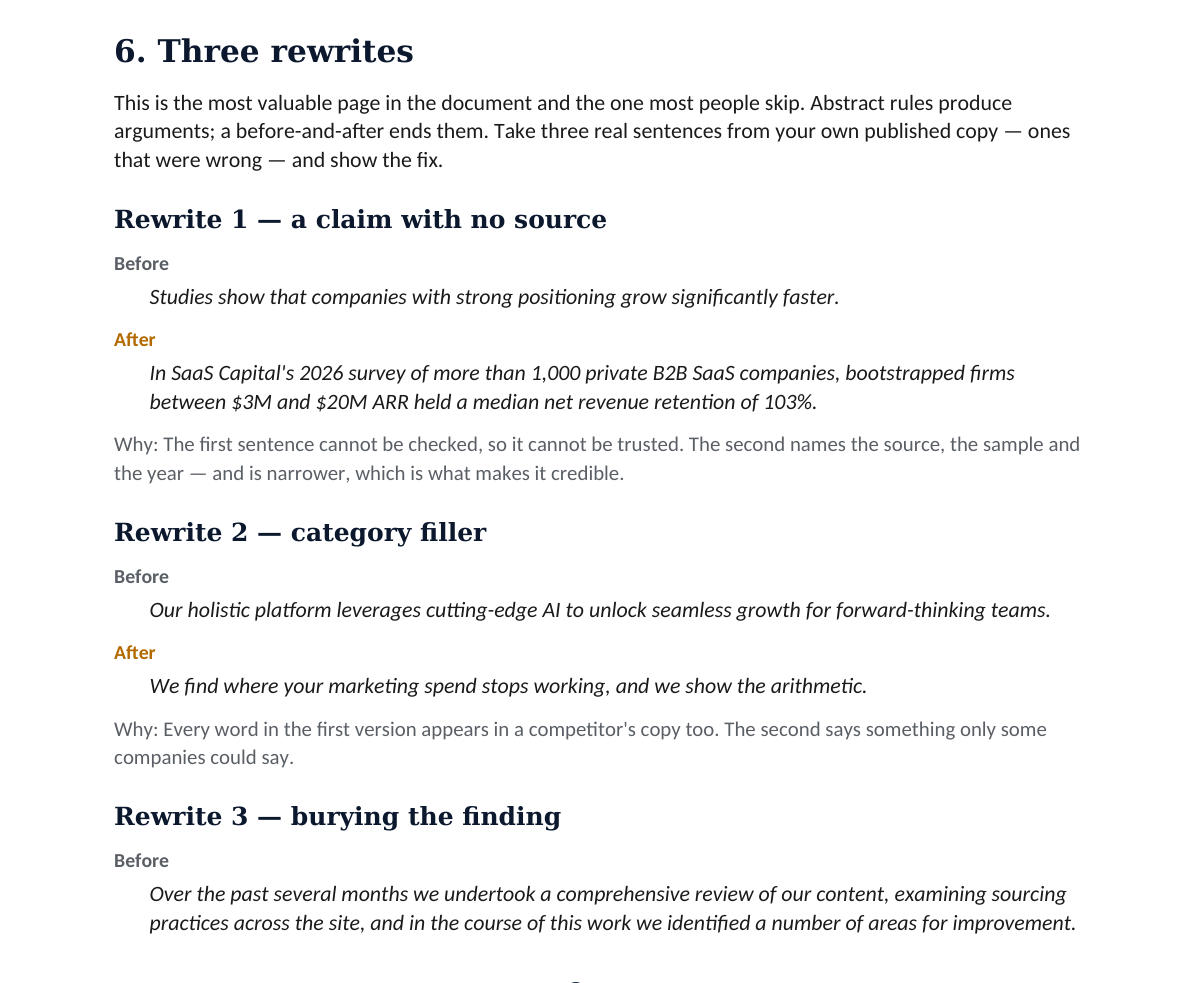
Three before-and-after rewrites
Take three real sentences from your own published copy — ones that were wrong — and show the fix with a short reason. Abstract rules produce arguments; a before-and-after ends them.
-
The four edge cases voice breaks on
Bad news, pricing, support replies, and anything a machine drafted. Voice holds in the easy cases on its own; these are where it slips.
-
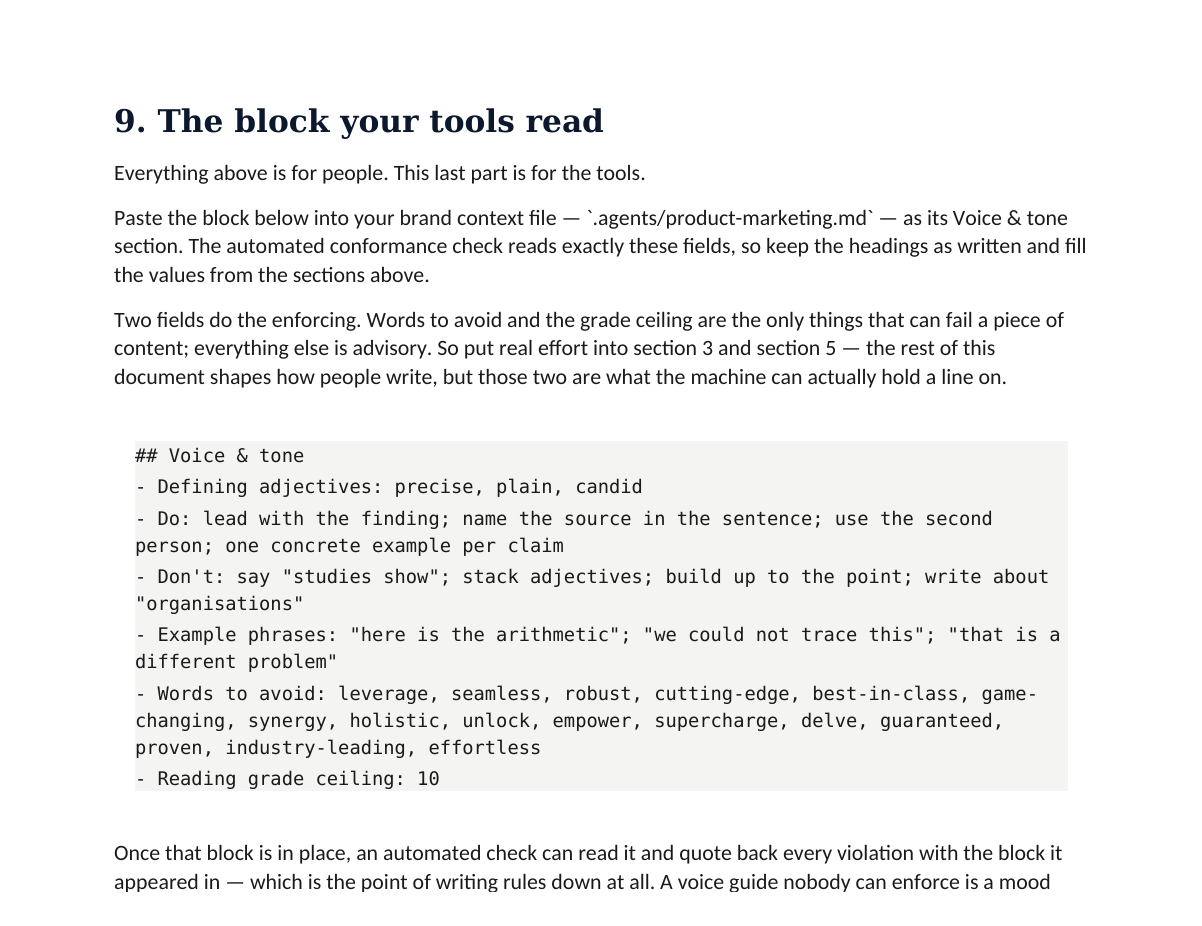
A paste-ready block your AI tools read
The last page is written for the machine: defining adjectives, do and don't, example phrases, words to avoid, and a reading-grade ceiling — in the fields an automated conformance check reads.
Diagnose → Design → Execute
1Diagnose
Read your last ten published pieces and mark where they stop sounding like the same company. That is your starting list.
2Design
Fill in the attributes, the rules and the words you never use. Write the three rewrites from your own copy, not invented examples.
3Execute
Paste the final block into the context file your AI tools read, and check the next thing you publish against it.
Founders whose team and AI tools are both writing faster than anyone wrote rules for it
I wrote this for the founders I work with, because the problem always shows up the same way: two people and three tools are producing copy, and no two pieces sound like the same company. Nobody wrote the rules down, so every draft becomes a matter of taste and every review becomes an argument.
What makes this one different is where it ends. Most brand voice documents are written to be admired — handsome pages, abstract adjectives, circulated once. This one is written to be applied, and its last page is a block your AI tools read, in fields an automated check can hold a line on. That is the difference between rules that get circulated and rules that get enforced.
It will not make your copy consistent on its own, and I would not claim it does. It gives your team and your tools something specific to check against — which is the part most voice guides never provide.
If you want the eight steps that produce what goes in it, read the method behind this template.
Pairs with the Positioning & Messaging Workbook: that one decides what you say, this one decides how it sounds.
Use the AI Tool Policy for Marketing to set the operating rules around the tools, then read how to use AI without losing your voice and why core marketing principles still govern AI-written content.
Frequently Asked Questions
What should a brand voice guide include?
Three or four voice attributes with what each one is not, do-and-don't rules specific enough to check a sentence against, a list of words to avoid, the phrases you do use, a reading-level ceiling, before-and-after rewrites, and decisions for the situations voice usually breaks on - apologies, pricing, and bad news.
How is a brand voice guide different from a style guide?
A style guide settles mechanics: serial commas, capitalisation, date formats. A brand voice guide settles character - what the company sounds like and what it refuses to sound like. Most teams need both, and confusing them produces a document full of comma rules that nobody can use to judge a headline.
Can AI writing tools follow a brand voice guide?
Only if the rules are written in a form a tool can read. A model given no explicit rules writes toward the average of its training data, which is where category jargon lives. This template ends in a block you paste into an agent context file, so a conformance check can quote back every violation rather than a human catching them by eye.
Is the template free, and what format is it?
Free, in exchange for an email address. It is a Word .docx so you can type directly into the tables and ruled lines, and it opens editable in Word, Google Docs, Pages and LibreOffice.
Write the rules down, then check against them
Want the rest? Browse the free templates.
More in Brand & Voice
Part of the Brand & Voice hub - see all 11 resources on this topic.
- Playbook: Brand Foundations Playbook
- AI agent skill: Brand Voice Definition
- Playbook: Brand Voice Playbook
- Article: Founder Story and Company Narrative: How to Tell Yours Without Overpromising
Also useful in Marketing Ops, AI & Team, Content, Copy & SEO.